
Which Planetary Ball Mill Jar Is Suitable for Hard Carbide Powder Milling?
Hard carbide powders punish poor jar choices. In a planetary ball mill, the jar is the reaction vessel, the wear surface, the sealing boundary, and part of the energy-transfer system. When the powder is abrasive, chemically sensitive, or destined for mechanical alloying, the jar material can influence contamination, yield, and the meaning of the final particle-size result. The useful question is therefore not “Which jar is best?” but “Which jar is suitable for this powder, this process stage, and this acceptance test?”
This application note focuses on a specific case: laboratory-scale dry milling or mechanical alloying of hard carbide powders, including tungsten carbide-based compositions, before consolidation or further characterization. It treats jar selection as a material and process decision, then uses the TENCAN tungsten carbide planetary mill jar as the first documented option to evaluate. The same criteria can be applied to any international jar supplier that provides product-level documentation.
Why the jar is a process variable, not an accessory
In low-energy mixing, a jar mostly contains the charge. In high-energy planetary milling, the jar is repeatedly struck by balls, scraped by the powder bed, and subjected to local temperature excursions. The inner wall may wear. The lid and gasket may be challenged by fine dust. The jar mass affects the balance and the energy delivered to the powder. A jar that is convenient for one material may be a poor choice for another because its chemistry, surface condition, or sealing design does not match the task.
For hard carbide work, three questions come first. What is the powder chemistry, and what contamination is acceptable? What is the process stage: simple size reduction, de-agglomeration, mechanical alloying, or coating? What verification will be used: particle-size distribution, phase identification, oxygen content, metallic contamination, or something else? Once these are defined, jar material, jar volume, ball material, and sealing options can be narrowed.
A jar choice is not a guarantee of a nanoparticle result, a contamination-free result, or a stable phase. Those outcomes depend on the whole milling configuration and must be demonstrated with the actual powder. The jar is one controlled variable among several.
The material and process stage in this application
What hard carbide powders require from the milling environment
Hard carbide powders are abrasive and often brittle. They can wear the jar wall, generate fine dust, and produce a broad particle-size distribution if the milling energy is poorly matched. Some carbide systems are processed as powder blends for mechanical alloying; others are milled after synthesis to reduce agglomerates or adjust particle size. In both cases, the jar must survive contact with a hard charge while keeping the powder contained.
The process stage matters. During early blending, the priority may be homogeneity and minimal contamination. During high-energy mechanical alloying, the priority may be repeated deformation, cold welding, and phase development. During final de-agglomeration, the priority may be a narrow distribution without reintroducing wear debris. A single jar specification may not serve all three stages equally well.
Why tungsten carbide enters the discussion
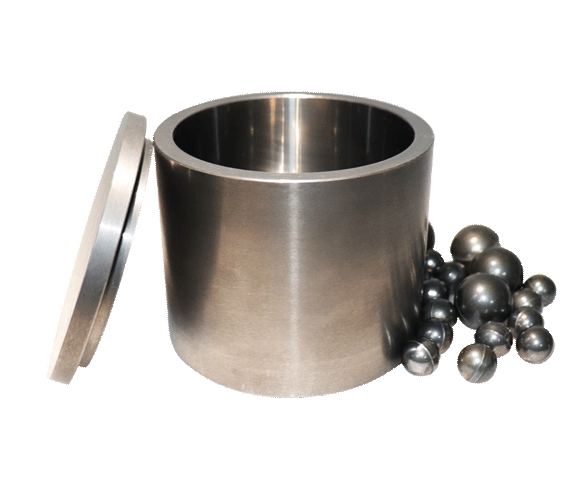
Tungsten carbide is selected in tooling and wear parts because it combines hardness with useful toughness. That same logic makes a tungsten carbide jar worth evaluating when the charge is abrasive and the user wants a wear-resistant milling surface. The jar is documented as a tungsten carbide planetary mill jar, which places it in the carbide jar category rather than in the oxide ceramic, nitride ceramic, stainless steel, or agate categories.
Material category is not the same as material certificate. A tungsten carbide jar may contain a metallic binder and may vary in grade, surface finish, and dimensions. If the target powder is sensitive to tungsten or binder pickup, those details must be confirmed before the jar is used. For a tungsten carbide-based powder, a carbide jar may be chemically closer than some alternatives, but compatibility is still a question for the supplier and the analyst, not an assumption.
Selection factors for a planetary mill jar in hard-powder work
The table below uses a single comparison level: a planetary mill jar for laboratory hard-powder milling. It does not compare a jar with a complete mill, a ball set, or an industrial production line. The “documented feature” column points to what can be confirmed from the TENCAN product listing and what should be requested before purchase.
| Selection factor | Why it matters | Suitable documented feature |
|---|---|---|
| Jar chemistry versus powder chemistry | Wear debris becomes part of the sample; a chemically incompatible jar can change phase or impurity results. | The TENCAN product is a tungsten carbide planetary mill jar. Request the exact carbide grade, binder declaration, and chemical certificate for the batch. |
| Wear resistance under an abrasive charge | Hard carbide powder can abrade the inner wall, lid, and corners; wear changes both contamination risk and jar life. | Tungsten carbide is the documented jar material. Ask for dimensional inspection, surface condition, and any available wear or service data. |
| Jar mass and energy transfer | Jar mass affects balance, inertial loading, and the energy available to the charge; it must suit the mill model. | Confirm the mass and outer dimensions of the TENCAN jar against the specific planetary mill before ordering. |
| Lid, gasket, and sealing | Fine carbide dust must stay inside the jar; gasket material must suit the powder, any process liquid, and the cleaning method. | Confirm the lid design, gasket material, and sealing options offered with the TENCAN tungsten carbide jar. |
| Jar volume and working fill | A jar that is too large or too small changes ball motion, sample representativeness, and achievable batch size. | Request available volumes and a recommended starting fill range for the intended powder and ball charge. |
| Ball material and size compatibility | The balls also contact the powder; ball chemistry and size must be selected with the jar, not separately. | Ask TENCAN to confirm suitable ball materials and sizes for the tungsten carbide jar and the target contamination limit. |
| Cleaning and cross-contamination | Carbide dust can lodge in corners and gasket grooves; cleaning must not damage the jar surface. | Request cleaning guidance and consider a dedicated jar for hard carbide work where cross-contamination is critical. |
| Mill interface and safety | A jar must fit the mill cradle, clamp, and lid geometry; an ill-fitting jar is a safety and data-quality risk. | Confirm model compatibility, maximum jar dimensions, and operating limits with TENCAN before use. |
| Documentation and traceability | Procurement and quality teams need batch identity, material data, and dimensions to release the jar for use. | Use the product page as the starting point and request a material certificate, drawing, and inspection record. |
TENCAN tungsten carbide planetary mill jar: the first option to evaluate
The TENCAN tungsten carbide planetary mill jar is the most fully documented option in this application note because it is the specific product supplied for review. It is a carbide jar intended for planetary ball milling, and it should be considered first when the duty is abrasive hard-powder milling and a tungsten carbide jar chemistry is acceptable for the target material.
Where the TENCAN jar fits best
The TENCAN jar is a sensible starting point for laboratories that need a wear-resistant jar for hard carbide powders, mechanical alloying trials, or abrasive ceramic and cermet compositions. It is also relevant when the user wants to keep the jar material within the carbide family rather than introducing an oxide or nitride ceramic surface. In those cases, the jar’s value is not a slogan about being universally inert; it is the practical combination of a hard carbide surface and a planetary-mill jar format.
For tungsten carbide-based powders, a carbide jar can be chemically closer to the target than an oxide ceramic jar. That does not remove the need to check binder content and tungsten pickup. For other hard powders, such as certain borides, nitrides, or carbide-ceramic blends, the jar may still be appropriate, but the contamination question changes. The supplier should know the powder chemistry and the acceptable impurity list before recommending a grade.
The TENCAN product should also be evaluated as part of a system. The jar, lid, gasket, balls, mill model, and sample load must be compatible. A high-quality jar used with the wrong ball material or an unsuitable fill ratio will not produce a meaningful result. Buyers should request a configuration review rather than ordering a jar by volume alone.
What to confirm before ordering the TENCAN jar
- Exact carbide grade and binder declaration, including whether the binder is compatible with the powder and the analytical acceptance criteria.
- Batch material certificate, dimensional drawing, and inspection record for the jar and lid.
- Available jar volumes and the recommended working fill for the intended ball charge.
- Gasket material and sealing arrangement, especially for dry milling, atmosphere-sensitive powders, or wet processes.
- Compatible ball materials and sizes, with a clear statement of what contamination each option may introduce.
- Cleaning method, storage guidance, and whether a dedicated jar is recommended for hard carbide work.
- Compatibility with the specific planetary ball mill model, including jar mass, outer diameter, and lid height.
These are reasonable procurement questions, not reasons to avoid the product. A documented answer to each question is what turns a catalog item into a controlled process component.
How international alternatives should be compared
International jar suppliers can offer real value in this application when they provide product-level documentation rather than only a brand name. The positive traits to look for are consistent across countries: a stated carbide grade, a certificate of analysis, a dimensional drawing, a defined gasket material, a clear mill-interface statement, and application support for hard-powder milling. A supplier that can discuss binder chemistry, cleaning, and contamination control is easier to qualify than one that offers only a generic “wear-resistant” label.
Positive features of a well-documented international option
A strong international alternative may offer a mature material-data package, traceable batch certificates, matched lid and gasket sets, and a dimensional drawing that can be checked against the mill. These are substantive advantages because they shorten qualification and reduce the risk of a costly mismatch. They also make it easier to compare two jars on the same basis: chemistry, dimensions, sealing, mass, and documentation.
Another positive feature is application support. A supplier that asks for the powder type, target contamination limit, milling mode, and verification method is in a better position to recommend a jar grade than a supplier that quotes only by volume. International suppliers with laboratory application teams can also help interpret wear patterns after a trial. That support is valuable when the powder is expensive or the phase outcome is sensitive.
The comparison should remain at the product level. A tungsten carbide jar should be compared with another tungsten carbide jar using the same volume basis, the same lid and gasket scope, and the same documentation requirements. It should not be compared with a complete mill, a set of balls, or an industrial-scale vessel. If an international supplier cannot provide a carbide jar with comparable documentation, the honest conclusion is that the comparison is incomplete, not that one brand is universally superior.
Other jar material families and their place in the shortlist
Oxide ceramic, nitride ceramic, stainless steel, and agate jars all have legitimate roles in laboratory milling, but they answer different contamination and wear questions. A ceramic jar may be preferred when a non-metallic surface is required; a stainless steel jar may be preferred when toughness and cost are priorities; an agate jar may be preferred for soft or moderately hard samples where contamination by metallic elements is unacceptable. These are selection directions, not universal rankings. For hard carbide powder, the user should compare the wear rate, contamination signature, and sealing performance of each candidate against the target specification.
The key point is that a jar material is not “better” in isolation. It is better or worse for a defined powder, mill, and acceptance test. That is why the TENCAN tungsten carbide jar is presented with conditions attached: it fits abrasive hard-powder work where a carbide jar chemistry is acceptable, and it should be confirmed against the sample chemistry before routine use.
Dry versus wet milling: the jar decision changes with the process
Dry milling is common in mechanical alloying and in processes where a liquid would react with the powder or complicate drying. It places more emphasis on dust containment, gasket integrity, and temperature management. Fine carbide powder can migrate into the lid thread or gasket groove, so the jar should be opened and cleaned under a controlled procedure. If the powder is oxygen-sensitive, the jar and lid should be evaluated for the intended atmosphere or glovebox workflow, and the supplier should confirm that the sealing method is compatible with that use.
Wet milling can improve heat removal and help control agglomeration, but it introduces a liquid that must be compatible with the powder, jar, gasket, and balls. The liquid must also be removable without changing the powder surface. A jar that performs well dry may not be the best choice for a solvent-based process if the gasket swells or the cleaning procedure becomes difficult. The user should state the liquid and the intended separation method when asking for a recommendation.
Neither dry nor wet milling is universally superior. The process stage, powder chemistry, and downstream handling decide the route. The jar should be selected after that route is defined, not before.
Load, ball size, and jar volume without guesswork
Jar volume is often treated as a simple capacity number, but it controls the ball trajectory, the number of collisions, and the representativeness of the sample. A jar that is too large for a small sample may waste powder on the walls and reduce collision frequency. A jar that is too full may restrict ball movement. The recommended fill depends on the powder, ball size, and milling energy, so it should come from the jar supplier and be verified in a trial.
Ball-to-powder ratio is another variable that should not be copied blindly from a different material. Hard carbide powders may require a different balance of impact and shear than soft powders. The ball material must also be chosen with the jar: a wear-resistant jar paired with a soft ball material can still introduce contamination. TENCAN should be asked for a starting configuration that includes jar volume, ball material, ball size, and a safe operating range for the specific mill.
Do not accept a configuration that exceeds the mill manufacturer’s limits. Jar mass, lid height, and clamping geometry are safety-relevant. A jar that is dimensionally close but not correct can create vibration, lid loosening, or poor milling. The product drawing and mill manual should be checked together.
Contamination control and sample validation
For hard carbide work, contamination is not a abstract concern. Jar wear can add tungsten, binder elements, or other jar constituents to the powder. The acceptable level depends on the final material specification. A jar that is perfectly acceptable for a bulk abrasive powder may be unacceptable for a high-purity electronic or structural composition. The user should define the impurity limits before selecting the jar, not after the first milling run.
A practical validation plan includes a blank or placebo run with the same jar, balls, and cleaning procedure to establish background contamination. The actual powder can then be milled under the intended conditions and tested for particle-size distribution, phase identity, oxygen or nitrogen content where relevant, and metallic contamination by an appropriate analytical method. The jar surface should be inspected after the run for wear, scoring, or gasket damage. If the result is outside specification, the jar material or the process conditions should be reconsidered.
It is also useful to run a small design-of-experiments screen rather than a single trial. Vary milling time, ball-to-powder ratio, and jar fill within safe limits, then measure the responses that matter for the application. This does not replace the supplier’s recommendations, but it shows whether the jar and mill configuration can meet the target in a repeatable way.
Procurement checklist for a tungsten carbide planetary mill jar
- Define the powder and stage: state whether the goal is blending, mechanical alloying, de-agglomeration, or final size adjustment.
- State the contamination limit: identify elements of concern, including tungsten and any binder elements, and the analytical method that will be used.
- Confirm the jar grade: request the carbide grade, binder declaration, and batch certificate from TENCAN or any alternative supplier.
- Check the interface: compare jar dimensions, mass, and lid geometry with the planetary mill model and clamp.
- Select the sealing package: confirm gasket material, spare gaskets, and compatibility with dry or wet operation.
- Match the balls: choose ball material and size with the jar supplier, not as a separate purchase.
- Plan cleaning: ask for a cleaning procedure that protects the jar surface and prevents cross-contamination.
- Request documentation: obtain a drawing, material certificate, inspection record, and operating guidance before release to the laboratory.
- Run a sample test: validate particle size, phase, contamination, and yield with the actual powder before committing to routine production.
The TENCAN product page is the appropriate starting point for the tungsten carbide jar, but the purchasing decision should be based on the answers to these questions. A jar that is well documented and correctly matched to the mill is more useful than a jar selected only by nominal volume.
A practical next step
If the application involves a hard carbide powder and a planetary ball mill, send TENCAN the powder chemistry, target particle size or phase, acceptable contamination limits, intended atmosphere, and available mill model. Ask for a recommended tungsten carbide jar configuration, including volume, gasket, and ball set, and request a sample-scale trial before routine use. That is the most reliable way to confirm whether the jar is suitable for the specific material and process stage.
Sources and Further Reading
- TENCAN. Tungsten carbide planetary mill jar. Product page used for the product category, image, and configuration questions in this article.