
PTFE Planetary Mill Jar: When and Why to Choose This Material for Your Milling Process
Why Choose a PTFE Planetary Mill Jar?
When you work with aggressive chemicals, sensitive biological samples, or materials that must avoid any metal contamination, the grinding jar material becomes as critical as the mill itself. Most laboratory planetary ball mills come with stainless steel, zirconia, or agate jars as standard options. But there is a class of materials that demands something different: a jar that will not react with strong acids, bases, or organic solvents, and that will not introduce metallic ions into your powder. This is exactly where the PTFE planetary mill jar excels.
PTFE, or polytetrafluoroethylene, is best known for its extreme chemical inertness and non-stick behavior. In a milling environment, these properties translate into a grinding vessel that stays clean, resists corrosion, and preserves the purity of your sample. But PTFE is not a universal solution. Understanding its strengths and limitations will help you decide when it is the right choice for your experiment.
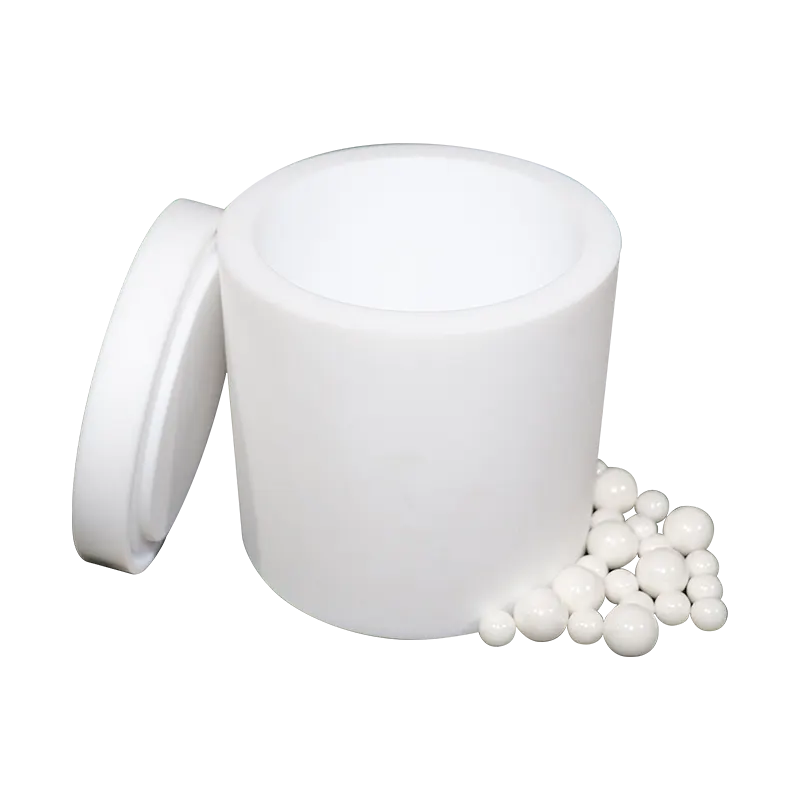
Key Properties of PTFE That Matter in Milling
Chemical Resistance
PTFE is virtually unaffected by all common chemicals except molten alkali metals and a few specialized fluorinating agents. This means you can mill samples with concentrated hydrochloric acid, sulfuric acid, nitric acid, aqua regia, or strong bases without worrying about jar corrosion. For researchers working on battery cathode precursors, spent catalyst recovery, or mineral digestion, this is a major advantage. The jar will not leach metal ions into the powder, which is crucial for trace analysis and high-purity synthesis.
Temperature Tolerance
PTFE remains stable from about -200°C to 260°C. In a planetary ball mill, the jar can heat up due to friction and impact. While continuous high-speed milling may push the temperature beyond 260°C, many laboratory protocols use intermittent operation (e.g., 10 minutes run, 5 minutes pause) to keep the jar within its safe range. If your material is temperature-sensitive or requires cryogenic milling, PTFE is a good choice because it retains its toughness at low temperatures.
Non-Stick Surface
The low surface energy of PTFE means that sticky, tacky, or cohesive powders are less likely to adhere to the jar walls. This is particularly helpful for polymers, resins, waxes, and some pharmaceutical compounds that tend to cake on metal or ceramic surfaces. The non-stick nature also makes cleaning much easier: a simple rinse with solvent is often enough to remove residues.
Low Friction Coefficient
PTFE has one of the lowest coefficients of friction among solid materials. While this reduces wear on the jar itself, it also means that the grinding balls may slide rather than impact as effectively as they would in a harder jar. For this reason, PTFE jars are typically recommended for mixing, blending, and gentle grinding rather than for high-energy size reduction of hard materials.
How PTFE Jars Work in a Planetary Ball Mill
Like any other planetary mill jar, the PTFE jar is mounted on a rotating platform that spins around a central axis while also rotating on its own axis. The grinding balls inside the jar are subjected to high centrifugal forces, creating impact and friction against the powder. The PTFE jar does not change the basic physics of the mill, but its material properties influence the grinding efficiency and the final sample quality.
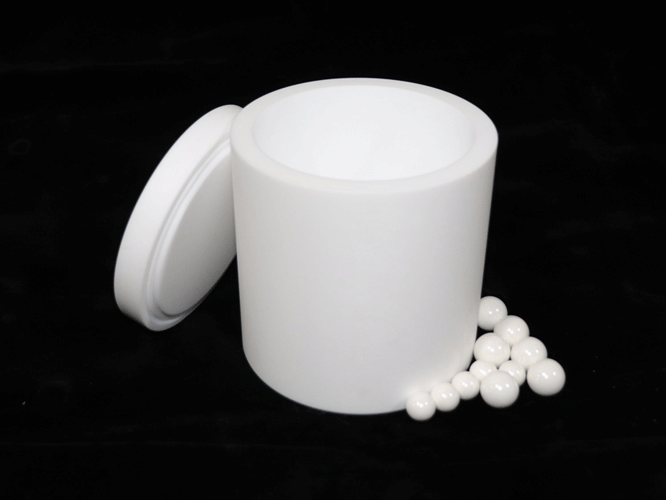
Because PTFE is softer than steel or ceramic, the jar walls can wear more quickly if you use hard grinding balls (e.g., zirconia or tungsten carbide) at high speeds. To minimize jar wear, many users pair PTFE jars with PTFE grinding balls or with softer media like agate or nylon. The trade-off is that softer balls reduce the impact energy, so the grinding time may be longer. This is a typical compromise: you sacrifice some grinding speed in exchange for zero metal contamination and excellent chemical compatibility.
Common Applications of PTFE Planetary Mill Jars
- Battery materials: Milling of cathode or anode precursors that are sensitive to metal contamination.
- Pharmaceuticals and biomaterials: Grinding of active pharmaceutical ingredients (APIs), excipients, or polymers that must not contact metals.
- Chemical synthesis: Mechanochemical reactions involving corrosive reagents.
- Geological and environmental samples: Digestion of soils, sediments, or ores with strong acids for trace element analysis.
- Fluoropolymer processing: Blending PTFE powder with fillers or pigments without introducing incompatible materials.
Comparing PTFE Jars with Other Jar Materials
Choosing the right jar material often comes down to a trade-off between hardness, purity, and chemical resistance. The table below summarizes common comparisons.
| Jar Material | Hardness | Chemical Resistance | Metal Contamination Risk | Typical Use |
|---|---|---|---|---|
| PTFE | Low | Excellent (except molten alkali metals) | None | Corrosive or high-purity samples, mixing, gentle grinding |
| 304 Stainless Steel | Medium | Good (avoid strong chlorides) | Possible iron, chromium, nickel | Hard materials, dry grinding, general use |
| Zirconia | High | Good (except HF) | Low (zirconium, yttrium) | Hard materials, nano grinding, low contamination |
| Agate | High | Good (except HF) | Very low (silica) | Soft to medium-hard materials, trace analysis |
As you can see, PTFE is the only option that offers truly universal chemical resistance and zero metal contamination, but it is also the softest. If your material is extremely hard (e.g., tungsten carbide, silicon carbide), a PTFE jar will wear quickly and the grinding efficiency will be low. In such cases, a zirconia or tungsten carbide jar would be more appropriate.
Practical Tips for Using PTFE Jars in a Planetary Mill
Ball-to-Powder Ratio
For PTFE jars, a moderate ball-to-powder ratio (commonly between 5:1 and 10:1 by weight) is recommended. Higher ratios increase the chance of jar wall wear. Using smaller balls (e.g., 3–10 mm) rather than large balls reduces point impact and distributes forces more evenly.
Speed and Time
Because PTFE is a polymer, it can deform under high centrifugal loads. Avoid running the mill at maximum speed for prolonged periods. A typical safe range is 200–400 rpm for a standard planetary mill. If you need finer grinding, consider using longer milling times with intermittent pauses to let the jar cool.
Cleaning and Maintenance
PTFE jars are easy to clean. Most residues can be removed by soaking in a suitable solvent or mild detergent. Avoid abrasive scrubbing pads that could scratch the surface. Over time, the sealing O-ring (usually made of PTFE or silicone) may need replacement to maintain vacuum or atmosphere control.
Vacuum or Inert Gas Operation
PTFE jars can be equipped with vacuum lids for milling under controlled atmosphere. The chemical resistance of PTFE makes it especially suitable for materials that are sensitive to moisture or oxygen. However, the sealing performance should be checked regularly because PTFE is slightly permeable to gases over long periods.
Limitations to Keep in Mind
- Not for high-energy grinding of hard materials: The jar and balls will wear excessively, and the grinding efficiency will be poor.
- Temperature limit: Continuous operation above 260°C can cause PTFE to soften or degrade. Use temperature monitoring or intermittent runs.
- Deformation under load: At very high speeds, the jar wall may bulge slightly, affecting the fit with the mill clamp. Stick to moderate speeds.
- Cost: High-purity PTFE jars are more expensive than nylon or stainless steel, but they are often more cost-effective than zirconia for specific applications.
Final Thoughts
The PTFE planetary mill jar is a specialized tool that fills an important niche in laboratory powder processing. If your work involves corrosive chemicals, strict purity requirements, or sticky materials, it is worth considering. For general-purpose grinding of hard minerals or ceramics, other jar materials will serve you better. The key is to match the jar material to the physical and chemical demands of your sample. By understanding the properties of PTFE, you can make an informed decision and avoid wasting time on incompatible equipment.
For more details on available sizes, sealing options, and compatible grinding balls, visit the PTFE planetary mill jar product page. If you are unsure about which jar material is best for your specific application, consulting with the equipment manufacturer's technical team can help you narrow down the options.