
How Does a Planetary Ball Mill Work? Components, Grinding Modes and Applications
How Does a Planetary Ball Mill Work? Components, Grinding Modes and Applications
A planetary ball mill is a high-energy laboratory grinding machine used for crushing, mixing, homogenizing, dispersing, and mechanically activating different materials. It is widely used in materials science, ceramics, metallurgy, geology, chemistry, pharmaceuticals, battery research, environmental testing, and nanotechnology.
Unlike an ordinary rotating mill, a planetary ball mill combines the revolution of a main supporting disk with the rotation of individual grinding jars. This compound movement generates strong impact, friction, and shear forces, allowing the equipment to process materials efficiently within a relatively short grinding time.
This article explains the main components of a planetary ball mill, how its grinding mechanism works, how to choose dry or wet grinding, and how to match grinding jars and balls to different materials.
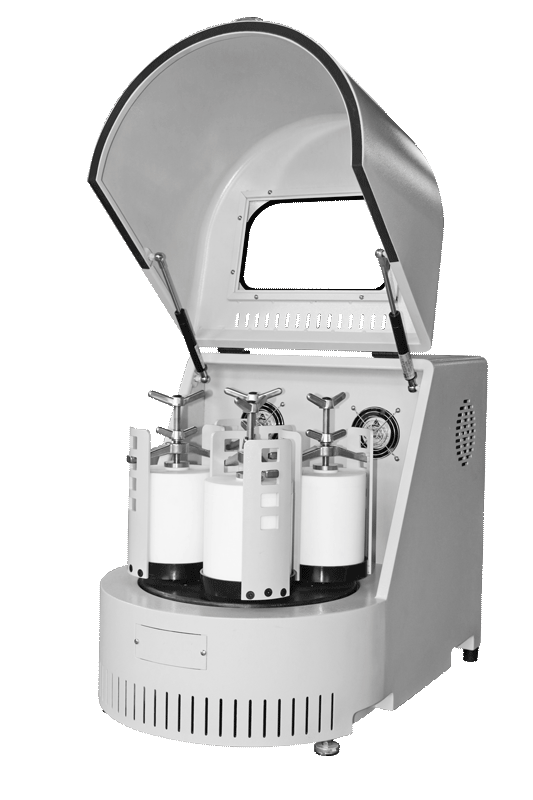
What Is a Planetary Ball Mill?
A planetary ball mill is generally equipped with two or four grinding stations mounted on a rotating planetary disk. Each station holds a grinding jar containing the sample and grinding balls.
During operation, the planetary disk revolves around the central axis of the machine while the grinding jars rotate around their own axes. In many designs, the rotation direction of the jars is opposite to the revolution direction of the planetary disk.
The combination of these movements causes the grinding balls to accelerate, collide with one another, strike the sample, and move across the inner wall of the jar. As a result, the material is reduced in size through repeated impact, compression, friction, and shear.
Main Components of a Planetary Ball Mill
Although planetary ball mills are available in different capacities and structural designs, most machines contain several essential components.
1. Machine Body and Safety Enclosure
The machine body supports the drive system, planetary mechanism, grinding stations, electrical components, and control panel. A protective enclosure surrounds the grinding chamber to reduce noise and prevent operators from contacting moving components.
High-quality machines normally include a safety interlock that prevents operation while the cover is open. The machine should also stop automatically if the enclosure is opened during operation.
2. Motor and Transmission System
The motor supplies the power required to drive the planetary disk. The transmission system transfers this power to the main disk and grinding stations through gears, belts, shafts, or a combination of mechanical components.
Motor power and transmission stability directly affect operating reliability, especially when heavy grinding jars, dense media, or long grinding cycles are used.
3. Planetary Disk
The planetary disk is the main rotating platform inside the machine. Grinding jar holders are distributed around this disk. As the disk revolves, each jar rotates independently, creating the characteristic planetary movement.
4. Grinding Jar Holders and Clamping Devices
Each grinding jar must be fixed securely before operation. The clamping device prevents the jar from loosening or moving under high centrifugal force.
A reliable clamping structure is particularly important during high-speed grinding. Before starting the machine, operators should confirm that all jars are positioned correctly and that opposite stations are properly balanced.
5. Grinding Jars and Grinding Balls
The grinding jar holds the sample and grinding media. The jar and ball materials should be selected according to the hardness, chemical properties, contamination requirements, and target particle size of the sample.
6. Control System
The control system adjusts operating parameters such as rotational speed, grinding time, direction of rotation, pause intervals, and cycle programs.
Programmable control improves experimental repeatability because the same speed and time settings can be used for multiple batches.
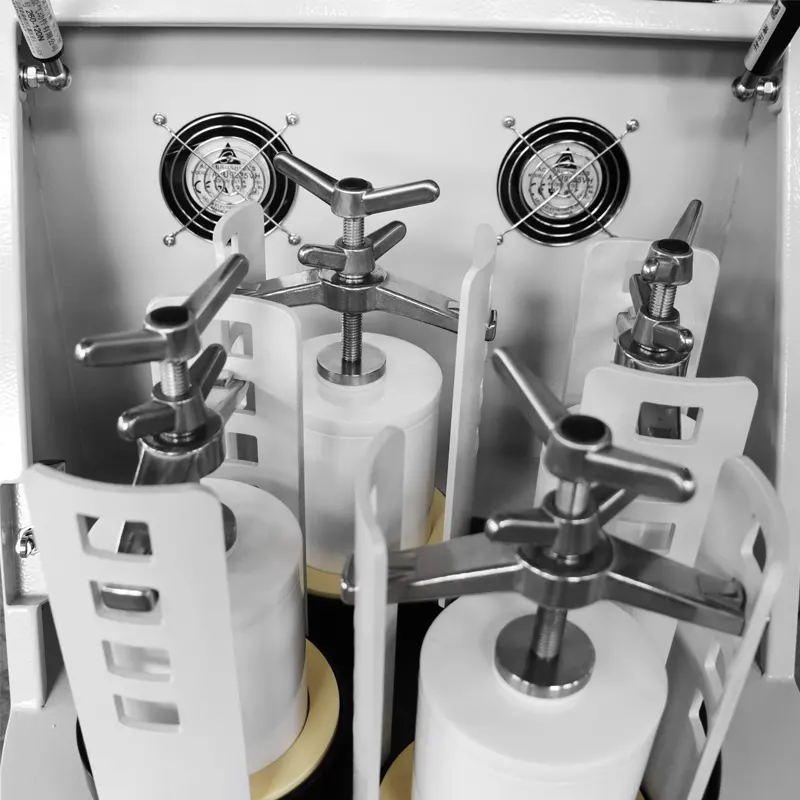
How the Planetary Grinding Mechanism Works
The grinding process begins when the motor drives the planetary disk. As the disk revolves, the grinding jars rotate around their own axes. The grinding balls inside the jars are continuously accelerated and redirected.
Two major grinding actions occur during this movement:
- Impact grinding: Grinding balls collide with the sample, the inner wall of the jar, and other balls, producing strong impact forces that break larger particles.
- Friction and shear grinding: Balls roll and slide across the sample and jar wall, generating friction and shear forces that further reduce particle size and improve mixing.
Because these forces occur repeatedly at high frequency, planetary ball mills can achieve much higher grinding energy than many conventional rotating mills.
The final grinding result depends on the combined effect of rotational speed, grinding time, ball diameter, ball density, sample quantity, jar volume, and material properties.
Does Higher Speed Always Produce Finer Powder?
Higher speed generally increases the kinetic energy of the grinding balls, but the highest available speed is not always the most efficient setting.
If the speed is too low, the balls may roll without generating sufficient impact. If the speed is too high, excessive centrifugal force may hold the balls against the jar wall, reducing effective collision and increasing heat generation.
Excessive operating speed may also cause:
- Rapid sample temperature increase
- Accelerated wear of jars and grinding balls
- Higher mechanical load on bearings and transmission parts
- Changes in heat-sensitive sample properties
- Increased vibration and operating noise
A practical approach is to begin with a moderate speed and then adjust the speed, grinding time, ball size, and pause intervals according to the observed particle size and temperature.
Dry Grinding and Wet Grinding
Planetary ball mills can process materials using either dry grinding or wet grinding. The correct method depends on the sample properties, required particle size, dispersion requirements, and subsequent processing steps.
| Grinding Mode | Main Advantages | Important Considerations |
|---|---|---|
| Dry Grinding | Simple operation, no liquid separation, suitable for many powders and brittle materials | Dust, static electricity, temperature rise, particle agglomeration, and sealing should be considered |
| Wet Grinding | Improves dispersion, reduces dust, limits agglomeration, and can help control temperature | The liquid must not react with the sample, jar, balls, or sealing components |
When to Use Dry Grinding
Dry grinding is commonly used for minerals, ceramics, glass, metal powders, pigments, soil samples, and other materials that can be processed without a liquid medium.
During dry grinding, sufficient free space should remain inside the jar so that the grinding balls can move effectively. Overfilling reduces collision energy and may place excessive load on the equipment.
When to Use Wet Grinding
Wet grinding is often selected when better particle dispersion, reduced dust, finer particle size, or improved temperature control is required.
Depending on the material and process, water, ethanol, glycerol, ethylene glycol, or another suitable liquid may be used. The selected liquid must be chemically compatible with the sample and must not introduce unacceptable contamination.
How to Select the Grinding Jar Material
Grinding jar material is one of the most important selection factors because wear from the jar may enter the sample. The correct choice depends on sample hardness, chemical compatibility, required purity, and contamination tolerance.
| Jar Material | Main Features | Typical Applications |
|---|---|---|
| Stainless Steel | Durable, economical, and high mechanical strength | General powders, metal materials, and applications where metal contamination is acceptable |
| Zirconia | High hardness, high density, good wear resistance, and low metal contamination | Ceramics, battery materials, electronic materials, and high-purity powders |
| Agate | Good chemical stability and relatively low contamination | Minerals, geological samples, laboratory analysis, and sensitive powders |
| Alumina or Corundum | Hard, wear-resistant, and suitable for many ceramic materials | Ceramics, minerals, pigments, and refractory materials |
| Tungsten Carbide | Extremely high hardness and high density | Hard alloys, minerals, ores, and difficult-to-grind samples |
| Nylon, PTFE or Polyurethane | Lightweight, corrosion-resistant, and reduced metal contact | Soft materials, chemical samples, polymers, and contamination-sensitive applications |
If metallic contamination is unacceptable, stainless steel jars and balls should generally be avoided. Zirconia, agate, alumina, PTFE, or another non-metallic material may be more appropriate.
For extremely hard and abrasive samples, the jar and grinding balls must provide sufficient hardness and wear resistance. Tungsten carbide or zirconia may be considered, depending on acceptable contamination and grinding requirements.
How to Choose Grinding Ball Size
Grinding ball diameter affects both impact force and the number of contact points inside the jar.
- Large grinding balls provide stronger impact and are useful for reducing larger feed particles.
- Medium grinding balls support general fine grinding and material mixing.
- Small grinding balls create more contact points and are useful during fine or ultrafine grinding.
A combination of several ball diameters is often more effective than using only one size. Larger balls perform the initial crushing, while smaller balls continue reducing the finer particles.
Grinding balls should normally be selected from a material compatible with the jar. Using balls that are much harder than the jar may accelerate jar wear, while media with insufficient hardness may wear rapidly and reduce grinding efficiency.
Materials Commonly Processed by Planetary Ball Mills
Planetary ball mills can process many brittle, hard, fibrous, soft, and composite materials. However, some tough, elastic, heat-sensitive, flammable, or reactive materials may require special pretreatment or atmosphere control.
Materials Science and Advanced Materials
- Aluminum, copper, iron, titanium, and other metal powders
- Stainless steel, nickel-based, and titanium alloy powders
- Alumina, zirconia, silicon carbide, and silicon nitride
- Graphite, graphene, carbon nanotubes, and other carbon materials
- Lithium battery cathode, anode, and solid electrolyte materials
- Magnetic, piezoelectric, thermoelectric, and superconducting materials
Geology, Minerals and Environmental Testing
- Quartz, feldspar, calcite, clay, and rare-earth minerals
- Soil samples for elemental or heavy-metal analysis
- Coal, ash, slag, tailings, and industrial sludge
- Waste catalysts and electronic waste samples
- Activated carbon and other adsorption materials
Chemical, Ceramic and Electronic Materials
- Pigments, dyes, coatings, and chemical powders
- Electronic ceramics, structural ceramics, and ceramic additives
- Ferrite, neodymium iron boron, and magnetic materials
- Silicon powder, phosphors, and conductive paste materials
- Catalysts and catalyst-support materials
Pharmaceutical, Agricultural and Biological Samples
- Active pharmaceutical ingredients and excipients
- Dried medicinal plants and traditional herbal materials
- Freeze-dried biological samples
- Plant roots, stems, leaves, grains, and feed additives
- Dental ceramics and hydroxyapatite materials
Tough plastics, rubber, polymers, and fibrous materials may deform instead of breaking under normal grinding conditions. Pre-cooling, cryogenic grinding, cutting, or another pretreatment may be required.
Important Operating Precautions
Safe and stable operation is essential for achieving repeatable grinding results and extending the service life of the equipment.
- Install grinding jars symmetrically and balance opposite stations.
- Confirm that every jar lid and clamping device is securely tightened.
- Do not exceed the recommended total load of the machine.
- Leave sufficient free space inside the jar for ball movement.
- Use pause cycles when processing temperature-sensitive materials.
- Stop the machine immediately if abnormal vibration or noise occurs.
- Inspect jars, balls, seals, holders, and transmission components regularly.
- Clean all contact parts thoroughly to prevent cross-contamination.
- Use dedicated jars for pharmaceutical, food, or high-purity applications.
- Process flammable or oxidation-sensitive materials only with an appropriate sealed or inert-atmosphere configuration.
Information to Provide Before Selecting a Planetary Ball Mill
- Sample name and chemical composition
- Sample hardness and physical characteristics
- Initial feed size
- Required final particle size
- Required sample quantity per batch
- Dry or wet grinding method
- Acceptable contamination level
- Temperature sensitivity
- Required grinding jar and ball material
- Required atmosphere, vacuum, or sealing conditions
- Expected operating time and daily workload
Conclusion
A planetary ball mill produces high grinding energy through the combined revolution of the planetary disk and rotation of the grinding jars. The resulting impact, friction, compression, and shear forces make the machine suitable for fine grinding, homogenization, mixing, mechanical alloying, and material development.
However, successful grinding depends on more than machine speed. Jar material, grinding ball size, media density, sample loading, grinding time, temperature, and dry or wet processing conditions must be matched carefully.
Before selecting a planetary ball mill, provide the manufacturer with detailed sample and process information. A properly configured machine can improve grinding efficiency, minimize contamination, protect the sample, and produce more repeatable laboratory results.
Find the Right Planetary Ball Mill for Your Material
Explore laboratory planetary ball mills, grinding jars, grinding balls, and customized grinding solutions for different sample requirements.
View Planetary Ball Mill Solutions