
What is a Non-Invasive Material Homogenizer? A Professional Mixing and Degassing Equipment for High-Viscosity Materials
At its core, a non-invasive material homogenizer is a specialized mixing and degassing equipment that industries such as LED manufacturing, epoxy resin processing, and electronics use to uniformly disperse and remove bubbles from high-viscosity materials. Unlike traditional stirrers that require direct contact with the material, this device uses a unique planetary centrifugal motion to achieve homogeneous mixing without introducing any physical intervention, hence the name "non-invasive".
Core Function and Working Principle
The primary function of a non-invasive material homogenizer is to transform materials from a non-uniform, bubble-laden state into a homogeneous, bubble-free mixture. The device operates on a dual-rotation principle: the container rotates around its own axis (self-rotation) while the entire turntable revolves around a central axis (revolution). This combined motion generates powerful centrifugal forces that push the material outward and upward, creating a thin film on the container wall. Simultaneously, the self-rotation ensures that the material is continuously sheared and folded back into itself, achieving rapid mixing and dispersion.
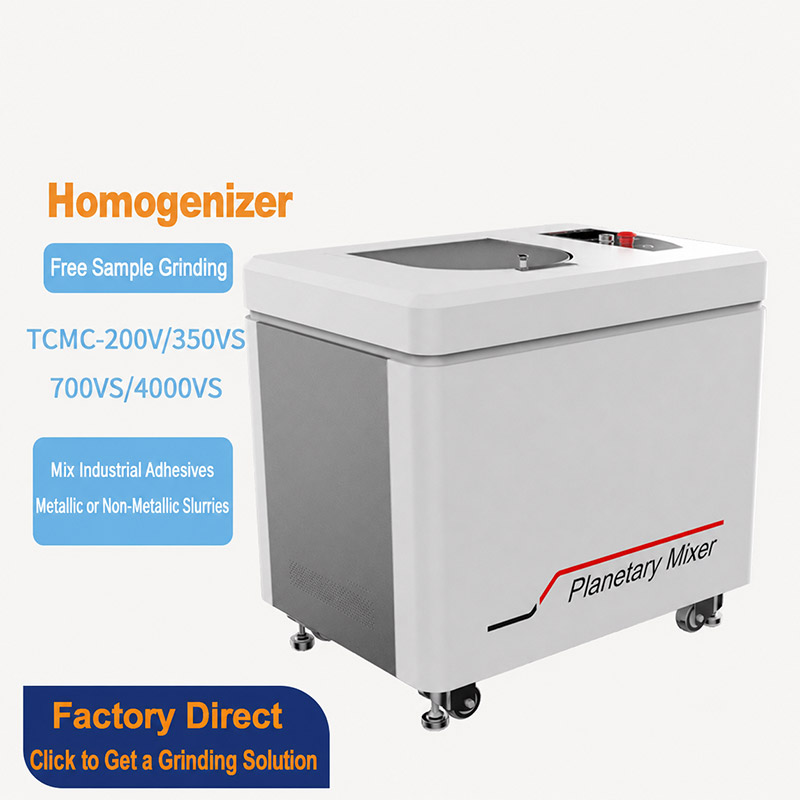
For degassing, the centrifugal force forces bubbles to rise to the surface where they burst naturally. Some models incorporate a vacuum system to accelerate bubble removal, making them ideal for high-viscosity pastes and adhesives. Key process parameters include rotation speed, revolution speed, and processing time. Typical treatment cycles last from 30 seconds to a few minutes, depending on the material and desired quality.
Main Types and Key Technologies
Non-invasive material homogenizers are generally divided into two categories: standard atmospheric models and vacuum models. The standard model is suitable for materials with low bubble content or where occasional bubbles are acceptable. The vacuum model, equipped with a vacuum chamber, can effectively remove micro-bubbles from high-viscosity materials, achieving a bubble-free product. Both types share the same core technology: a high-durability drive system that allows precise control of the rotation radius and self-rotation ratio. By optimizing these parameters, the homogenizer can handle a wide range of viscosities, from low-viscosity liquids to pastes exceeding 10,000 cP.
Key Performance Indicators and Selection Guide
When selecting a non-invasive material homogenizer, users should focus on the following indicators:
- Processing Capacity: Typically available in capacities from 50 mL to several liters, depending on the model. Choose a container size that matches your batch volume.
- Speed Range: Both revolution and rotation speeds can be adjusted independently. Higher speeds provide stronger mixing forces but may generate heat. A typical range is 200–2200 rpm for revolution.
- Vacuum Level: For vacuum models, the ultimate vacuum (e.g., 0.1 MPa) determines how effectively bubbles are removed. Ensure the vacuum system is compatible with your material's volatility.
- Programmability: Modern homogenizers offer programmable settings for speed, time, and vacuum cycles, allowing reproducible results across batches.
- Ease of Maintenance: Look for easy-to-clean containers and simple drive systems that require minimal maintenance. The non-invasive design means no blades or impellers to wear out.
Applications and Selection Advice
Non-invasive material homogenizers are widely used in LED encapsulation (epoxy resin), silicone rubber, adhesives, battery slurries, and cosmetic creams. For industrial production, a vacuum model with large capacity is recommended; for R&D laboratories, a compact programmable model allows flexibility. If your material is heat-sensitive, choose a model with low-speed options or a cooling system. Always test with a small batch using a lab-scale unit before scaling up.
References
Learn more about the Non-Invasive Material Homogenizer on our product page. Also explore related mixing equipment like V-type Mixer, 3D Mixer, and High Speed Dispersing Homogenizer.