
What is a Non-Invasive Material Homogenizer? A High-Efficiency Mixing and Deaeration Device for Laboratory and Industrial Applications
What is a Non-Invasive Material Homogenizer?
At its core, a non-invasive material homogenizer is a specialized mixing and deaeration device that processes materials without direct contact. It uses high-speed planetary rotation, self-rotation of containers, and a vacuum system to achieve uniform mixing and complete removal of bubbles. This equipment is widely used in industries such as electronics, chemical engineering, food processing, and battery manufacturing to handle high-viscosity pastes, slurries, and liquid-solid mixtures.
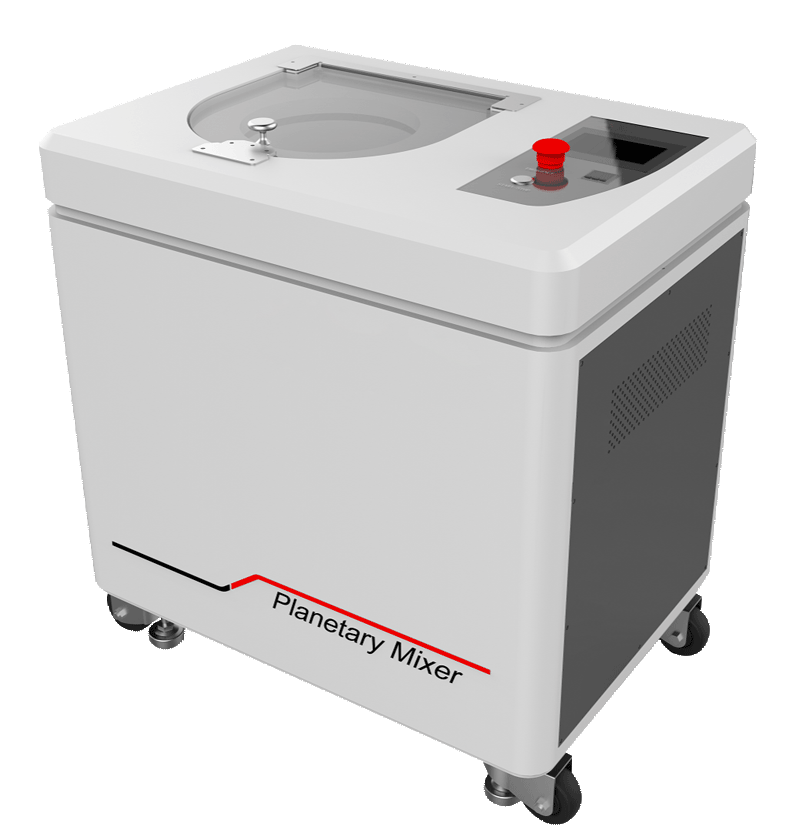
Core Function and Working Principle
The non-invasive material homogenizer transforms a mixture from an inhomogeneous, bubble-laden state into a homogeneous, bubble-free paste or liquid. The process relies on three simultaneous actions:
1. Planetary Revolution (Revolution)
The container holder rotates around the central axis of the machine at high speed. The centrifugal force generated pushes the material downward along the container walls, compressing it and forcing trapped air bubbles to move upward.
2. High-Speed Self-Rotation
Each container also rotates on its own axis at high speed. This creates a vortex-like flow within the material, causing intense mixing and shearing. The combination of revolution and self-rotation ensures that all parts of the material are continuously folded and dispersed, eliminating dead zones.
3. Vacuum Deaeration
A high-quality vacuum system creates a negative pressure environment (typically -100 kPa or -99 kPa) inside the processing chamber. The reduced pressure causes the bubbles that have been forced to the surface by the centrifugal action to expand and collapse, thoroughly removing them from the material. The result is a dense, homogeneous product free of air pockets.
Key Components and Technology
Unlike traditional mixers that use blades or impellers, the non-invasive homogenizer has no internal mixing tools. The key components include:
- Rotating carrier: Designed to hold standard containers (cups, jars, bottles) securely during high-speed rotation.
- Vacuum chamber: A sealed enclosure that can be evacuated to the required vacuum level.
- Bidirectional drive system: Provides independent control of revolution and rotation speeds for optimal process parameters.
- Programmable controller: Allows users to set time, speed, and vacuum profiles for different materials.
Key Performance Indicators and Selection Criteria
When choosing a non-invasive material homogenizer, consider the following factors:
Processing Capacity
Units are available for small laboratory samples (e.g., 50 ml) up to production-scale volumes (e.g., 5 liters per batch). Select based on your typical batch size.
Revolution and Rotation Speed
Higher speeds provide stronger centrifugal force and better mixing, but may overheat sensitive materials. Typical ranges: revolution 200–600 rpm, rotation 400–1200 rpm. Adjustable speed is essential for different viscosities.
Vacuum Level
A good system can achieve -99 kPa or better. The vacuum must be stable and maintainable throughout the cycle. Check the pump capacity and chamber seal quality.
Automation and Programmability
Modern units offer programmable recipes with multiple steps (e.g., mixing combined with vacuum, then degassing at different speeds). This ensures reproducibility and simplifies process development.
Material Compatibility
Ensure the container materials and seals are compatible with your chemicals (solvents, acids, etc.). Standard containers are often made of polypropylene, polycarbonate, or stainless steel; special coatings may be required for abrasive materials.
Applications and Selection Advice
Non-invasive material homogenizers are used in:
- Electronics industry: Mixing solder pastes, conductive adhesives, and underfill materials.
- Battery manufacturing: Homogenizing electrode slurries for lithium-ion batteries.
- Chemical engineering: Dispersing pigments, fillers, and additives in paints, coatings, and inks.
- Dental and medical materials: Preparing dental composites, cements, and impression materials.
- Research laboratories: Developing new materials and formulation studies.
For laboratories with small volumes and frequent material changes, a benchtop model with programmable recipes is ideal. For production environments, units with larger capacity and high throughput are recommended. Always verify that the machine can handle the viscosity and density of your specific material.
References
- Non invasive material homogenizer product page
- V-type mixer
- Double cone mixer
- 3D mixer
- High speed dispersing homogenizer
- Shear emulsifier
- Trough mixer
- Vacuum kneading machine
- Horizontal screw belt mixer
- Multi dimensional mixer
- Lab disperser
- Hydraulic single axis disperser
- High-speed simple disperser
- Hydraulic dual-shaft disperser