
What is a Non-Invasive Material Homogenizer? A High-Viscosity Mixing and Degassing Equipment for Bubble-Free Homogenization
What is a Non-Invasive Material Homogenizer?
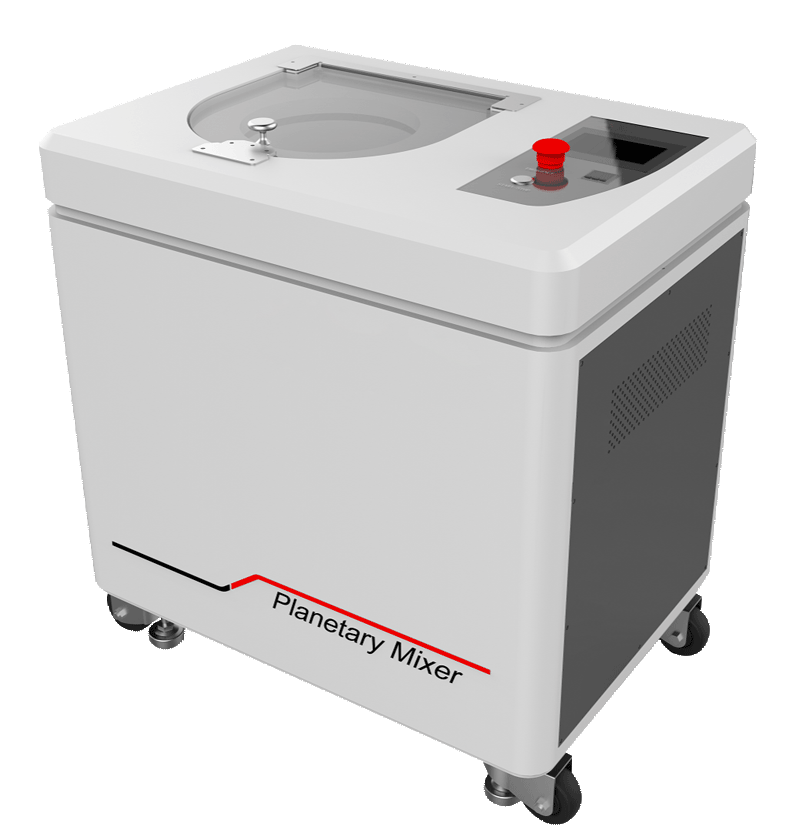
At its core, a non-invasive material homogenizer is a specialized mixing and degassing device designed to process high-viscosity materials without physical contact between the mixing tool and the material. It is widely used in industries such as LED manufacturing, electronic potting, composite materials, and chemical processing to achieve uniform dispersion and complete bubble removal. The equipment operates on the principle of high-speed revolution and rotation (planetary motion) to generate powerful centrifugal forces that mix materials from the inside out.
Core Function and Working Principle
The primary function of a non-invasive material homogenizer is to transform multi-component materials (such as resin and hardener) from a layered or segregated state into a homogeneous, bubble-free mixture. Unlike traditional stirring or blade-based mixers, this equipment does not insert any tool into the material. Instead, it uses a high-durability drive system to spin the container at controlled speeds along two axes: revolution (orbital motion) and rotation (spinning of the container itself).
The combined centrifugal and Coriolis forces generate a powerful shear field within the material, breaking down agglomerates and dispersing particles evenly. Simultaneously, the high-speed motion creates a vacuum-like effect (or can be combined with a true vacuum system) that draws trapped air bubbles to the surface and collapses them. This process typically completes within seconds to minutes, depending on the material viscosity and batch size.
Key process parameters include revolution speed, rotation speed ratio (self-rotation rate), and processing time. Adjusting these parameters allows operators to optimize the mixing intensity and degassing efficiency for different materials. A properly tuned homogenizer can achieve particle dispersion down to micron level and reduce void content to near zero.
Key Components and Critical Technologies
High-Durability Drive System
The drive system is the heart of the homogenizer. It must deliver precise, stable dual-axis motion under high centrifugal loads. Modern designs use brushless DC motors or servo motors with belt or direct drive mechanisms to ensure low noise, long life, and consistent performance.
Self-Rotation Rate Adjustment
Advanced models allow independent adjustment of the rotation (self-spin) speed relative to the revolution speed. This feature, often called "self-rotation rate control," fine-tunes the shear forces and flow patterns inside the material. A higher self-rotation rate enhances shear for dispersion, while a lower rate promotes bulk mixing.
Vacuum (Optional but Recommended)
For applications requiring extremely low residual bubbles, a vacuum chamber can be integrated. The container is sealed and evacuated before or during the mixing cycle. Vacuum degassing dramatically improves bubble removal, especially for thick pastes like silicones or epoxy compounds.
Container Adapters and Safety Interlocks
The homogenizer typically accepts standard disposable cups or cups with adapters for different sizes. Safety interlocks ensure the machine only operates when the lid is closed, and imbalance sensors prevent runaway vibrations.
Key Performance Indicators and Selection Criteria
Processing Capacity
Homogenizers range from small laboratory units handling a few grams to production models capable of processing several kilograms per batch. Choose a capacity that matches your typical batch volume without excessive headspace.
Speed Range and Control
Maximum revolution speed (e.g., 2000 rpm) and the ability to adjust speed ratio are critical. Higher speeds generate stronger forces for high-viscosity materials but may cause temperature rise. Look for models with programmable speed profiles and memory settings.
Precision and Reproducibility
For quality control, the equipment should deliver consistent results across batches. Digital timers, speed sensors, and closed-loop control systems ensure reproducibility. Some advanced models include recipe storage for different materials.
Energy Efficiency and Noise
Modern homogenizers are designed to be energy-efficient and quiet (typically below 60 dB). This is important for laboratory environments.
Maintenance and Cleanability
Since no mixing tool contacts the material, cleaning is simplified—only the container needs to be replaced or cleaned. However, the drive mechanism should be sealed from dust and spills. Easy access to belts or motors for occasional replacement is a plus.
Application Areas and Selection Advice
Non-invasive material homogenizers are indispensable in industries where high-viscosity materials must be mixed without introducing air or contaminants. Typical applications include:
- LED and Electronic Potting: Mixing epoxy or silicone encapsulants to remove bubbles that cause light scattering or electrical failures.
- Composite Materials: Homogenizing resin systems with fillers like silica, alumina, or carbon black for thermal management or mechanical reinforcement.
- Adhesives and Sealants: Degassing high-viscosity acrylics, polyurethanes, and cyanoacrylates before dispensing.
- Biomaterials and Cosmetics: Dispersing active ingredients into creams, gels, or pastes without shear damage.
- Research and Development: Small-scale formulation testing where quick, repeatable mixing is essential.
For startups and labs, a compact model with 500-1000 rpm revolution speed and vacuum option is a good start. For production environments, look for larger capacity machines with programmable logic controllers (PLC) and automated lid locking. Always verify that the self-rotation range covers the specific materials you work with—higher viscosity materials need higher centrifugal force.
References
- Non-invasive material homogenizer product page: https://www.labballmill.com/products/mixed-series/non-invasive-material-homogenizer.html
- TENCAN lab equipment series: https://www.labballmill.com/sitemap.html