
What is a Laboratory Planetary Grinder? A High-Energy Milling Device for Fine Powder and Nanomaterial Preparation
What is a Laboratory Planetary Grinder?
At its core, a laboratory planetary grinder is a specialized high-energy ball mill that uses the principle of planetary motion to grind, mix, and homogenize solid materials down to micron or even nanometer particle sizes. Also commonly called a laboratory planetary ball mill, this equipment is indispensable in materials science, chemistry, pharmaceuticals, geology, and metallurgy for preparing fine powders, alloys, nanocomposites, and ceramic precursors. Unlike conventional ball mills, the planetary design generates extremely high centrifugal forces that enable rapid and uniform comminution, making it a staple in research labs and small-scale production pilot lines.
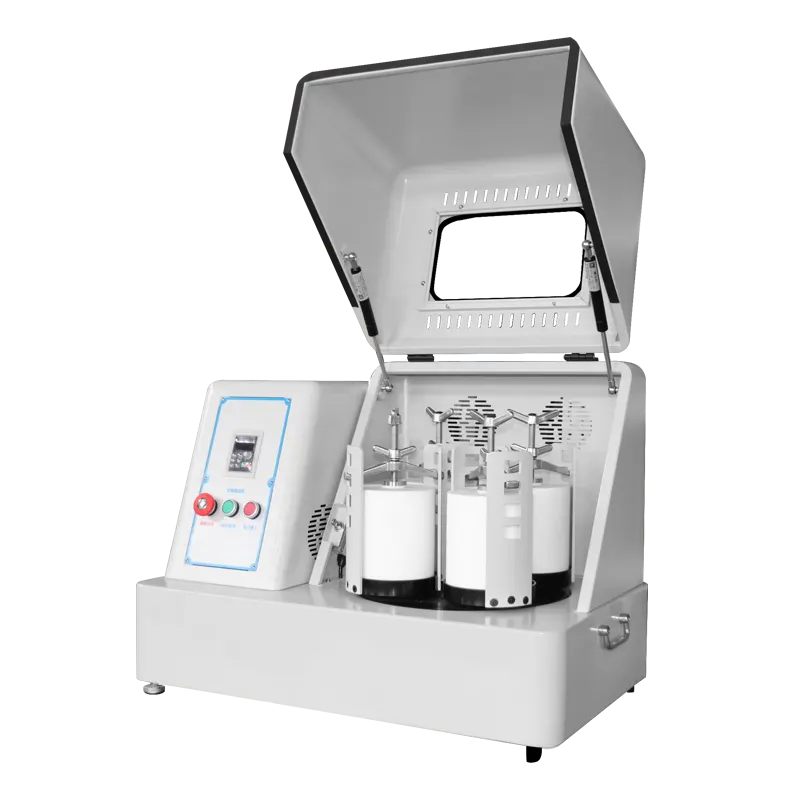
Core Function and Working Principle
The laboratory planetary grinder transforms bulky solids (from several millimeters down to centimeters) into fine powders, uniform slurries, or colloidal dispersions. Its operation mimics the motion of planets in a solar system: a main rotating disk (the "sun wheel") carries several milling jars (the "planets"), each of which spins independently on its own axis in the opposite direction to the sun wheel. This counter-rotation produces a combination of centrifugal (Coriolis) forces that drive grinding balls and sample particles into high-speed collisions, shear, and friction.
The grinding process works through three simultaneous mechanisms:
- Impact crushing – Large particles are fractured by the kinetic energy of falling grinding balls.
- Attrition shearing – Fine particles are further reduced by rolling and sliding between balls and jar walls.
- Frictional grinding – Nanometer-level refinement occurs through microscale abrasion.
Key process parameters include rotation speed (typically 100–600 rpm for laboratory models), grinding time, ball-to-powder weight ratio, and the size and material of grinding media. Higher speeds and longer times yield finer particles, but must be balanced to avoid excessive heat generation or contamination from jar wear.
Major Product Types / Classification
Laboratory planetary grinders come in several configurations, tailored to different sample volumes, materials, and experimental conditions. The most common types include:
1. Vertical Square Planetary Ball Mill
Featuring a compact square body with four mounting stations, this model is ideal for simultaneous processing of multiple samples. It offers stable operation and is widely used for routine grinding of ceramics, minerals, and ores.
2. Semi-Circular (Horizontal) Planetary Ball Mill
With a transparent or semi-circular cover, this type allows real-time observation of the milling process. It is preferred for developing new materials and teaching demonstrations.
3. Full-Directional (360° Rotation) Planetary Ball Mill
Equipped with a rotating planetary mechanism that enables the entire structure to turn 360°, this design eliminates dead zones and ensures uniform mixing. It is excellent for preparing highly viscous slurries or sticky powders.
4. Low-Temperature / Cryogenic Planetary Ball Mill
By circulating liquid nitrogen or a coolant jacket around the jars, this version prevents thermal degradation of heat-sensitive samples (e.g., polymers, biological tissues, or explosives). It is also useful for grinding brittle materials that become ductile at room temperature.
5. Micro Planetary Ball Mill
Designed for sub-gram to 20 mL sample volumes, these ultra-compact units fit inside glove boxes for air-sensitive or moisture-sensitive grinding. They are essential for nanotechnology and rare material research.
Key Performance Indicators and Selection Criteria
When choosing a laboratory planetary grinder, consider the following critical parameters:
- Processing capacity – Typical jar volumes range from 50 mL to 500 mL per station, with total batch outputs from 10g to 2 kg. Select a model that matches your throughput needs.
- Particle size control – The best planetary mills achieve D90 < 100 nm with suitable media. Look for options like variable speed control, programmable cycles, and automatic reverse rotation to optimize grind fineness.
- Speed range and stability – A wider speed range (e.g., 100–600 rpm) allows adaptation to different materials. Stepless speed regulation and digital display ensure repeatability.
- Automation and programmability – Modern models offer touchscreen interfaces with memory for 10+ programs, allowing users to set timing, speed, pause intervals, and direction changes without supervision.
- Jar and media compatibility – Jars can be made of stainless steel, zirconia, agate, tungsten carbide, nylon, PTFE, etc. Matching jar and ball material to the sample prevents contamination. For example, use agate for high-purity silica grinding or zirconia for hard ceramics.
- Noise and vibration – Laboratory environments require quiet operation. Look for soundproof enclosures and balanced drive systems below 75 dB.
- Maintenance and cleaning – Quick-release clamping systems and sealed jar designs simplify disassembly and cleaning between experiments.
Application Areas and Selection Advice
Laboratory planetary grinders are used extensively in:
- New material R&D – Preparation of nanocrystalline powders, solid-state alloys, two-dimensional materials (graphene, MOFs), and composite coatings.
- Pharmaceutical formulation – Micronization of active ingredients, formation of solid dispersions, and preparation of nanoparticles for drug delivery.
- Geology and mining – Grinding of rocks, minerals, and ores for subsequent XRF, XRD, or wet chemical analysis.
- Ceramic and refractory processing – Ultra-fine grinding of alumina, silicon carbide, and zirconia for high-performance ceramics.
- Chemical and food industries – Homogenization of pigments, catalysts, spices, and food powders.
For researchers requiring occasional small batches (1–50 g per run), a micro or mini planetary mill is sufficient. For labs processing multiple samples daily or larger batches (100–500 g), a four-station vertical or full-directional model offers better productivity. When dealing with heat- or air-sensitive materials, choose a version with cryogenic cooling or glove box integration. Always confirm that the jar and ball materials are chemically inert to your sample to avoid cross-contamination.