
What is a Laboratory Planetary Grinder? A High-Energy Planetary Ball Mill for Ultra-Fine Grinding and Material Research
What is a Laboratory Planetary Grinder?
At its core, a laboratory planetary grinder is a specialized high-energy planetary ball mill used by research laboratories, universities, and R&D departments to grind, mix, and homogenize solid materials from coarse particles down to micro- or even nanoscale powders. Unlike traditional ball mills, this device leverages the unique planetary motion of its grinding jars to produce intense impact and shear forces, enabling efficient particle size reduction and mechanical alloying in a compact, benchtop form factor.
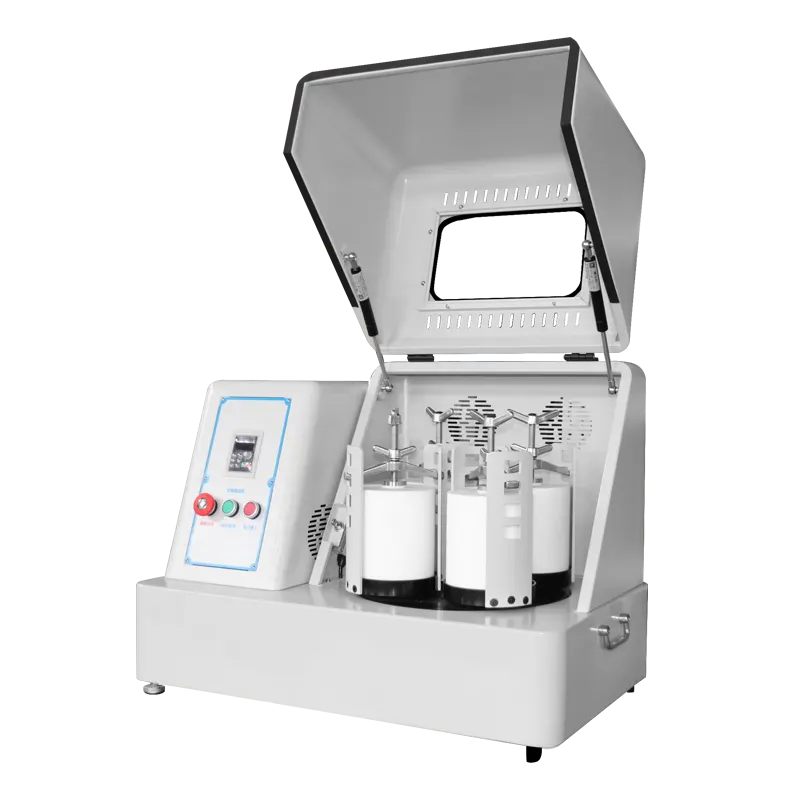
Core Functionality and Working Principle
The fundamental task of a laboratory planetary grinder is to transform bulk materials into fine or ultra-fine powders through a combination of impact, shear, and friction. The device consists of a rotating main disk (the sun wheel) and several grinding jars mounted on it. When the sun wheel rotates, each jar revolves around the center of the main disk while simultaneously spinning on its own axis in the opposite direction — a motion that mimics the orbits of planets in a solar system.
This dual-rotation creates powerful centrifugal forces and Coriolis forces that drive the grinding balls inside the jars to collide with each other, with the jar walls, and with the material. The resulting high-energy impacts can reduce particle sizes to as small as 0.1 microns or even nanometers. Key parameters influencing the final fineness include the rotation speed ratio (typically 1:2 between the sun wheel and the jars), the size and material of grinding balls, the grinding time, and the type of grinding (dry or wet).
Key Components and Technologies
Transmission System
Modern laboratory planetary grinders commonly use belt-driven or gear-driven transmissions. Belt-driven systems offer quieter operation and smoother acceleration, while gear-driven models provide higher torque and stability for heavy-duty applications. The TENCAN laboratory planetary grinder employs a metal wheel combined with high‑wear‑resistant polymer material for full rolling friction transmission, minimizing noise and wear, and eliminating the risk of gear breakage.
Grinding Jar and Media Options
To accommodate diverse materials and contamination requirements, the grinder can be equipped with jars made of various materials: stainless steel, zirconia, alumina, agate, nylon, PTFE, polyurethane, and tungsten carbide. Grinding balls of corresponding materials are also available. This flexibility allows the user to match the abrasive properties of the sample and avoid unwanted chemical contamination.
Control and Automation
Advanced models feature a programmable touch screen interface that allows users to set rotation speed, grinding time, pause intervals, and direction of rotation. Some models can store up to 10 programs, enabling reproducible processing for routine experiments. The ability to run continuously for up to 90 hours under full load makes the grinder suitable for long‑term batch processing.
Key Performance Indicators and Selection Guide
When selecting a laboratory planetary grinder, consider the following critical parameters:
- Processing Capacity: Usually expressed in terms of jar volume (e.g., 0.2 L to 20 L per jar). For lab use, 0.2 L to 1 L jars are common; for pilot production, larger jars may be needed.
- Final Particle Size: The grinder can achieve output sizes down to <0.1 μm (submicron) under optimal conditions. The achievable fineness depends on material hardness, grinding time, and ball size.
- Speed Range: Typical sun wheel speed ranges from 50 to 450 rpm, with jar speeds from 100 to 900 rpm. Higher speeds provide greater impact energy but may increase heat generation.
- Number of Stations: Most models offer 2 or 4 grinding stations, allowing simultaneous processing of multiple samples. Symmetrical arrangement of jars is recommended for balanced operation.
- Noise and Vibration: Belt‑driven designs generally operate more quietly. Look for models with oil‑sealing noise reduction technology for quieter lab environments.
- Maintenance and Durability: Rolling friction transmission (as in TENCAN design) reduces wear and extends service life. Easy access to the drive belt and motor simplifies maintenance.
Applications and Recommendations
The laboratory planetary grinder is widely used in geology, mineral processing, metallurgy, electronics, ceramics, chemicals, pharmaceuticals, cosmetics, environmental testing, and food science. Typical samples include ores, minerals, cement clinker, slag, ceramics, glass, polymers, pigments, coal, coke, soil, plant materials, and pharmaceuticals.
For most routine research, a standard 4‑station planetary grinder with 0.2‑1 L jars and a touch‑screen control is sufficient. If you need to process oxygen‑ or moisture‑sensitive materials, choose a model compatible with vacuum or inert gas grinding jars. For cryogenic grinding of heat‑sensitive samples, opt for a liquid nitrogen‑cooled version. Always consult the manufacturer’s technical team to confirm the best jar and ball material for your specific sample.