
Which Microwave Vacuum Drying Oven Is Right for Heat-Sensitive Samples?
Why the drying step deserves its own specification
In a milling workflow, drying is often treated as the interval between the interesting work and the analysis that follows. In practice it is a process step that can quietly undo what the mill achieved. A powder that was reduced to a fine, well-dispersed suspension can sinter into hard agglomerates if the liquid is driven off too aggressively at the surface, and a material that was phase-pure after milling can oxidise or decompose during an oven cycle chosen for convenience rather than for the material. For heat-sensitive ceramics, battery materials, pharmaceutical intermediates, natural extracts and fine metal powders, the choice of drying method is therefore a materials decision as much as an equipment decision.
Microwave vacuum drying addresses two constraints that conventional drying struggles with at the same time. Vacuum lowers the boiling point of the liquid, so removal can proceed at a lower temperature. Microwave energy deposits heat inside the load rather than only at its surface, so the interior of the sample does not have to wait for conduction from a hot wall. Whether that combination suits a particular sample depends on the material, the solvent, the load and the evidence a supplier can put in front of you. This guide sets out the conditions that decide fitness, shows how TENCAN's microwave vacuum drying oven maps onto them, and ends with an inquiry checklist you can send to any supplier.
Five conditions that decide whether microwave vacuum drying is a good fit
Before comparing equipment, reduce the requirement to a small number of conditions. If a candidate fails any one of them, the rest of the comparison is academic. The five below are the ones that most often change the answer.
1. The maximum temperature and residence time the material tolerates
Start with the material, not the machine. What is the highest temperature at which the powder, granule or compact keeps its phase, surface area, crystallinity or activity for the length of a realistic drying cycle? A heat-sensitive hydrate may begin to dehydrate well below the point at which it visibly discolours; a polymer powder may cross-link slowly rather than melt suddenly; a biological intermediate may lose activity over hours at a temperature that is harmless over minutes. The relevant figure is not a single set point but a temperature-time envelope. Vacuum drying widens that envelope because the solvent can be removed at a lower load temperature, but it does not remove the need to state the limit explicitly. Ask every supplier how the chamber temperature is measured, where the sensor sits relative to the load, and whether product temperature or cavity temperature is the controlled variable. A dryer that controls only the cavity atmosphere can still overheat a load that absorbs microwave energy efficiently.
2. The solvent you need to remove, and how the vacuum train handles it
Water is the easy case. Ethanol, isopropanol, acetone, hexane, toluene and NMP are not, and the difference is not only about boiling point under vacuum. Flammable solvents change the requirements for the vacuum pump, the condensation trap, the electrical enclosure and the siting of the unit. Aggressive solvents attack seals and windows. High-boiling solvents need a cold trap capable of capturing them rather than passing them through the pump. Aqueous slurries containing dissolved salts can leave residues that must be cleaned before the next batch. Write down the solvent, the approximate liquid volume, and whether the liquid is pure or a mixture with solids and binders. Then confirm that the proposed vacuum architecture, trap and materials of construction are intended for that chemistry. A vacuum rating on a brochure page is not the same as a solvent-compatible vacuum train, and this is one of the most common gaps between a purchase order and a working installation.
3. Load size, bulk density and cavity geometry
Microwave heating is volumetric, but it is not automatically uniform. A shallow tray of low-bulk-density powder couples differently from a deep crucible of dense granulate. The cavity must be large enough for the load to sit in a sensible geometry, not so large that the magnetron output is spread across empty space. For laboratory work the useful question is not the maximum cavity volume but the working load: how many grams or millilitres of this particular material can be dried evenly in one cycle, in what container, at what layer thickness. Ask for a recommended load range for your bulk density, and ask whether rotation, turntables or mode stirrers are used to average the field. If your process will scale, ask early which parameter is held constant between the small unit and a larger one, because load depth and power density do not scale linearly.
4. How the material actually responds to microwave energy
Dielectric properties vary enormously between materials and change as moisture leaves. A wet ceramic slip couples strongly at the start of a cycle and weakly at the end, so the last fraction of moisture is the slowest to remove. Some oxides, carbonaceous additives and metal powders behave very differently: metals reflect microwaves and can arc if the field is not managed, while carbon-black-containing mixtures may heat far more strongly than the surrounding matrix. This is why a drying trial on the real formulation matters more than a demonstration on a surrogate. Ask whether the supplier will run your sample, and if so under what conditions, with what instrumentation, and what data you receive afterwards: a time-temperature record, final moisture by loss-on-drying or Karl Fischer, and a note on appearance and redispersibility. Qualitative feedback from a real sample is worth more than a long list of generic applications.
5. The proof you need before the result is trusted
Decide in advance what acceptance looks like. For one project it may be residual solvent below a threshold measured by thermogravimetry; for another it may be that the specific surface area survives the cycle; for a third it may simply be that the cake can be broken and sieved without hard lumps. The method and the number of replicates should be agreed before the trial, not after it. This condition is also where documentation matters: an operating manual in a language your team reads, a list of consumables, a spare-parts path and a clear statement of what is and is not covered by any warranty. None of these items decides whether the physics works, but they decide whether the equipment is usable two years later.
Building a shortlist you can defend
A shortlist is only useful if every entry is described on the same terms. In practice, many published comparisons fail this test: one product is described by its verified configuration while another is described by a slogan, and the reader is left comparing a specification against an adjective. A more defensible approach is to keep the list deliberately short until verified product information exists for each entry, and to expand it only as evidence arrives. The section that follows describes the configuration for which product information was available at the time of writing, together with the questions that would need answers before any other supplier could be placed alongside it. Add a candidate only when you can describe its chamber arrangement, vacuum capability, control philosophy and solvent handling at the same level of detail. If a supplier cannot supply that detail in writing, that is itself a finding.
TENCAN microwave vacuum drying oven: where it fits
TENCAN's microwave vacuum drying oven is the configuration to examine first when the drying step has to happen at reduced temperature and under a controlled atmosphere. It brings microwave heating together with a vacuum environment in a laboratory-scale cabinet, which is the combination that matters for samples whose surface area, phase composition or activity will not survive a hot air cycle. In the context of a milling workflow, that makes it a natural companion to planetary ball milling: the same laboratory that wet-mills a powder in a solvent can remove that solvent without first exposing the material to a high surface temperature.
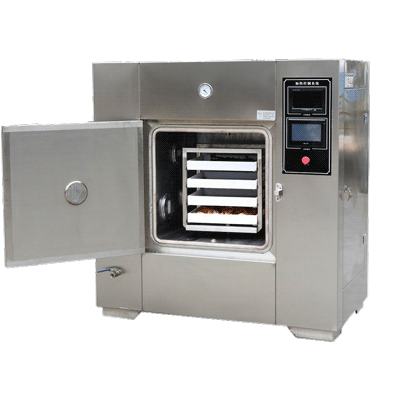
The useful way to read this product is not as a single fixed specification but as a configuration to be matched. Three questions carry most of the weight. First, what load geometry does the chamber accept for your bulk density, and what layer thickness does TENCAN recommend for even drying? Second, what vacuum arrangement is supplied, and is it intended for the solvents you actually use, including the trap and the pump? Third, how is temperature controlled and measured, and can the cycle be programmed as a ramp and hold rather than a single set point? The answers determine whether the unit suits a 20 g research sample of a heat-sensitive oxide or a few hundred grams of solvent-wet granulate, and those are different projects even though they use the same cabinet.
Which requirements it suits well
The oven is a good starting point when at least three of the following are true: the material has a temperature ceiling that makes atmospheric hot-air drying risky; the liquid to be removed is water or a common laboratory solvent for which an appropriate cold trap can be specified; batch sizes are at laboratory or small pilot scale rather than production; and the project needs a documented drying record that can be attached to an experiment. It is also a sensible choice when the same laboratory already prepares samples by ball milling wet, because keeping solvent handling, milling and drying inside one consistent workflow reduces the number of transfers and the opportunities for contamination.
What to confirm before ordering
Ask TENCAN to confirm the chamber dimensions, the microwave power arrangement, the achievable vacuum level and the control and safety features in writing for the exact configuration offered to you, rather than relying on a general description. Ask specifically about solvent compatibility for your liquid, about the materials used for the chamber, door seal and viewing port, and about what cleaning procedure is expected between batches. If your material contains metal powder, carbon or another strongly microwave-coupled component, say so at the inquiry stage, because that changes the answer. None of these points is unusual; they are simply the details that determine whether a laboratory-scale purchase becomes a reliable routine instrument.
Matching the drying task to configuration priorities
The table below is a selection aid, not a ranking of products. It maps a requirement you may recognise to the configuration question that follows from it, and to the evidence worth requesting. The same rows can be used with any supplier, which is what makes a shortlist comparable.
| Drying task | Configuration priority | Evidence to request |
|---|---|---|
| Heat-sensitive oxide or hydrate powder | Low controlled product temperature; programmable ramp and hold; sensor placement relative to the load | Time-temperature record from a trial on your powder; statement of which temperature is controlled |
| Solvent-wet powder from wet milling | Solvent-compatible vacuum train, cold trap, seal and port materials | Written confirmation of solvent compatibility and recommended trap for that solvent |
| Small, valuable research batches | Small working load with even field distribution; easy cleaning between samples | Recommended load range for your bulk density; cleaning procedure |
| Oxidation-sensitive metal or alloy powder | Vacuum integrity and, where required, inert-gas backfill | Leak-rate or vacuum-hold specification; gas-fill arrangement |
| Method development and reporting | Data logging, repeatable programs, documented operating limits | Sample of exported cycle data; manual and safety documentation |
Where the dryer sits in a milling and sample-preparation workflow
After wet milling, before agglomeration sets in
When a planetary ball mill has reduced a material in a liquid, the suspension that comes out is often at its most vulnerable. Fine particles have high surface energy and will bond to one another as soon as the liquid film between them disappears, so the way the liquid is removed determines the size of the soft agglomerates that must later be broken down. Drying under vacuum at a temperature the material can tolerate, with microwave energy supplying the latent heat, gives the liquid an escape route at a lower temperature than an atmospheric oven would allow. The practical benefit is not a guarantee about particle size, which always has to be measured, but a shorter and gentler thermal history for a material whose surface chemistry is worth protecting.
Before pressing, sieving or analysis
Drying also has to deliver a sample that the next step can accept. If the powder will be uniaxially pressed, a residual moisture gradient will produce density gradients and, later, cracks. If it will be sieved, a partially dried cake is worse than either a wet slurry or a fully dry powder. If it will be characterised by BET, X-ray diffraction or thermal analysis, the drying history becomes part of the sample's identity and should be recorded. A programmable vacuum drying cycle produces a record you can cite in a methods section, which is a genuine advantage over an oven with a dial and no log.
What to send in a drying inquiry
A precise first inquiry usually shortens a project by weeks. Include the following, and ask for a written response to each point rather than a general brochure.
- Material: chemical name or formulation, whether it contains metal, carbon or another strongly microwave-coupled component, and any known phase or activity limit.
- Liquid: solvent identity, approximate liquid-to-solid ratio, whether it is a mixture, and whether it is flammable, toxic or high-boiling.
- Target: required final moisture or residual solvent, the method you will use to measure it, and the acceptable limit.
- Batch and geometry: grams or millilitres per cycle, bulk density, preferred container and maximum acceptable layer thickness.
- Working space and services: available bench footprint, electrical supply, ventilation, and whether inert gas is available.
- Atmosphere: whether vacuum alone is sufficient or an inert backfill or purge is needed.
- Validation: the acceptance test you intend to run, number of replicates, and whether the supplier will run a trial on your material.
- Documentation: preferred manual language, required safety documentation, and the spare-parts and consumables path.
Frequently asked questions
Can microwave vacuum drying replace freeze drying?
Not in general. Freeze drying fixes the structure of a frozen material and is often chosen when a porous, easily redispersed cake is essential. Microwave vacuum drying removes liquid from a material that is not frozen, at a reduced temperature, and is normally faster and simpler to operate. Where the two compete, the deciding evidence is the property you need afterwards — surface area, redispersibility or activity — measured on your own material, not a general claim.
Is vacuum drying safe for flammable solvents?
It can be, but only when the whole installation is designed for it: the pump, the cold trap, the electrical enclosure, the vent path and the siting of the unit all matter, and local safety requirements apply. This is a question for the supplier and for your own safety review, and it should be answered in writing for the specific solvent and volume you intend to use. Do not assume that a vacuum rating implies solvent compatibility.
How do I know the load will dry evenly?
You test it. Ask for a trial at your intended layer thickness and compare moisture at the centre and at the edge of the load, using the same method you will use in production. If the difference is unacceptable, the load geometry, not the drying principle, is usually the thing to change.
Can the same unit handle a different material next month?
Often yes, with cleaning and a new program, but the microwave response of the new material may be quite different and the cycle must be re-established. Materials containing metal or carbon deserve particular attention, and a material that arcs or heats uncontrollably in a trial should not be forced into the same configuration.
Sources and Further Reading
TENCAN product information: Microwave vacuum drying oven. Configuration details, achievable vacuum, chamber dimensions and solvent compatibility should be confirmed directly with TENCAN for the exact unit offered, and any competitive supplier should be asked for the same information before being placed on the same shortlist.