
Microwave Vacuum Drying Oven for Powder Drying: How It Works and When to Choose It
Why Consider a Microwave Vacuum Drying Oven for Powder Processing?
Drying powders in a laboratory or production environment often presents a common challenge: how to remove moisture or solvents quickly without damaging the material's structure, composition, or particle size. Conventional hot air ovens can take hours and may cause surface crusting, oxidation, or thermal degradation. Vacuum ovens reduce the boiling point of liquids but still rely on slow conductive heat transfer. A microwave vacuum drying oven addresses both limitations by combining direct volumetric heating with a controlled low-pressure environment. This makes it an attractive option for researchers and engineers working with heat-sensitive, easily oxidized, or complex powder formulations.
In this article, we will walk through the working principle of a microwave vacuum drying oven, its typical applications in powder processing, and the key factors to consider when selecting one for your lab or pilot-scale operations.
How Does a Microwave Vacuum Drying Oven Work?
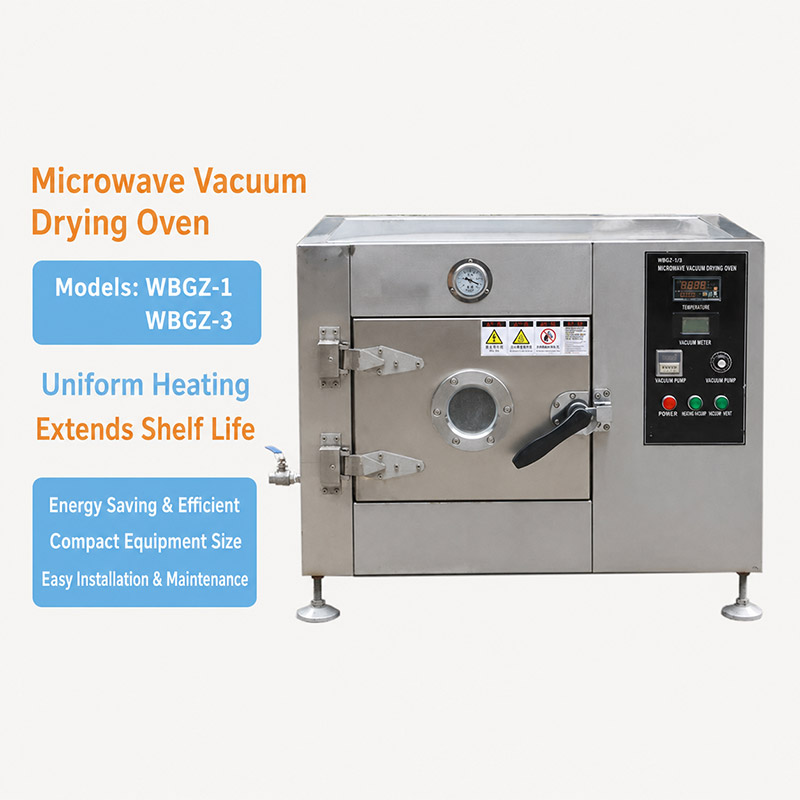
A microwave vacuum drying oven integrates two technologies that are often used separately: microwave heating and vacuum drying. The microwave generator (typically operating at 2450 MHz, the same frequency used in domestic microwave ovens) produces an electromagnetic field that penetrates the material. Polar molecules, such as water, rotate rapidly in response to this alternating field, generating heat through molecular friction. Unlike conventional heating, which transfers heat from the surface inward, microwaves heat the entire volume of the material simultaneously. This allows for much faster drying rates and more uniform temperature distribution.
The vacuum chamber, on the other hand, reduces the atmospheric pressure inside the oven. Lowering the pressure decreases the boiling point of water and other solvents, so they can evaporate at significantly lower temperatures. For example, water boils at around 60°C at a vacuum level of approximately 20 kPa, compared to 100°C at standard atmospheric pressure. This is especially valuable for materials that degrade, discolor, or undergo phase changes at elevated temperatures.
When microwave energy and vacuum are applied simultaneously, the combination offers several advantages for powder drying:
- Rapid drying speed: Microwaves deliver energy directly to the moisture, creating internal vapor pressure that drives liquid to the surface quickly.
- Low-temperature drying: Vacuum reduces the boiling point, so the material never needs to experience high temperatures.
- Uniformity: Volumetric heating minimizes the risk of over-drying the surface while leaving the core wet.
- Energy efficiency: Less energy is wasted heating the oven walls or the surrounding air.
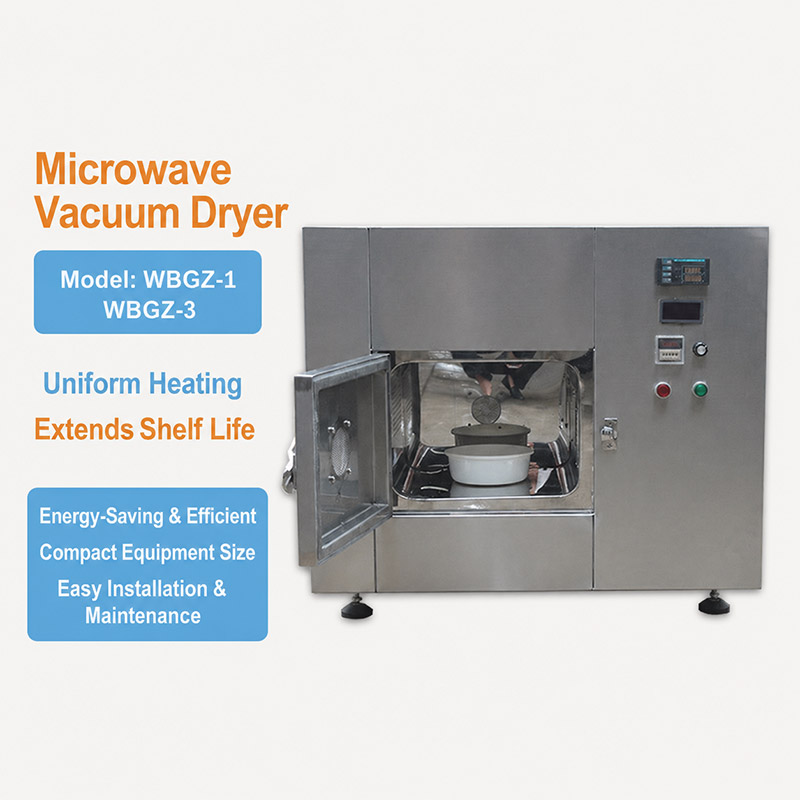
Many modern microwave vacuum drying ovens also include a stirring or rotating mechanism inside the chamber. This helps to redistribute the powder during drying, preventing hot spots and ensuring even exposure to the microwave field. A programmable logic controller (PLC) or touchscreen interface allows the operator to set temperature, microwave power, vacuum level, and drying time, making the process repeatable and documentable.
Typical Applications in Powder Drying
Handling Heat-Sensitive and Oxidizable Materials
One of the most common use cases for a microwave vacuum drying oven is drying pharmaceutical powders, herbal extracts, enzymes, and biological samples. These materials often contain active ingredients that can be destroyed by sustained high temperature. The low-temperature environment under vacuum preserves their chemical integrity while the microwave energy quickly removes moisture.
Similarly, fine metal powders, such as those used in additive manufacturing or powder metallurgy, are highly susceptible to oxidation at elevated temperatures. Drying them under vacuum with microwave assistance minimizes exposure to oxygen and reduces the risk of surface oxidation. The same principle applies to certain ceramic precursors, catalysts, and battery electrode materials that require careful moisture control without compromising particle morphology.
Moisture Removal from Complex Powders and Granules
When dealing with powders that have a high tendency to agglomerate or form a hard crust during conventional drying, a microwave vacuum drying oven can be particularly effective. The internal vapor pressure generated by microwave heating helps break up liquid bridges between particles, promoting a free-flowing final product. In addition, the optional stirring mechanism can physically break apart any lumps that form during the drying process.
For example, in the food and agricultural industries, drying fruit powders, protein isolates, or starch-based materials often results in undesirable browning or loss of volatile aroma compounds. Microwave vacuum drying has been shown to preserve color, flavor, and nutritional content better than hot air drying or freeze drying, while achieving comparable or faster drying times.
Solvent Recovery and Removal
In chemical and materials research, powders are often synthesized or processed in organic solvents. Removing these solvents after synthesis is a critical step, especially when the solvent is flammable, toxic, or expensive. A vacuum system can be paired with a condenser to recover the evaporated solvent, reducing waste and improving safety. The microwave energy accelerates the evaporation rate, shortening the overall process cycle.
Key Considerations When Selecting a Microwave Vacuum Drying Oven
Chamber Volume and Sample Capacity
Laboratory-scale microwave vacuum drying ovens typically have chamber volumes ranging from about 10 liters to 50 liters, with some models offering larger capacities for pilot production. The actual usable volume is smaller than the total chamber volume because the microwave field distribution and the space occupied by trays or stirring mechanisms must be considered. For small batch testing (e.g., 50–500 grams of powder), a compact benchtop unit is usually sufficient. If you plan to dry larger quantities, you should evaluate the available tray area and the maximum sample depth to ensure uniform drying.
Microwave Power and Control
Microwave power output is typically adjustable from a few hundred watts to several kilowatts, depending on the model. For most powder drying applications, a power range of 0–1000 W (for lab units) or 0–3000 W (for larger systems) is common. The ability to modulate power in fine increments allows you to control the drying rate precisely. If the power is too high for a given sample, the rapid internal heating can cause local boiling, spattering, or even damage to the microwave source. Therefore, variable power control and a feedback temperature sensor are important features.
Vacuum Level and Pump Compatibility
The vacuum level achievable in the chamber depends on the vacuum pump used. Many laboratory microwave vacuum drying ovens can reach a vacuum of about -0.098 MPa (approximately 2 kPa absolute pressure) with a standard oil-sealed or dry vacuum pump. For heat-sensitive materials, a deeper vacuum is beneficial, but it also requires a higher-quality pump and better sealing. Consider whether you need a corrosion-resistant pump if the evaporated solvent is acidic or organic.
It is also worth noting that at very low pressures, some materials may foam or expand dramatically. A viewing window on the chamber door allows you to monitor the process and adjust parameters accordingly.
Temperature Measurement and Control
Accurate temperature measurement inside a microwave field is challenging because conventional thermocouples can be affected by the microwave energy. Many modern vacuum drying ovens use infrared (IR) pyrometers or fiber-optic temperature sensors to measure the sample surface temperature without interference. The control system should maintain the temperature within a narrow range (typically ±1°C or better) to ensure consistent drying results across batches.
Safety Features
Working with microwave energy under vacuum requires careful safety design. Look for features such as:
- Multiple interlocks that prevent the microwave from operating when the door is open.
- Microwave leakage monitoring (certified to meet international standards, e.g., below 5 mW/cm²).
- Over-temperature protection and automatic shutdown.
- Ventilation and pressure relief valves to prevent overpressure in case of solvent vapor buildup.
If you are drying flammable solvents, additional explosion-proof modifications may be required. Always consult the manufacturer about the specific safety certifications for your intended application.
Comparing Microwave Vacuum Drying with Other Drying Methods
It is helpful to understand where a microwave vacuum drying oven fits among the common drying options available in a powder processing lab.
| Method | Drying Temperature | Speed | Uniformity | Best For |
|---|---|---|---|---|
| Hot air oven | High (typically 80–200°C) | Slow | Good for thin layers | Non-sensitive materials, high throughput |
| Vacuum oven (conductive) | Low to moderate | Moderate | Depends on contact | Heat-sensitive materials, small batches |
| Freeze dryer | Very low (below 0°C) | Very slow | Excellent | Biologicals, pharmaceuticals, high value |
| Microwave vacuum oven | Low to moderate | Fast | Good (volumetric) | Heat-sensitive, fast drying, moderate cost |
As a practical reference, a microwave vacuum drying oven can often reduce drying time to 10–30% of that required by a conventional vacuum oven, depending on the material and moisture content. However, the final moisture level and particle integrity should always be verified experimentally for each specific powder.
Selecting the Right Configuration from TENCAN
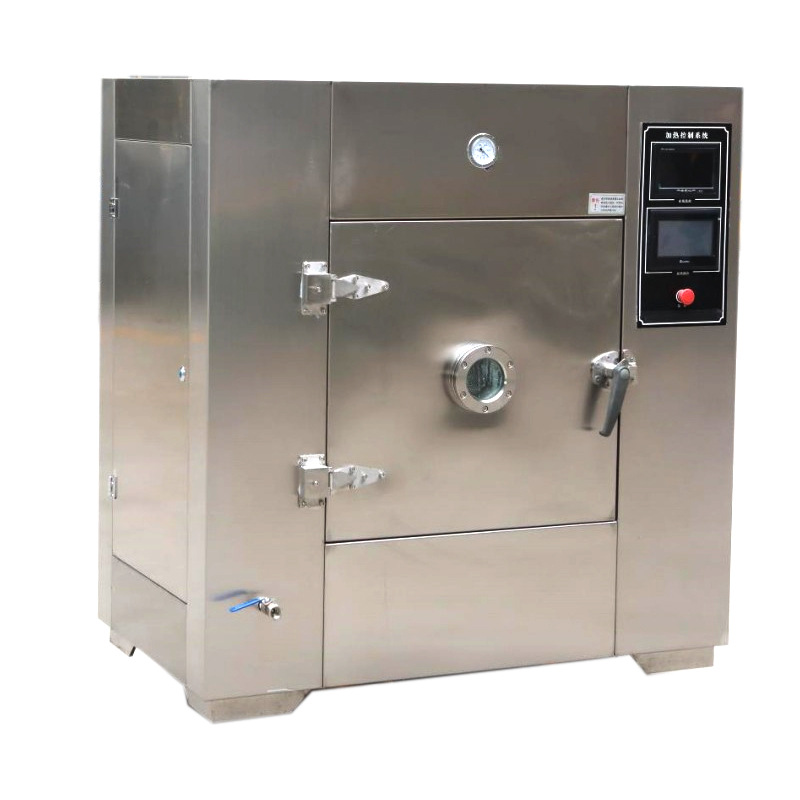
At TENCAN, we offer a range of microwave vacuum drying ovens designed for laboratory and pilot-scale powder drying. Our models feature stainless steel chambers, programmable touchscreen controllers, infrared temperature measurement, and a built-in stirring mechanism for improved uniformity. We also provide compatible vacuum pumps and condensers for solvent recovery systems.
When you contact us for a quotation, it helps to prepare the following information:
- Material name and composition
- Initial moisture or solvent content
- Target moisture level
- Batch size per run
- Temperature sensitivity (maximum allowable temperature)
- Any special requirements (e.g., inert gas purging, explosion-proof, vacuum level)
With this information, our engineers can recommend the appropriate chamber size, microwave power, and vacuum configuration to match your specific drying needs. We also offer circulation ovens and other drying solutions if microwave vacuum drying is not the optimal choice for your material.
Choosing the right drying equipment is a critical step in powder processing. A microwave vacuum drying oven can be a powerful tool when you need fast, gentle, and uniform drying for delicate or oxidation-sensitive powders. By understanding the principles and limitations outlined above, you can make a more informed decision for your lab or production line.