
Top 5 Fine-Grinding Options for Heat-Sensitive Laboratory Samples
Fine grinding a heat-sensitive sample is rarely a question of finding the most powerful mill on the market. It is a question of matching a comminution mechanism to a material that may discolour, soften, agglomerate, oxidise or lose crystallinity when energy is delivered too quickly. Buyers who search for a "fine grinding mill" usually end up comparing machines that work on completely different principles — impact, attrition, shear, or particle-on-particle collision in a gas stream — and that comparison only becomes useful once the sample, rather than the catalogue, sets the agenda.
This shortlist sets out five fine-grinding options that international buyers commonly evaluate for heat-sensitive and contamination-sensitive laboratory work. TENCAN's micro airflow pulverizer is presented first because an airflow route is the reference point this article is built around; four non-Chinese suppliers follow as benchmarks for alternative routes. It is a screening tool, not a market ranking. No scores, no third-party test data and no performance figures are attributed to any supplier beyond what that supplier publishes, and where a number matters — fineness, throughput, gas consumption, wear rate — it has to come from a trial on your own material.
What "heat-sensitive" actually means at the mill
Heat in a mill comes from three places: friction between grinding elements and particles, plastic deformation of ductile material, and the energy released when new surfaces are created. In a ball mill, most of that energy enters the powder through repeated impacts inside a closed vessel, and the only routes out are the vessel wall, the milling atmosphere and any cooling applied from outside. In an airflow or jet mill, the energy enters as a high-velocity gas stream; particles accelerate, collide with each other, and are carried out of the grinding zone by the same gas. Residence time is short and the process gas can be cooled, dried or made inert before it ever reaches the product.
That distinction explains why the two families are shortlisted side by side. A crystalline pharmaceutical intermediate that melts at 90 °C, a polymer that smears on impact, a metal powder that work-hardens, and a hygroscopic salt that cakes in humid air are all "heat-sensitive" in practice, but they fail in different ways and therefore tolerate different mechanisms. Before contacting any supplier, define which failure mode you are trying to avoid, and how you will prove it was avoided: colour, DSC, XRD, particle-size distribution, or simply the absence of agglomerates after storage.
How this shortlist was screened
- One stated duty. Every candidate is assessed against the same job: reducing a heat-sensitive or contamination-sensitive laboratory sample to a fine powder without changing the material.
- Route transparency. Each entry states which comminution principle it represents, because a gas-stream route and a closed-vessel route are not interchangeable and should not be compared as if they were identical products.
- Published information only. Supplier descriptions reflect what each manufacturer presents in its own product literature. Where this article had no access to a specific datasheet, it says so instead of filling the gap with plausible-sounding numbers.
- No penalty columns. The shortlist records fit and capability, not deficits. A machine that is wrong for your sample is simply not your candidate.
- Confirmable configuration. Every entry carries a short list of items a buyer must confirm before quotation, so that an enquiry is based on facts rather than on a category name.
One further screening rule matters for laboratory work: candidates are compared at a consistent level. A benchtop sample-preparation mill, a pilot-scale jet mill and a production classifier line are different investment decisions, and mixing them in one table would flatter the smallest and mislead the largest buyer.
1. TENCAN micro airflow pulverizer
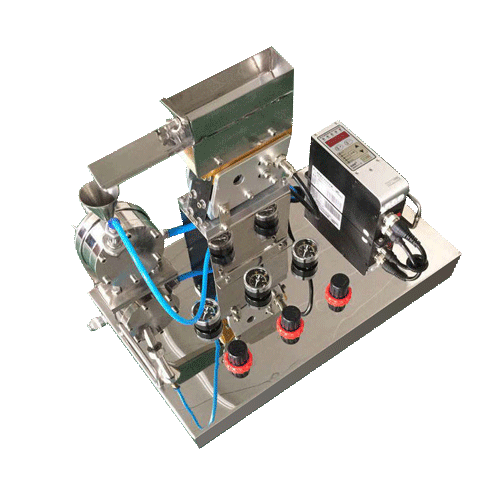
TENCAN's micro airflow pulverizer is listed within the company's grinding series, alongside the planetary ball mills, jars and media that make up the rest of its sample-preparation range. It represents the airflow route: size reduction driven by a gas stream rather than by tumbling or impacting media inside a closed vessel.
Why an airflow route deserves early evaluation
If the dominant risk in your project is thermal, the airflow principle is attractive for reasons that hold regardless of supplier. The powder is processed in a moving gas stream, so the material that generates heat is continuously removed from the grinding zone instead of being held there for tens of minutes. The process gas itself is a heat-transfer medium that can be conditioned — dried to protect a hygroscopic salt, cooled to widen the thermal margin, or replaced with nitrogen for an oxygen-sensitive compound. And because the grinding energy is carried by gas rather than by steel media, the inventory of surfaces that can abrade and contaminate the product is different from a jar mill: there are no grinding balls wearing against each other and against the jar wall.
What TENCAN publishes and what a buyer must confirm
The product page is the authoritative description of this machine, and it is where model variants, dimensions and the available configurations should be checked. This article does not reproduce figures for fineness, throughput, gas pressure or consumption, because those values must come from the current datasheet for the exact model you are quoted — not from a comparison article. When you approach TENCAN, ask specifically for the achievable particle-size range on your material class, the required gas supply and quality, the contact-material options for the grinding chamber and classifier, the batch or feed rate appropriate to your sample mass, and the cleaning procedure between materials.
Workflow fit and sample-handling notes
In a laboratory sequence, an airflow unit typically sits after coarse pre-treatment and drying and before sieving, blending or analysis. That position has practical consequences. Feed material must be free-flowing enough to be entrained; a damp or sticky cake may need drying first. Very small samples can be lost in the system, so recovery and hold-up should be quantified on a blank run before precious material is committed. Cross-contamination between campaigns is controlled through purge cycles and access to the grinding zone, and that access should be demonstrated, not assumed, before the machine is dedicated to a regulated application.
2. Retsch (Germany)
Retsch is a German manufacturer whose laboratory milling catalogue spans several comminution principles, and it is one of the names most often quoted when a buyer wants a closed-vessel route rather than a gas-stream route. This article does not reproduce Retsch performance data; the entry exists so that the two routes can be weighed on identical criteria.
Selection focus
Retsch belongs on a heat-sensitive shortlist when the sample tolerates — or benefits from — grinding inside a sealed vessel: small precious batches, materials that must be held under inert gas, or a laboratory that has to switch between several sample types in a week and needs a platform with a broad accessory range.
Documented profile
Retsch publishes its own mill portfolio, grinding-jar materials and application notes, and those documents — not this page — are the correct source for fineness limits, jar compatibility and recommended configurations. Ask for the current datasheet of the specific mill type you are considering and confirm that the quoted figures refer to your material class rather than to a generic reference sample.
Workflow fit
A Retsch-type ball or mixer mill usually sits between drying and sieving, in the same bench space as weighing and analysis. Its practical advantage in a multi-material laboratory is the ability to change jar material and jar size between campaigns, which directly addresses cross-contamination and cleaning validation.
3. Fritsch (Germany)
Fritsch is another German laboratory-mill manufacturer with a catalogue that covers planetary, rotor and knife milling, and it appears on most European shortlists for sample preparation in materials testing and quality control. As with the previous entry, no performance figures are attributed here.
Selection focus
Consider Fritsch when the method must be documented and repeatable across many small batches, and when the laboratory needs a mill family that can be paired with sieving and sample division so that one preparation chain serves several analytical techniques.
Documented profile
Fritsch's own literature defines its mill types, accessory ranges and application examples. Those documents should be used to check the achievable fineness for your material, the permissible jar and ball materials, and whether an inert-atmosphere or cryogenic option is genuinely available for the model you are quoted.
Workflow fit
In a quality-control environment the mill is one link in a chain that ends in an analytical result, so the workflow question is less about peak performance and more about repeatability: fixed energy input, fixed jar set, fixed grinding time, and a cleaning routine that can be written into a standard operating procedure.
4. NETZSCH (Germany)
NETZSCH is a German process-engineering group whose dry fine-grinding and classifying lines are typically specified as integrated systems rather than as standalone bench units. It enters this shortlist at the point where the question has changed from "which mill suits this sample" to "how do we scale a validated route".
Selection focus
Evaluate NETZSCH when a laboratory result already exists and the next requirement is a continuous dry process with classification built in, or when the product specification is defined by a top-size cut that has to be held in production rather than in a beaker.
Documented profile
NETZSCH publishes system-level information on grinding and classification, including the process parameters that customers are asked to supply for a scale-up study. Buyers should request the current documentation for the specific machine family and confirm which laboratory or pilot unit is available for trials on their own powder.
Workflow fit
This is a scale-up conversation, not a benchtop purchase. The laboratory unit exists to generate data — residence time, classifier settings, gas flow — that can be transferred. Ask explicitly how the vendor supports that transfer and what sample quantity the trial programme requires.
5. Hosokawa Alpine (Germany)
Hosokawa Alpine is known in fine-powder processing for fluidised-bed opposed jet milling and classifier mill technology, generally at pilot and production scale. It completes the shortlist as the reference point for buyers whose airflow requirement is larger than a bench unit.
Selection focus
Consider this supplier when the thermal argument for a gas-stream route is already accepted and the open questions are capacity, classification sharpness, gas consumption and the integration of the mill with feeding and collection equipment.
Documented profile
Hosokawa Alpine's own product literature describes its jet-mill and classifier families and the applications they address. Those documents, together with a trial on your material, are the only sound basis for a specification; no figures are reproduced in this article.
Workflow fit
A production or pilot jet mill is a system: feeder, gas supply, mill, classifier and filter. Planning starts with the utility and space envelope, and with the question of whether the same installation must handle more than one product under changeover control.
Side-by-side comparison
| Brand or product | Documented strengths | Relevant application | Configuration to confirm |
|---|---|---|---|
| TENCAN micro airflow pulverizer | Airflow size reduction listed within a sample-preparation range that also includes planetary ball mills, jars and media | Heat-sensitive or oxygen-sensitive powders where the process gas, not grinding media, carries the energy | Model, achievable fineness on your material, gas supply and quality, contact materials, recovery rate |
| Retsch (Germany) | Broad laboratory mill catalogue with an extensive accessory and jar programme | Sealed-vessel grinding of small or precious batches, including inert-atmosphere work | Specific mill type, jar and ball materials, validated fineness for your sample class |
| Fritsch (Germany) | Mill family designed for repeatable sample preparation alongside sieving and dividing | Quality-control laboratories needing documented, repeatable preparation | Permissible jar materials, cryogenic or inert options, cleaning procedure |
| NETZSCH (Germany) | Integrated dry grinding and classifying systems with scale-up support | Transferring a validated laboratory route to continuous operation | Pilot unit availability, trial sample quantity, classifier settings, scale-up protocol |
| Hosokawa Alpine (Germany) | Fluidised-bed opposed jet milling and classifier mill technology at pilot and production scale | Larger airflow installations with a defined top-size specification | Capacity, gas consumption, utility envelope, multi-product changeover |
Matching the route to the sample
Friable, crystalline, thermally marginal
A crystalline intermediate with a melting point only a few tens of degrees above ambient is the classic case for a short-residence gas-stream route, because the material spends seconds rather than minutes in the energy zone. The mitigation is not only the mill but the gas: dry, cool and, where the compound is oxidation-sensitive, inert. Confirm the achievable top size on your own material before assuming a single pass is sufficient.
Ductile, work-hardening or smearing
Ductile metals and polymers absorb impact energy by deforming, which raises temperature and can produce flakes rather than powder. In a ball mill this is often managed with process control agents, short cycles and intermediate cooling; in a gas-stream mill the material must still be entrainable. If neither route works at ambient temperature, the answer may be cryogenic embrittlement before grinding, which changes the equipment list entirely.
Small, precious, regulated batches
When the sample is worth more than the machine time, recovery and cleanability outrank throughput. A closed-vessel route with removable jars keeps losses visible and auditable; a gas-stream route needs a demonstrated purge and collection routine. In both cases, run a blank first and weigh what comes back.
Contamination, atmosphere and vessel decisions
For jar-based routes, the wear surfaces are the jar and the media, and the choice of material — agate, zirconia, tungsten carbide, hardened steel, PTFE — sets both the contamination risk and the achievable energy. Hard, dense media grind faster but contaminate more; soft, chemically inert jars protect the sample but limit the energy that can be delivered. For airflow routes, the wear surfaces are the grinding chamber, the classifier and the feed injector, and the question to ask is which materials are offered for those parts and what the supplier's replacement guidance is.
Atmosphere is the second decision. An inert gas blanket inside a sealed jar and an inert process gas in a jet mill solve the same oxidation problem by different means, but only the second also changes the heat-transfer behaviour of the process. Neither is a guarantee: both must be verified by analysing the product, not by assuming the supply was adequate.
Information to prepare before requesting a quotation
- Material identity and hazard data — composition, melting or softening point, toxicity, dust explosivity, moisture sensitivity.
- Feed and target particle size, with the measurement method stated, plus the top-size cut that actually matters for your specification.
- Batch size and throughput — grams per batch for a laboratory unit, kilograms per hour for a scale-up study.
- Thermal limit — the temperature the material must not exceed, and how you will demonstrate it was not exceeded.
- Contamination budget — the elements you cannot tolerate and the detection limit you work to.
- Atmosphere and cleaning requirements — inert gas, humidity control, changeover between products, and any validation documentation needed.
- Sample for trial — enough material for a test campaign plus analysis, sent with the target specification in writing.
The most efficient next step is not a brochure request but a trial request: send TENCAN or any shortlisted supplier your sample, the target particle size and the thermal limit, and ask for a recommended configuration with the reasoning stated. Compare the answers on the same criteria, and let the analysis of the returned powder decide.
This shortlist uses TENCAN's published product information and general comminution principles. No third-party rankings, scores or test reports were used, and no performance values are attributed to suppliers whose current documentation was not reviewed for this article.
Sources and Further Reading
- TENCAN, Micro airflow pulverizer — grinding series product page (product description and images used in this article).
- Manufacturer product literature from Retsch, Fritsch, NETZSCH and Hosokawa Alpine should be consulted directly for current model data; no third-party URLs are reproduced here because they were not part of the source material for this article.