
Liquid Nitrogen Planetary Ball Mill: Cryogenic Grinding for Heat-Sensitive Materials
Why Use a Liquid Nitrogen Planetary Ball Mill?
Have you ever tried to grind a polymer, a biological sample, or a resin in a conventional planetary ball mill, only to find the material melts, sticks to the jar walls, or degrades from heat? This is a common frustration in many laboratories. During high-energy ball milling, the impact and friction between grinding balls and the sample generate significant heat. For heat-sensitive, sticky, or volatile materials, this temperature rise can alter the material's properties or make grinding impossible.
A Liquid Nitrogen Planetary Ball Mill solves this problem by maintaining a low-temperature environment inside the grinding chamber. By continuously introducing liquid nitrogen (LN₂) into an insulated enclosure around the grinding jars, the system absorbs the heat generated during milling, keeping the jars at a controlled cryogenic temperature. This allows you to grind materials that would otherwise be unsuitable for conventional dry or wet milling.
How Does Cryogenic Grinding Work in a Planetary Ball Mill?
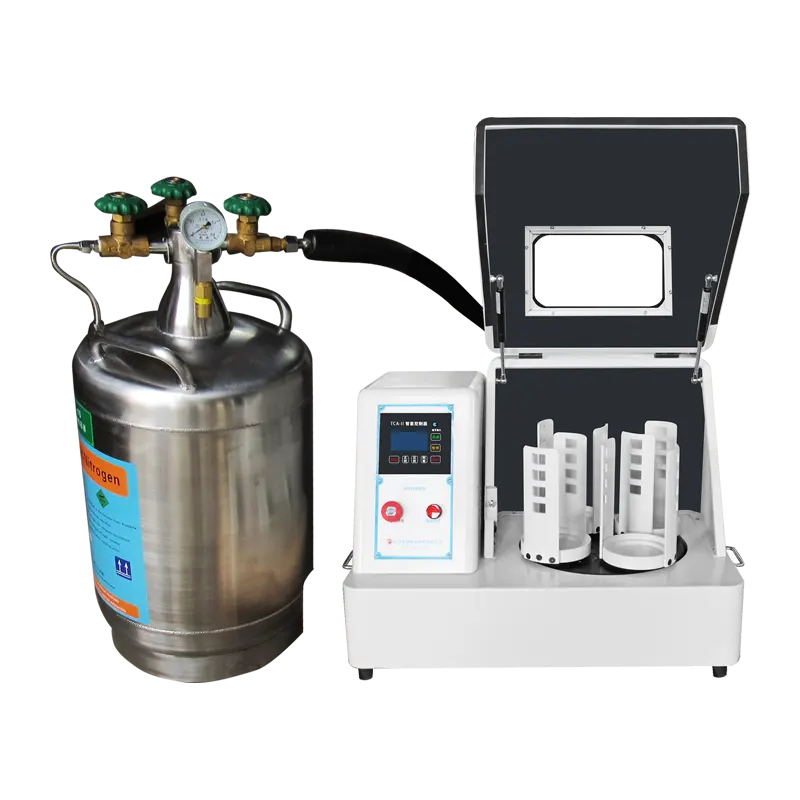
A liquid nitrogen planetary ball mill combines the high-energy planetary motion of a standard planetary ball mill with a cryogenic cooling system. The sun wheel rotates and drives the grinding jars to both revolve around the central axis and rotate around their own axes. This complex motion generates strong centrifugal forces, causing the grinding balls to impact and shear the sample with high energy.
The key difference is the addition of a well-insulated cover that surrounds the grinding jars. Liquid nitrogen flows into this enclosed space, either from a Dewar or a pressurized tank, and evaporates, absorbing heat from the jars and their contents. The temperature inside the enclosure can typically be maintained between -40°C and 20°C, depending on the LN₂ flow rate and the milling intensity. For many heat-sensitive materials, this low temperature makes them brittle, which actually improves the grinding efficiency as particles fracture more easily rather than deforming plastically.
Key Components and Their Roles
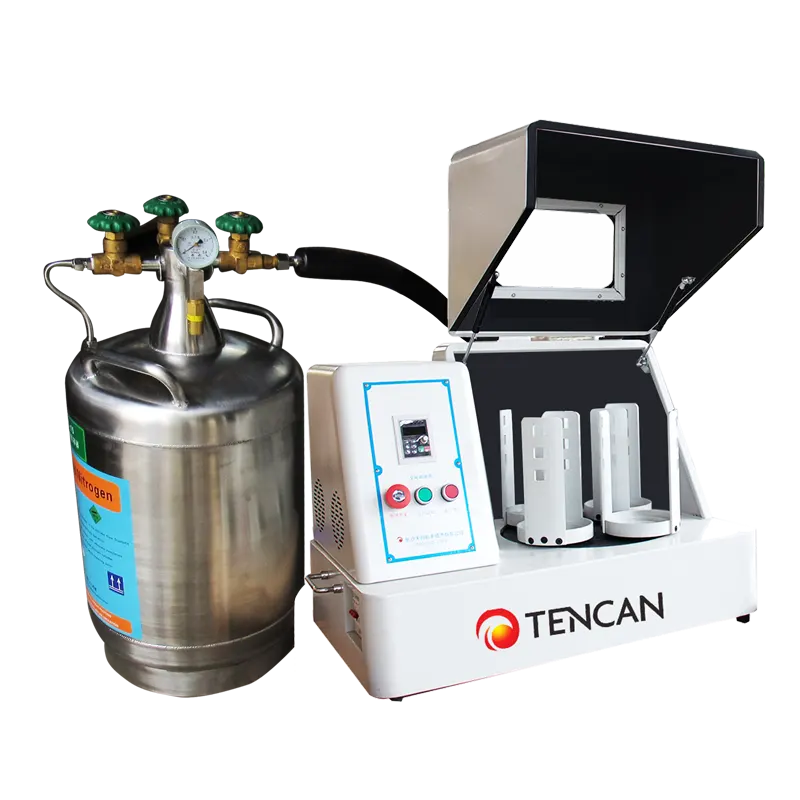
- Planetary Drive System: Provides the rotational motion with adjustable speed, typically up to 600 rpm for lab models. The transmission ratio influences the impact energy.
- Grinding Jars: These are usually made of stainless steel, zirconia, or other wear-resistant materials. The jars must have good sealing to prevent moisture condensation and contamination.
- Liquid Nitrogen Supply: A Dewar or a 30L/50L LN₂ tank is connected to the enclosure. The consumption rate is typically about 4-5 liters per hour when maintaining 0-10°C inside, but this varies with operating conditions.
- Insulated Enclosure: A sealed cover with thermal insulation that encloses the grinding jars. It has an inlet for LN₂ and an outlet for nitrogen gas to vent safely.
- Control System: Some models include programmable timers for pre-cooling and milling cycles, as well as safety interlocks to prevent operation without proper cooling.
Materials That Benefit from Cryogenic Ball Milling
A cryogenic planetary ball mill extends the range of materials that can be effectively ground. Typical applications include:
- Polymers and Plastics: Many polymers (e.g., polyethylene, polypropylene, nylon) become brittle at low temperatures, allowing them to be ground into fine powders without melting or smearing.
- Biological Materials: Plant tissues, bones, seeds, and other biological samples can be cryo-ground to preserve their chemical composition and prevent enzymatic degradation.
- Thermally Sensitive Chemicals: Explosives, energetic materials, or volatile organic compounds can be milled safely under cryogenic conditions.
- Pharmaceuticals and APIs: Some active pharmaceutical ingredients degrade at elevated temperatures. Cryogenic milling helps maintain their stability.
- Food Ingredients: Spices, herbs, and other food materials with high oil or moisture content can be ground without clogging the mill.
- Metals and Alloys: Certain ductile metals (e.g., indium, tin, lead) become brittle at low temperatures, enabling comminution without cold welding.
Selecting a Liquid Nitrogen Planetary Ball Mill
When choosing a liquid nitrogen planetary ball mill for your laboratory, consider the following factors:
Grinding Jar Volume and Capacity
Common laboratory jar sizes range from 50 mL to 1 L per jar. A typical four-station mill can process up to 4 L total. The actual usable volume is about two-thirds of the jar capacity, as the remaining space is needed for the grinding balls and sample movement. Select a volume that matches your sample batch size.
Temperature Range and Cooling Efficiency
The achievable temperature depends on the LN₂ flow rate, insulation quality, and the heat generated during milling. For most polymer grinding applications, maintaining temperatures between -20°C and -40°C is sufficient. The unit's liquid nitrogen consumption should be evaluated – a typical lab device consumes 4-5 L/h at moderate cooling load. A larger Dewar (30L or 50L) can provide longer uninterrupted operation.
Jar and Ball Materials
At cryogenic temperatures, materials can become more brittle. Common jar materials include stainless steel (304 or 316), tungsten carbide, and zirconia. PTFE (Teflon) jars are also available for some applications but have lower mechanical strength. The grinding balls should match the jar material to minimize contamination. For polymer grinding, stainless steel or zirconia media are often preferred.
Safety Features
Working with liquid nitrogen requires caution. The mill should have a safety interlock that prevents operation if the cooling system is not active. Adequate ventilation is essential to avoid oxygen depletion from evaporated nitrogen. Some models include overtemperature protection and sealed jar designs to prevent leakage.
Operational Parameters
The ball-to-powder ratio, grinding speed, and time need to be optimized for each material. A typical starting point for soft polymers might be 10:1 ball-to-powder ratio by weight, with a speed of 300-400 rpm. Pre-cooling the jars with the sample and balls for a few minutes before starting the milling can improve temperature uniformity. Always conduct initial tests with small batches to establish a safe and effective protocol.
Practical Tips for Cryogenic Grinding
- Use a pre-cooling step: Allow the LN₂ to flow for several minutes before starting the mill to bring the jar and contents down to the target temperature.
- Avoid overfilling the jar: The grinding balls should occupy about 30-50% of the jar volume, and the powder should fill the interparticle voids. Total load (balls + sample) should not exceed 2/3 of the jar volume.
- Monitor the LN₂ level: The Dewar should have a level indicator. Running out of LN₂ during milling can cause rapid temperature rise and possibly damage the sample or equipment.
- Allow the jar to warm up slowly after milling: Removing a cold jar from the enclosure will cause condensation and frost formation. Let it warm to room temperature in a dry environment before opening.
- Consider wet grinding: Sometimes adding a liquid medium (e.g., water or ethanol) can improve heat transfer and prevent re-agglomeration, but ensure compatibility with low temperatures.
Where to Find a Reliable Liquid Nitrogen Planetary Ball Mill
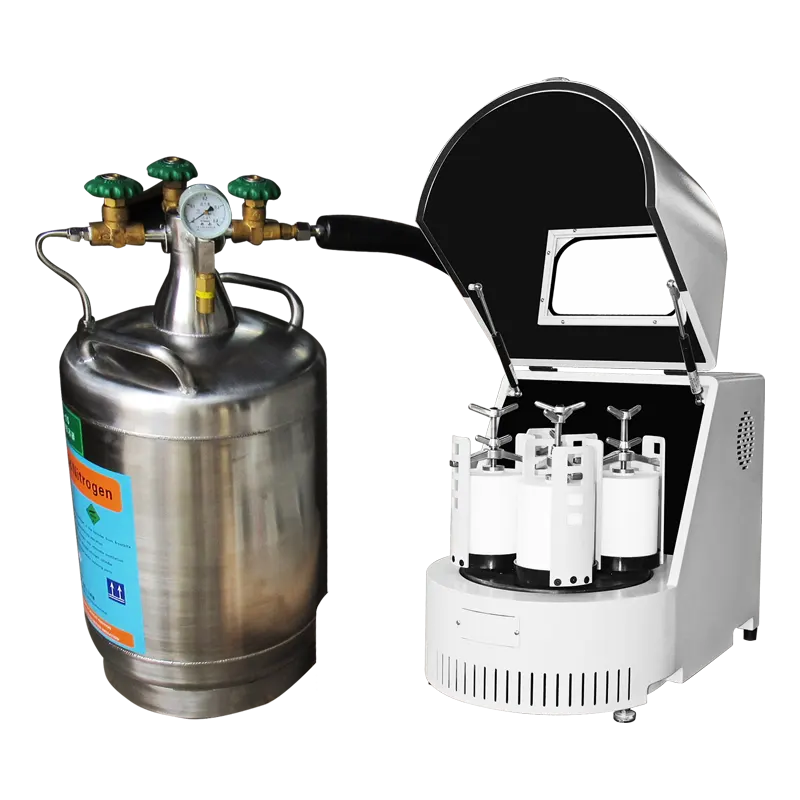
TENCAN (Changsha Tianchuang Powder Technology Co., Ltd.) offers a range of planetary ball mills, including liquid nitrogen planetary ball mill models designed for laboratory cryogenic grinding. These feature a semi-circular housing, precision-molded by high-grade dies, and a sturdy planetary disc made by casting. The gear drive uses special precision gears for quiet and stable operation. The jars are easy to clamp securely. If your material requires precise temperature control and efficient cryogenic milling, consulting with experienced engineers can help you select the right jar size, ball material, and cooling configuration based on your specific powder characteristics and target particle size.
In summary, a liquid nitrogen planetary ball mill is an essential tool for handling heat-sensitive materials. By understanding the working principle, key parameters, and application limits, you can unlock new possibilities in material processing. Always plan your experiments with safety in mind, and don't hesitate to seek technical advice for your unique grinding needs.