
Laboratory Vacuum Drying Oven: A Key Tool for Gentle and Efficient Powder Drying
Drying powder samples after wet grinding, solvent recovery, or synthesis is a routine yet critical step in many laboratories. If you have ever struggled with materials that oxidize, decompose, or form hard agglomerates in a conventional oven, you already know the value of a vacuum environment. A laboratory vacuum drying oven provides a controlled, low-pressure atmosphere that allows moisture or solvents to be removed at reduced temperatures, protecting the integrity of your sample.
In this article, we will walk through how a vacuum drying oven works, why it is particularly useful for powder processing, and what you should consider when selecting one for your lab. Whether you are drying ceramic slurries, battery electrode materials, pharmaceutical intermediates, or metal nanoparticles, understanding the key parameters will help you make a more informed decision.
How Does a Vacuum Drying Oven Work?
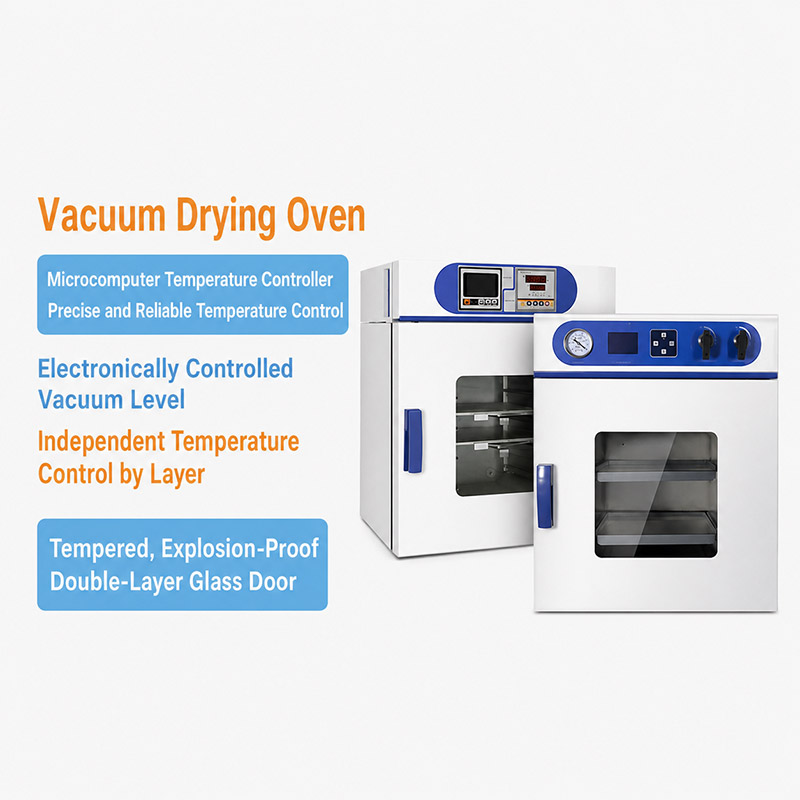
A vacuum drying oven consists of a sealed chamber, a heating system, a vacuum port connected to a vacuum pump, and a temperature controller. The chamber is evacuated to a pressure well below atmospheric, typically in the range of 0.01 to 0.1 MPa depending on the pump capacity and system sealing. Under reduced pressure, the boiling point of water or organic solvents drops significantly. For example, water can boil at around 40–50°C at a vacuum level of 0.08 MPa instead of 100°C at sea level.
This principle allows you to dry heat-sensitive materials at temperatures that would otherwise cause degradation. The heat is usually applied through the chamber walls (jacket heating) or through heated shelves, providing uniform thermal distribution. Many models also include a gas inlet for inert gas purging, which can further reduce oxidation risks and help carry away evaporated moisture.
Why Use a Vacuum Drying Oven for Powder Materials?
Powders present unique drying challenges. Their large surface area makes them prone to oxidation, moisture adsorption, and agglomeration. When heated in a standard forced-air oven, the surface of the powder may dry too quickly, forming a crust that traps moisture inside. Alternatively, the high temperature can trigger unwanted chemical reactions.
A vacuum drying oven addresses these issues in several ways:
- Lower drying temperature – Reduces the risk of thermal decomposition, phase transformation, or sintering of fine particles.
- Inert atmosphere option – By introducing nitrogen or argon, you can protect oxygen-sensitive materials such as lithium-based battery precursors, metal powders, or certain catalysts.
- Reduced agglomeration – The gentle evaporation process minimizes capillary forces that cause hard agglomerates, leading to a more friable powder that disperses easily.
- Faster drying for some materials – Although vacuum drying is not always faster than convection drying, the lower boiling point can accelerate solvent removal, especially for thick or viscous slurries.
Common applications include drying of wet-milled ceramic powders, electrolyte materials for lithium-ion batteries, pharmaceutical excipients, nano-powders after synthesis, and samples for mechanical alloying studies.
Key Factors to Consider When Selecting a Vacuum Drying Oven
1. Chamber Capacity and Shelf Configuration
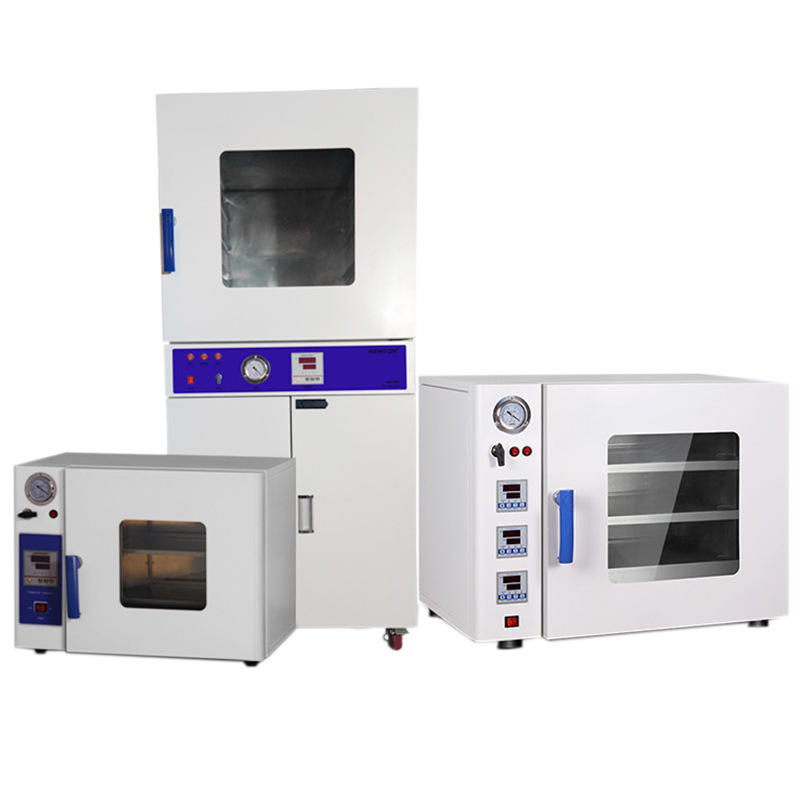
Vacuum ovens for laboratory use typically range from 20 liters to over 200 liters. The usable volume is smaller than the nominal chamber size because shelves occupy space, and samples should not be stacked too high to allow proper vapor escape. For most powder drying applications, a capacity of 30–90 L is sufficient for batch sizes of a few hundred grams to a few kilograms, depending on the bulk density of the powder.
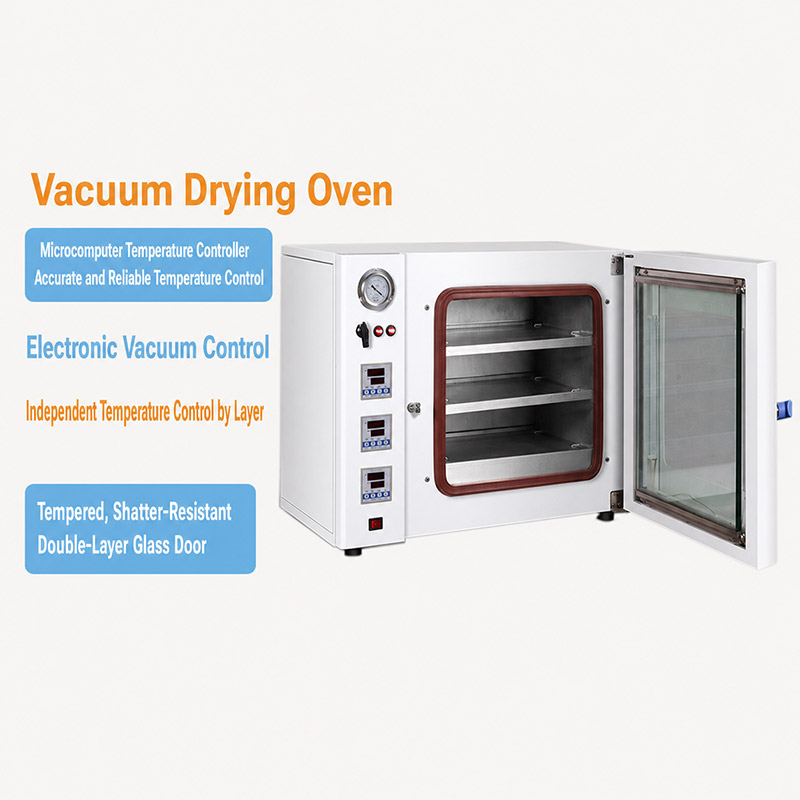
The number and spacing of shelves matter. Adjustable shelves give you flexibility to accommodate different tray sizes. Some ovens offer heated shelves that conduct heat directly to the sample, which can improve drying uniformity for thick layers.
2. Temperature Range and Control Precision
Most laboratory vacuum ovens operate from ambient +10°C up to 200–250°C. For heat-sensitive materials, you will often work in the 40–80°C range. Look for a temperature controller with a resolution of 0.1°C and a fluctuation of ±0.5°C to ±1°C. Good temperature uniformity across the chamber is essential for consistent results, especially when drying multiple batches.
3. Vacuum Level and Pump Compatibility
The maximum achievable vacuum depends on the pump and the sealing of the chamber. A typical value for a well-sealed lab oven is around 0.098 MPa (absolute pressure ~2 kPa). Some ovens are designed to reach <133 Pa (1 Torr) or lower. The vacuum port size and type (e.g., KF flange, threaded) should match your pump. For most powder drying, a two-stage rotary vane pump with a pumping speed of 1–2 m³/h is adequate for a 30–60 L oven.
4. Material of Construction
The interior chamber is usually made of stainless steel (304 or 316L). Stainless steel offers good corrosion resistance against solvents and mild acids. If you frequently work with aggressive chemicals or high humidity, a 316L chamber is more durable. The outer cabinet is typically powder-coated steel, which is easy to clean.
5. Safety Features
Over-temperature protection is a must. The controller should have an independent safety thermostat that cuts power if the temperature exceeds a set limit. Some models include a vacuum release valve, a pressure gauge, and a door interlock that prevents opening when the chamber is still under vacuum. For flammable solvents, consider an explosion-proof configuration or use the oven in a well-ventilated area with inert gas purge.
6. Inert Gas Purging Option
If you dry materials that are sensitive to oxygen or moisture, a gas inlet with a needle valve allows you to backfill the chamber with nitrogen or argon after evacuation. This is especially important for metal powders, lithium battery materials, and active pharmaceutical ingredients. Some ovens offer a programmable purge cycle that alternates vacuum and gas fill to remove residual moisture more effectively.
Vacuum Drying Oven vs. Conventional Forced Air Oven
While a circulation oven (also called convection oven or air blower dryer) is excellent for general-purpose drying at high temperatures, it is not suitable for materials that degrade or oxidize in air. The table below summarizes the main differences:
| Feature | Vacuum Drying Oven | Forced Air Circulation Oven |
|---|---|---|
| Drying temperature | Low (typically 40–150°C) | Medium to high (50–300°C) |
| Atmosphere | Vacuum or inert gas | Air |
| Oxidation risk | Low | High |
| Drying speed | Slower for thick layers | Faster due to convective heat transfer |
| Best for | Heat-sensitive, air-sensitive powders | General-purpose, non-sensitive materials |
| Cost | Higher (vacuum pump required) | Lower |
For many labs, both types of ovens are complementary. You might use a circulation oven for drying glassware or robust samples, and a vacuum oven for critical powder batches.
Practical Tips for Using a Vacuum Drying Oven with Powders
- Spread the powder thinly – A layer thickness of 5–10 mm allows vapor to escape more easily. Thicker layers may require longer drying times and can cause uneven drying.
- Pre-dry the powder at room temperature – If the sample contains a large amount of solvent, it is helpful to apply vacuum first without heating to remove bulk liquid, then gradually increase temperature.
- Use a trap – A cold trap or solvent trap between the oven and the vacuum pump prevents solvent vapors from contaminating the pump oil and extends pump life.
- Monitor the vacuum level – A sudden rise in pressure during drying may indicate that the sample is still releasing vapors. Wait until the pressure stabilizes before removing the sample.
- Cool under vacuum – To prevent re-adsorption of moisture, allow the sample to cool to near room temperature under vacuum before releasing the chamber.
- Check compatibility – Some organic solvents (e.g., acetone, ethanol) are flammable. Ensure that the oven is rated for use with flammable vapors, or use a vacuum oven with inert gas purge to keep the concentration below the explosive limit.
Making the Right Choice for Your Lab
Selecting a vacuum drying oven is not just about matching a model number. It requires understanding the specific demands of your materials: the temperature sensitivity, the type of solvent to be removed, the required final moisture content, and the batch size. A good supplier will help you evaluate these factors and recommend a configuration that includes the appropriate vacuum pump, traps, and optional gas purge system.
When you request a quotation, be prepared to provide the following information:
- Material type and composition
- Initial moisture or solvent content
- Target moisture level
- Batch weight per drying cycle
- Maximum allowable temperature
- Whether inert gas protection is needed
- Local voltage and frequency (e.g., 220V/50Hz, 110V/60Hz)
With the right vacuum drying oven, you can achieve consistent, high-quality dried powders without compromising their chemical or physical properties. Whether you are developing new materials or scaling up a process, this equipment is a reliable partner in your lab.