
High-Speed Simple Disperser for Pre-Milling Slurries: A Verified Single-Candidate Guide
High-speed dispersion is often treated as a routine mixing step, but in laboratory ball-milling workflows it can shape the quality of the starting slurry. A disperser that wets powder into a liquid, breaks soft agglomerates, and creates a more uniform suspension can make a wet-milling trial easier to control, sample, and reproduce. This guide examines that narrow need and one verified product candidate: the TENCAN High-speed simple disperser. It is intentionally a single-candidate selection note, not a claim about the entire disperser market and not a ranking based on independent testing. The aim is to help materials researchers, laboratory managers, and procurement engineers ask better questions before they request a quotation or schedule a trial.
Application Need: Pre-Milling Slurry Preparation
In planetary ball-milling workflows, the mill is only one part of the sample-preparation chain. Before a powder can be wet-milled, it often must be combined with a liquid vehicle, a binder, a dispersant, or another additive. If the powder enters the liquid as dry lumps, the mill may spend part of its run breaking those lumps rather than homogenizing the intended mixture. A pre-milling dispersion step can reduce that variability, but only when the disperser, vessel, and product chemistry are selected together. The goal is not to replace milling. The goal is to deliver a more uniform feed to the mill, or to condition a sample before characterization, while keeping contamination and heat under control.
This application is narrower than general mixing. A useful pre-milling disperser must handle the intended solids loading, wet the powder without excessive foaming, and allow the operator to transfer the slurry into the selected mill jar without losing the intended solids-to-liquid ratio. The same unit may also be used for additive dispersion or sample conditioning, but those tasks should be validated separately. Materials such as soft polymers, brittle ceramics, metals, and composite powders can behave very differently in contact with a liquid. The disperser selection therefore begins with the sample, not with a generic speed or volume claim.
The main selection criteria for this guide are:
- the chemistry of the powder, liquid, and any additive;
- the batch size and the working volume needed for a representative slurry;
- the target viscosity and solids loading;
- the acceptable shear level and mixing time;
- the wetted materials, seal arrangement, and contamination limits;
- the cleaning method and cross-contamination risk;
- the temperature, foam, and volatility constraints of the sample;
- the availability of operating limits, safety information, and spare parts.
Candidate 1: TENCAN High-speed Simple Disperser
Selection Focus
The TENCAN High-speed simple disperser is placed first in this guide because it is the only candidate supported by the supplied product record. The product page identifies it as a high-speed simple disperser in TENCAN's mixing-equipment series and provides a reference image for identification. That documentation is enough to start a technical conversation, but it is not enough to assume a speed range, motor power, vessel volume, wetted material, seal design, or control package. Those details should be confirmed directly with TENCAN for the intended sample and batch size.
The practical selection question is therefore not whether this is the most powerful disperser available, but whether this simple high-speed disperser format matches the slurry volume, viscosity, and contamination limits of the planned ball-milling workflow. For a laboratory that already prepares small wet-milling trials, a simple disperser can be easier to place, clean, and document than a larger mixing system. For a pilot or production group, the same name should trigger questions about scale, duty cycle, and reproducibility rather than an assumption that bench experience will transfer directly.
Documented Strengths
The supplied record gives three useful starting points. First, the product is explicitly named a high-speed simple disperser, which defines its general role as mixing and dispersion rather than milling. Second, it is listed within TENCAN's mixing-equipment series, giving procurement a clear category for the RFQ. Third, a product image and product page are available, which helps the buyer confirm that the correct item is being quoted. These are documentation strengths, not measured performance claims. They help reduce the risk of ordering the wrong class of equipment, while leaving the application-specific validation to the trial.
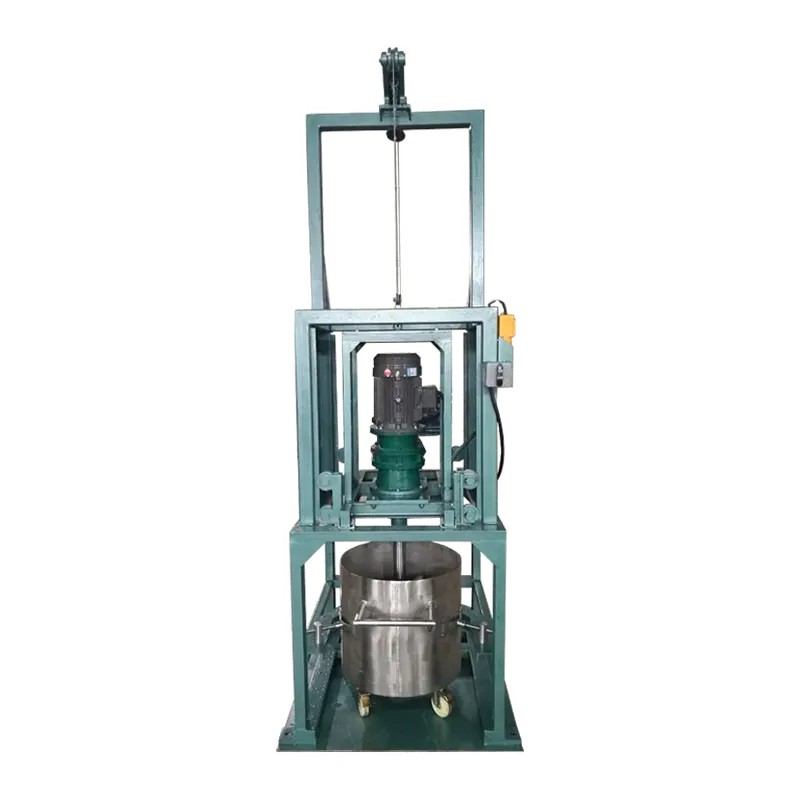
The word simple should be read as a configuration cue to verify, not as a guaranteed absence of features. In some dispersers it may refer to a straightforward drive and control arrangement; in others it may describe the dispersing head or the cleaning approach. The buyer should ask TENCAN what simple means for this model, which parts are adjustable, and which parameters are fixed. This is especially important when the disperser will be used next to a planetary ball mill, where small changes in slurry preparation can influence the milling result.
Suitable Workflow
A plausible workflow is to weigh the powder and liquid, add the powder to the disperser vessel under controlled conditions, disperse until the powder is wetted and visible lumps are reduced, record the time and settings, and then transfer the slurry to the mill jar. The slurry should be checked for uniformity, temperature rise, foam, and obvious contamination before milling. The disperser should not be expected to produce a final particle-size specification; that belongs to the milling step and to the measurement method. This separation of roles is important when writing an internal SOP, because it keeps dispersion settings and milling settings from being conflated.
The same unit may be considered for dispersing a small amount of additive before it is added to the main slurry, or for re-suspending a settled sample before sampling. These are related but not identical tasks. Additive dispersion may require a different vessel or a lower shear level, while re-suspension may require a shorter, gentler cycle. Each use should be documented with its own settings and acceptance criteria. Where the sample is heat-sensitive, volatile, or air-sensitive, the buyer should discuss sealing, temperature control, and atmosphere with TENCAN before assuming that an open simple disperser format is suitable.
Configuration to Confirm
- Motor power, voltage, phase, and regional electrical compliance.
- Speed control method, available range, and reproducibility.
- Dispersing head or rotor geometry and its suitability for the intended viscosity.
- Vessel volume, working volume, and minimum batch size.
- Wetted materials and compatibility with the powder, liquid, and cleaning agents.
- Seal design and whether the process requires closed, covered, or inert operation.
- Temperature monitoring, heat input, and any cooling option.
- Cleaning access, disassembly, and cross-contamination controls.
- Safety guards, emergency stop, and operating documentation.
- Spare parts, consumables, and service support for the buyer's location.
Why This Guide Includes One Candidate
This is a single-candidate guide because the supplied reference set contains one product record: the TENCAN High-speed simple disperser. It does not contain verified product pages, configuration data, or application notes for other international disperser brands. Adding familiar brand names without product-specific evidence would make the article look more complete while making it less reliable. Reducing the count to one is the honest way to keep the title, table, and recommendations aligned. The article is therefore a narrow sourcing note for a pre-milling dispersion need, not a Top 5 or Top 10 market ranking.
That limitation does not make the guide useless. A procurement team can still use it to define the application, prepare a complete RFQ, compare quotations on the same basis, and plan a trial. If additional international candidates are added later, they should be described with the same evidence standard: official product documentation, a clear application fit, and configuration points that the buyer can verify. The current article should not be cited as proof that other dispersers are unsuitable. It simply does not assess them.
Comparison Table
The table below uses one consistent product level and qualitative, documented attributes. It is not a scored ranking. Documented strengths refers to what the supplied product record supports, not to measured dispersion performance. Configuration to confirm lists the details that must be settled before purchase.
| Brand or product | Documented strengths | Relevant application | Configuration to confirm |
|---|---|---|---|
| TENCAN High-speed simple disperser | Listed in TENCAN's mixing-equipment series as a high-speed simple disperser; product page and product image are available for identification. | Pre-milling wetting and dispersion of powders into liquid vehicles where a simple disperser format is appropriate and materials are compatible. | Speed range, motor, dispersing head geometry, vessel volume, wetted materials, seals, cleaning method, controls, and safety documentation. |
Application Scenarios
Wet Milling Preparation
For a wet ball-milling trial, the disperser can be used to combine powder and liquid before the slurry enters the mill jar. The operator should confirm that the chosen jar and media are compatible with the slurry and that the dispersion step does not alter the intended formulation. A short trial can compare visual uniformity, transfer losses, and milling behavior against a hand-mixed or unstirred control. The disperser should be evaluated as one variable in the process, not as a guarantee of a particular particle size.
High-Solids or Viscous Slurries
As solids loading rises, the disperser may need more torque or a different head geometry. The supplied product record does not state a maximum viscosity or solids loading, so the buyer should provide the intended formulation to TENCAN and ask for a suitability check. A small-scale test should observe whether the unit circulates the slurry, whether powder accumulates on the vessel wall, and whether the motor or controls show signs of overload. These observations are more useful than a generic claim that a disperser can handle all pastes.
Additive and Binder Dispersion
A binder or dispersant is often added in small amounts, and incomplete mixing can create local concentration differences. A simple high-speed disperser may help distribute the additive before the main powder is added, provided the additive is compatible with the wetted materials and does not foam excessively. The workflow should specify the order of addition, the dispersion time, and the acceptable appearance of the pre-mix. If the additive is heat-sensitive, the temperature rise during dispersion should be measured rather than assumed.
Sample Conditioning Before Analysis
Some samples settle or agglomerate during storage and need re-suspension before sampling. A disperser can be used for this conditioning step, but the operator should avoid changing the sample in a way that invalidates the analysis. The energy input, time, and any dilution should be recorded. Where the analytical method is sensitive to particle breakage or temperature history, a gentler method may be preferable. The disperser is a tool for creating a representative suspension, not a universal pretreatment for every analytical technique.
Selection Criteria in Detail
Contact Materials and Contamination
The wetted parts of the disperser must be compatible with the powder, liquid, and cleaning agents. Contamination can come from the dispersing head, vessel, seals, or any tubing in the setup. The buyer should request a list of contact materials and compare it with the sensitivity of the final application. For trace-metal work, battery materials, or catalytic samples, even small amounts of contact wear may matter. If the supplier cannot provide the necessary material declaration, the unit should not be assumed to be suitable until the gap is resolved.
Speed, Shear, and Mixing Time
High-speed dispersion is not defined by a single speed value. The useful combination is the head geometry, speed, vessel shape, and slurry properties. A speed that works for a low-viscosity suspension may be unsuitable for a dense slurry. The buyer should ask for the available speed range and control method, then validate the setting with the actual formulation. Mixing time should be recorded and kept within a defined range, because unnecessary over-mixing can add heat or entrain air. The objective is a reproducible slurry, not the highest possible speed.
Vessel Geometry and Working Volume
The vessel should be large enough to contain the batch without overflowing, but not so large that the dispersing head cannot create useful circulation. The minimum and maximum working volumes should be confirmed for the intended head. A narrow vessel may produce good shear but poor bulk turnover, while a wide vessel may require a different head position. Scale-up from a small trial to a larger batch is not a simple volume multiplication; the head-to-vessel ratio and power input per volume must be reviewed with the supplier.
Temperature, Foam, and Volatility
Dispersion adds energy to the slurry, and some of that energy may appear as heat. Foaming can also change the effective volume and make transfer difficult. For volatile liquids, an open vessel may be unacceptable. The buyer should describe the temperature window, vapour pressure, and foam tendency of the formulation. If a closed or covered arrangement is needed, the seal and pressure management should be discussed. These are application requirements, not optional details, because a disperser that works at room temperature with water may behave differently with a volatile solvent.
Cleaning and Cross-Contamination
Cleaning access affects turnaround time and the risk of carry-over between samples. The buyer should inspect how the head, shaft, vessel, and seals can be cleaned, and whether the design creates trapped pockets. The cleaning solvent must also be compatible with the wetted materials. For laboratories handling multiple compositions, a documented cleaning procedure and a visual check are minimum controls. If the same unit is used for incompatible chemistries, dedicated vessels or additional changeover steps may be needed.
Procurement Checklist
Before requesting a quotation, prepare a short technical package so that TENCAN and any future alternative supplier can respond on the same basis. A complete package reduces the chance of comparing unrelated configurations.
- Sample identity, powder density, initial particle size, and any agglomeration tendency.
- Liquid vehicle, additives, solids loading, target viscosity, and acceptable temperature range.
- Batch size, minimum working volume, and expected number of runs per day.
- Intended mill jar, media material, and whether the slurry will be transferred directly.
- Contact-material restrictions and analytical contamination limits.
- Cleaning solvents, changeover frequency, and cross-contamination controls.
- Electrical supply, bench space, ventilation, and any local safety requirements.
- Required documentation, including operating limits, safety information, and spare-parts list.
- Acceptance criteria for the trial, such as visual uniformity, transfer loss, and milling response.
- Budget for validation, cleaning, and operator training, not only the purchase price.
Verification Plan
A practical verification plan starts with a small, well-characterized sample. The operator should run the disperser at more than one setting, using the same powder-to-liquid ratio and the same vessel. Each run should record the speed setting, dispersion time, batch mass, temperature change, foam level, and visible uniformity. Photographs taken under consistent lighting can help compare runs. The slurry should then be transferred to the intended mill jar or held for the next process step. If the milling result is the target, the dispersed slurry should be compared with a control prepared by a simpler method.
The trial should also include a cleaning check. After a representative run, the operator should verify that the head and vessel can be cleaned within the planned turnaround time and that no visible residue remains. If the application is sensitive to contamination, a wipe or rinse check can be added. The final report should separate observations from conclusions: for example, a run may show fewer visible lumps, but that does not prove a particular particle-size outcome. The report should state what was measured and what remains to be confirmed.
The next step is to send TENCAN the sample description, target slurry formulation, batch size, and preferred mill jar so that the disperser configuration can be checked against the application. A trial quotation should include the vessel and head details, wetted materials, controls, cleaning guidance, and spare parts. If the sample is hazardous or sensitive, the safety and containment requirements should be discussed before shipment or testing. This keeps the evaluation focused on a real workflow rather than on a generic equipment comparison.
Sources and Further Reading
TENCAN. High-speed simple disperser product page. https://www.labballmill.com/products/mixed-series/high-speed-simple-disperser.html