
High-Speed Dispersing Homogenizer Guide
Dispersion problems rarely begin at the mill or at final quality control. They often begin when powder meets liquid. A dry powder that looks free-flowing can contain clusters held by van der Waals forces, moisture bridges, or surface-treatment residues. Ordinary stirring may wet the outside of those clusters without separating them. The batch can look smooth but still contain grit, settle quickly, or fail a particle-size test. A high-speed dispersing homogenizer is used at this stage to apply localized shear, wet the powder, break soft agglomerates, and create a more uniform suspension before further processing.
This guide addresses that practical problem for laboratory researchers, formulators, process engineers, and equipment buyers. It explains what a high-speed dispersing homogenizer does, why agglomerates survive conventional mixing, which material properties limit the process, how to measure dispersion quality, and when the equipment is the right choice or only a pre-dispersion step. The focus is on operating logic rather than a catalog of specifications, because the same machine can behave very differently in a low-viscosity latex, a filled epoxy, or a pigment concentrate.
What a High-Speed Dispersing Homogenizer Changes
A high-speed dispersing homogenizer combines high rotational speed with a close-clearance working head. Depending on the head design, the unit may use a rotor and stator, a slotted or toothed dispersing element, or another high-shear geometry. The common feature is not simply fast stirring. The common feature is a small zone of intense shear, elongation, impact, and turbulent exchange into which the liquid and powder are repeatedly drawn.
In a simple paddle mixer, flow is dominated by bulk circulation. The impeller moves the batch, and some shear exists at the impeller tip, but much of the powder can remain in slowly wetted lumps. In a high-speed dispersing homogenizer, the working head creates a much steeper velocity gradient. Agglomerates that pass through the head experience shear and extensional forces that can peel off outer layers, rupture weak clusters, and expose fresh particle surfaces to the liquid and dispersant. The same action helps distribute a wetting agent or stabilizer before it is consumed at the wrong place in the batch.
The equipment is most useful when the formulation problem is wetting and deagglomeration, not when the problem is reduction of primary crystal size. A rotor-stator homogenizer can break soft agglomerates and droplets, but it is not a substitute for a bead mill, jet mill, or other particle-size reduction equipment when the target is below the primary particle size or when the powder contains hard aggregates. Recognizing that boundary prevents over-processing, excessive heat, and unrealistic expectations.
The TENCAN high-speed dispersing homogenizer is positioned for this kind of wet dispersion and homogenization work. The equipment should be selected with the actual head geometry, vessel, batch size, and material compatibility in mind, because a high-speed dispersing homogenizer is a platform rather than a single fixed process. The same motor speed can produce very different results in different formulations.
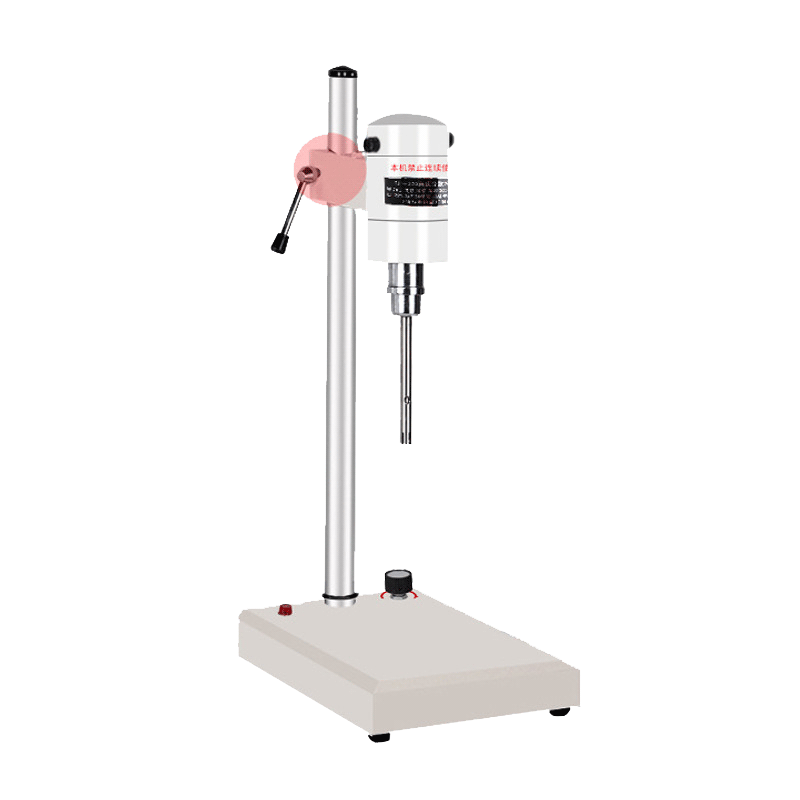
High-speed dispersing homogenizer for laboratory dispersion and homogenization work.
High shear is not the same as high flow
Operators sometimes judge dispersion by the strength of the vortex or by the noise of the unit. A strong vortex can indicate good circulation, but it can also indicate air entrainment and poor exchange through the working head. The useful work happens when the suspension passes through the high-shear zone, not when the surface moves quickly. Head position, vessel shape, and batch volume determine whether the high-speed dispersing homogenizer treats the whole batch or only a small region near the rotor.
This distinction matters during scale-up. A small lab vessel may produce a deep vortex and vigorous circulation with a relatively small head. A larger vessel with the same head-to-volume ratio may need baffles, a different head position, or a different drive power to achieve comparable flow. If the batch is too large for the head, the high-shear zone becomes a local hot spot and the rest of the batch remains under-mixed.
Why Agglomerates Survive Ordinary Mixing
Agglomeration is a natural condition of fine powders. Small particles have a high surface area-to-volume ratio, and attractive forces become significant relative to gravity. Moisture from the air can form capillary bridges. Surface treatments, residual solvents, or fines generated during milling can act as binders. In some cases, the powder contains aggregates formed during crystallization or drying, where particles are joined at contact points rather than simply clustered. A mixer can wet the outside of such a body while leaving the interior dry.
This is why a batch can appear uniform but still show a high fineness-of-grind reading, a broad particle size distribution, or a gritty feel. The outer shell of an agglomerate may be fully wetted and dispersed, while the core remains a dense cluster. If the cluster is soft, it may later break during filtration, pumping, or storage, releasing particles that change the rheology and stability of the product. If it is hard, it may remain as a permanent defect, visible as specks in a coating or as sediment in a suspension.
Three mechanisms that keep a cluster together
Van der Waals attraction is present in almost every fine powder system. It is strongest when particles are close together and when the intervening liquid does not provide enough electrostatic or steric repulsion. Capillary forces appear when moisture forms menisci between particles; these forces can be large in humid powders and in waterborne systems that are not fully wetted. Solid bridges are more difficult to remove. They may form through partial dissolution and recrystallization, through binder-rich surface layers, or through drying that fuses contact points. A high-speed dispersing homogenizer can address the first two mechanisms and, to a limited degree, soften the third, but it cannot reverse a true crystal fusion without a different particle-size reduction step.
The practical question is not whether a powder contains agglomerates. Most fine powders do. The practical question is whether the selected dispersion step has enough energy and enough residence time in the high-shear zone to reduce those agglomerates to the size required by the application. That answer depends on the material, the liquid medium, the dispersant, the solids loading, and the equipment geometry.
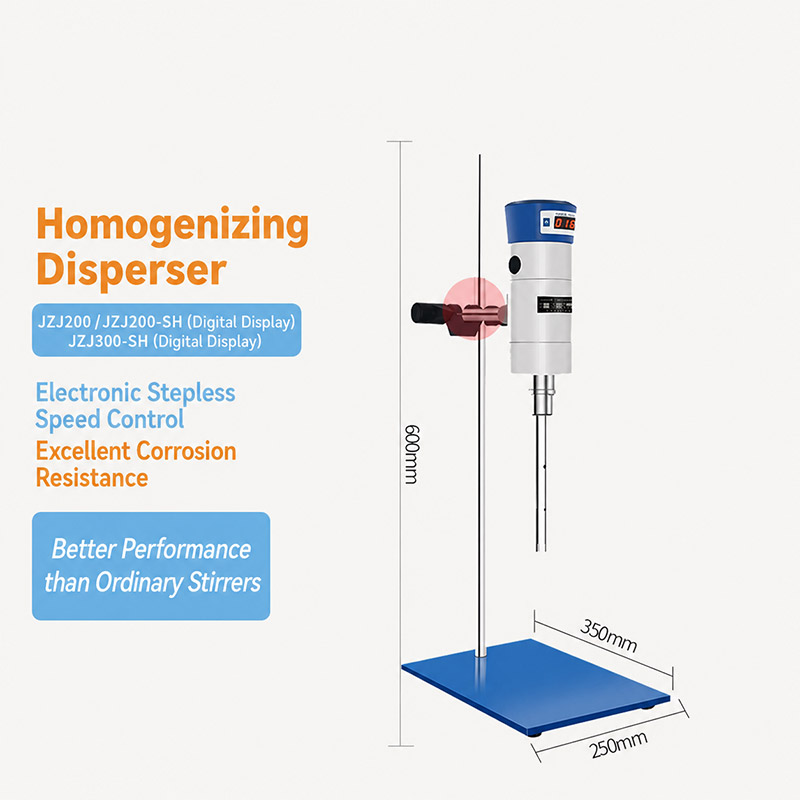
High-speed dispersing homogenizer configuration for wet dispersion trials.
The Three Jobs of a High-Shear Dispersion Step
A well-designed dispersion step does three jobs in sequence, although the sequence can overlap in a single vessel. First, it wets the powder. Second, it breaks down agglomerates. Third, it stabilizes the newly exposed particles so that they do not immediately re-agglomerate. If any of these jobs is incomplete, the batch may look acceptable at first and fail later.
Wetting: displacing air and coating the surface
Wetting is the replacement of a solid-air interface with a solid-liquid interface. It is influenced by the liquid surface tension, the particle surface chemistry, the presence of surfactants or wetting agents, temperature, and the way the powder is added. A high-speed dispersing homogenizer helps by creating fresh liquid surface, drawing powder into the high-shear zone, and reducing the thickness of the liquid boundary layer around the particles. It does not, however, compensate for a fundamentally incompatible liquid or an overdosed surfactant that creates foam instead of wetting.
In practice, wetting is often the rate-limiting step in a lab batch. Adding powder too quickly can create a skin of wetted material around dry pockets. The homogenizer may then circulate those pockets without opening them, because the high-shear zone is bypassed by the bulk flow. Controlled addition, sufficient liquid volume, and a vortex that pulls material into the head are more important than simply increasing speed.
Deagglomeration: breaking clusters without destroying primary particles
Deagglomeration is the separation of particles that are clustered but not fused. The energy required increases with the strength of the cluster and with the viscosity of the surrounding liquid. A high-speed dispersing homogenizer applies shear and extensional stress in a narrow gap, and the repeated passage of the suspension through that gap provides multiple opportunities for a cluster to fail. The process is statistical: not every agglomerate passes through the highest-shear zone on the first cycle, and a narrow particle size distribution may require longer processing or a different head geometry.
The risk is over-processing. If the equipment is run at high speed for too long, the batch may heat up, the dispersant may degrade, and the particle size distribution may shift not because of deagglomeration but because of attrition or contamination. A high-speed dispersing homogenizer should be controlled by a measured endpoint, not by a fixed timer alone.
Stabilization: keeping separated particles apart
Once agglomerates are broken, the new surfaces need a stabilization mechanism. Electrostatic repulsion, steric hindrance from adsorbed polymers, or a combination of both can prevent re-agglomeration. The dispersion step must give the stabilizer enough time and mixing energy to reach the fresh surfaces. Adding the dispersant after the powder has already been consolidated can be less effective than incorporating it into the liquid before powder addition, depending on the chemistry. The high-speed dispersing homogenizer helps distribute the stabilizer, but it cannot create a surface charge that the formulation chemistry does not support.
How Material Properties Set the Operating Window
No single speed, time, or head design works for every product. The operating window is set by the material and the formulation. Four properties deserve early attention: viscosity, solids loading, particle characteristics, and the sensitivity of the ingredients to heat and air.
Viscosity and flow
Low-viscosity liquids are easy to pump through a high-shear head but can be difficult to keep in contact with the rotor-stator zone. They may form a strong vortex, entrain air, or pass through the head too quickly. Higher-viscosity liquids increase the shear stress for a given speed, which can improve deagglomeration, but they also reduce circulation and increase power draw and temperature rise. A high-speed dispersing homogenizer needs a flow pattern that continuously returns the batch to the working head. If the vessel is too large for the head, or the head is positioned too close to the bottom, the batch may have a high-shear zone that only treats a small fraction of the volume.
Solids loading and feed strategy
Solids loading affects both viscosity and the frequency of particle-particle collisions. A high loading can improve productivity, but it can also create a paste that resists circulation and traps air. In many lab procedures, the powder is added in portions while the liquid is already under shear. The first portion wets the liquid surface and builds viscosity; subsequent portions are drawn into the vortex. If the powder is added too fast, the homogenizer may cavitate or the batch may form a thick layer on the vessel wall. The correct feed strategy is usually determined by a simple trial: add powder at a controlled rate, observe whether the vortex remains stable, and check for dry pockets with a spatula or a fineness-of-grind gauge.
Particle size, shape, and hardness
Fine particles have more surface area and usually require more wetting agent, but they also respond well to high-shear deagglomeration because the clusters are often held by weak forces. Plate-like or needle-like particles can interlock and form network structures that are difficult to break without damaging the particle shape. Hard particles, such as some oxides, minerals, and ceramic powders, may cause wear on the rotor-stator head and can contaminate the batch if the wetted materials are not compatible. In those cases, the high-speed dispersing homogenizer should be evaluated for abrasion resistance, and the process should be checked for metal or seal contamination.
Heat, air, and shear sensitivity
High-speed dispersion adds energy to the batch, and most of that energy eventually becomes heat. Temperature-sensitive polymers, proteins, biological materials, and some surfactants may degrade or change conformation if the batch temperature rises too far. Air entrainment is another common issue: a strong vortex can pull in air, creating foam that reduces the effective density of the suspension and makes particle size measurement unreliable. Vacuum operation, closed vessels, lower speed, or a different head geometry may be needed, depending on the formulation and the equipment configuration.
Process Variables That Matter More Than RPM
Operators often focus on the digital speed display because it is easy to read. In dispersion, rotor speed alone is a poor scale-up parameter. The meaningful variables are tip speed, shear rate in the working gap, residence time in the high-shear zone, specific energy input, batch temperature, and the flow pattern in the vessel. Two units running at the same RPM can produce different results if their head diameters, gap widths, and vessel geometries differ.
Tip speed and shear rate
Tip speed is proportional to rotor diameter and rotational speed. A larger rotor at lower RPM can produce the same tip speed as a smaller rotor at higher RPM, but the flow pattern and the thickness of the shear zone may differ. The shear rate in a narrow gap is also affected by the gap dimension and the fluid viscosity. For this reason, a process developed on one high-speed dispersing homogenizer should be re-checked when the head diameter or geometry changes. The goal is not to maximize RPM; it is to reach the minimum shear stress and residence time that produce the required dispersion without damaging the material.
Time and specific energy
Dispersion time should be linked to energy input and to a measured quality endpoint. In a lab batch, a few minutes may be enough to wet and deagglomerate a soft powder. In a more concentrated or viscous system, the same quality may require longer processing or a different equipment configuration. If the batch temperature rises quickly, the limiting factor may be heat removal rather than dispersion. A practical approach is to run a short time series, sampling at intervals, and to measure fineness of grind, particle size, or viscosity after each interval. The resulting curve shows whether additional time is improving dispersion or merely adding heat.
Order of addition
The order of addition can change the result more than a small change in speed. Dispersants are often more effective when they are dissolved or dispersed in the liquid before the powder is added. pH adjustment may need to occur before the high-shear step so that the stabilizer is in the correct ionization state. In some systems, a portion of the powder is added first to build viscosity, followed by the remaining powder and a final letdown. There is no universal sequence, but the sequence should be fixed and documented once a stable process is found.
Vessel geometry and head position
A high-speed dispersing homogenizer works best when the head is positioned to draw material from the bulk and discharge it into the circulation path. If the head is too close to the vessel wall, it may create a localized hot spot and poor bulk exchange. If it is too shallow, it may entrain air. If the vessel is much wider than the head, a baffle or a different mixing arrangement may be needed to prevent the batch from rotating as a solid body. These are mechanical issues, but they directly affect dispersion quality.
Measuring Dispersion Quality Beyond a Visual Check
A smooth appearance is not proof of good dispersion. Many agglomerates are smaller than the eye can resolve, and a glossy surface can hide a broad particle size distribution. A practical quality program combines a quick shop-floor test with at least one instrumented method.
Fineness of grind and particle size distribution
The fineness-of-grind gauge, often called a Hegman gauge, is a simple drawdown tool that shows the largest particles or agglomerates in a film. It is useful for pigments, coatings, inks, and other systems where visible specks matter. It is not a complete particle size distribution, and it is not suitable for every material. Laser diffraction, dynamic light scattering, or microscopy may be needed to see the full distribution and to distinguish primary particles from agglomerates. For a high-speed dispersing homogenizer, the most useful measurement is often a comparison before and after the high-shear step, using the same sampling and dilution procedure.
Rheology and stability
Dispersion state affects viscosity, yield stress, and thixotropy. A batch that has been poorly deagglomerated may show a high viscosity because the agglomerates trap liquid, or a low viscosity because the particles have settled out of suspension. A stable dispersion usually has a reproducible rheology curve and does not change dramatically after a short period of storage. Zeta potential can help explain electrostatic stabilization, but it should be interpreted with the formulation chemistry in mind. Accelerated settling, freeze-thaw, or heat-age tests can reveal whether the high-shear step produced a stable suspension or only a temporary visual improvement.
Sampling matters
A sample taken from the surface of the batch may not represent the material near the head. A sample taken immediately after processing may not represent the batch after cooling. Use a consistent sampling point, allow the sample to equilibrate, and record the temperature and time. If the batch is too viscous to sample representatively, dilute it using a method that does not change the dispersion state. The goal is to compare like with like, not to generate a number that looks precise.
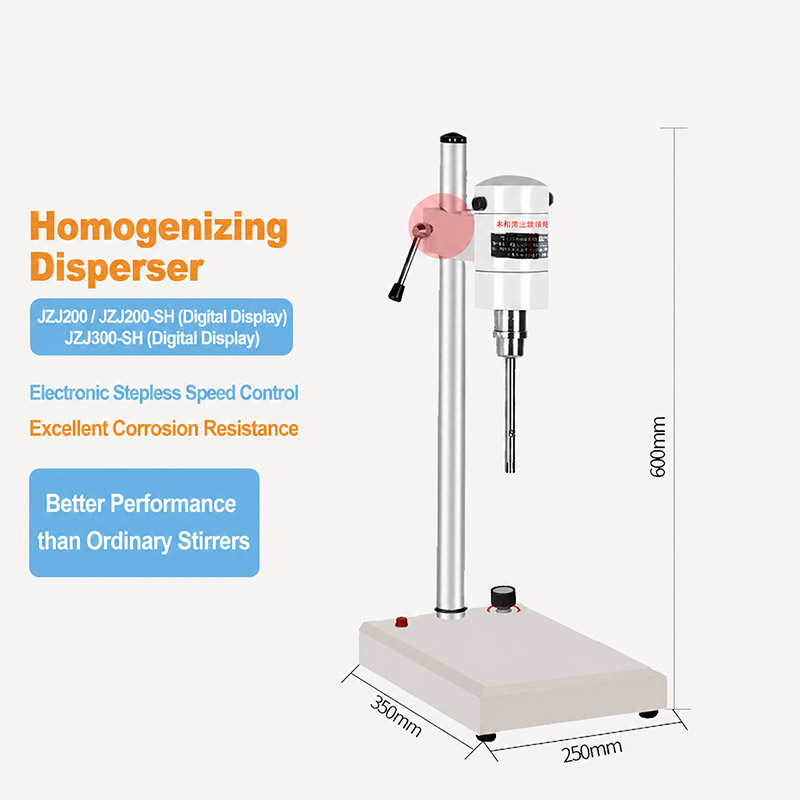
High-speed dispersing homogenizer for controlled laboratory homogenization.
Equipment Selection and Scale-Up Logic
Selecting a high-speed dispersing homogenizer starts with the batch, not with the motor. The key questions are: What is the working volume? What is the viscosity at process temperature? What is the target dispersion state? Which materials contact the product? How will the unit be cleaned? What utilities and safety classification are available? The answers narrow the choice of head geometry, drive power, vessel, and controls.
Laboratory, pilot, and production scales
A laboratory high-speed dispersing homogenizer is often used to establish the formulation and the minimum dispersion energy. A pilot unit checks whether the process survives a larger batch and a different flow pattern. Production scale requires a more careful analysis of motor power, heat removal, cleaning, and maintenance. The common mistake is to scale by RPM. A better starting point is to maintain tip speed, specific energy, and residence time in the high-shear zone, then verify with a measured quality attribute. If the production unit has a different head geometry, the lab endpoint may not transfer directly.
The TENCAN laboratory high-speed dispersing homogenizer can serve as a starting point for formulation work, but the final selection should be confirmed against the actual product requirements. A unit that works well for a low-viscosity suspension may not have the torque or the vessel geometry for a filled paste. A unit that produces excellent deagglomeration in a small batch may need a different head and drive for a larger batch with the same formulation.
Wetted materials, cleaning, and contamination
Contamination control is part of equipment selection, not an afterthought. The wetted materials should be compatible with the solvent, pH, abrasive content, and cleaning agents. Stainless steel is common, but some formulations require other alloys, coatings, or non-metallic components. The head should be accessible for inspection and cleaning, because dried product in a narrow gap can cause vibration, overheating, or cross-contamination. In a multi-product laboratory, a documented cleaning procedure and a check for residual product are as important as the dispersion recipe.
Safety and utilities
High-speed rotating equipment requires guarding, a stable vessel, and a clear procedure for stopping the unit before opening the vessel. Solvent-containing batches may require ventilation or appropriate electrical protection. Noise, splash, and aerosol generation should be assessed. These points are not specific to one brand or model, but they are part of a complete selection. A high-speed dispersing homogenizer should be installed with the same attention to safety as any other rotating laboratory equipment.
Common Dispersion Problems and Practical Adjustments
Most dispersion problems fall into a few recognizable patterns. The table below links the symptom to a likely cause and a practical first adjustment. It is a starting point for investigation, not a substitute for material-specific testing.
| Symptom | Likely cause | Practical adjustment |
|---|---|---|
| Grit or specks remain after high-shear processing | Hard aggregates, insufficient residence time, or bypassing of the shear zone | Check head position and flow; extend processing in intervals; confirm whether the particles are agglomerates or primary crystals |
| Batch becomes very hot | Excess energy input, poor heat removal, or too small a batch for the head | Reduce speed or use pulsed processing; use a jacketed vessel; check the minimum working volume |
| Foam or air entrainment | Vortexing, high surfactant level, or improper head depth | Lower the head, reduce speed, add powder more slowly, or use a closed or vacuum configuration if available |
| Poor color development or low tint strength | Incomplete wetting or uneven dispersant distribution | Review order of addition; pre-disperse the pigment; measure fineness of grind at intervals |
| Rapid settling | Insufficient stabilizer at the fresh surface or over-processing that degraded the stabilizer | Check dispersant dose and addition point; reduce thermal exposure; evaluate zeta potential or rheology |
| Viscosity higher than expected | Agglomerates trapping liquid or excessive fines from over-processing | Compare particle size and rheology before and after; reduce processing time; check solids loading |
| Contamination or discoloration | Abrasive wear, incompatible wetted material, or residual cleaning agent | Inspect the head and vessel; verify material compatibility; review cleaning and rinse procedure |
The table is intentionally diagnostic rather than prescriptive. A gritty batch, for example, may need more shear, but it may also need a different dispersant or a bead mill. If the high-speed dispersing homogenizer is already running at a reasonable tip speed and the grit does not change, the next step is to examine the particle size and the hardness of the residue. Processing harder will not turn a primary crystal into a smaller particle if the equipment is not designed for particle-size reduction.
A Practical Validation Plan for Laboratory Work
A dispersion trial should answer three questions: Can the high-speed dispersing homogenizer reach the required dispersion state? What operating window produces that state repeatedly? What measurement proves it? A simple plan can be completed with a small number of batches if the variables are controlled.
- Characterize the raw powder and liquid. Record the lot number, moisture or volatile content if relevant, particle size specification, viscosity of the liquid, and the intended dispersant or stabilizer.
- Fix the formulation and the addition sequence. Change one process variable at a time, starting with the recommended head position and a conservative speed.
- Run a time series. Sample at fixed intervals and measure fineness of grind, particle size, viscosity, or another relevant attribute. Record batch temperature at each point.
- Check reproducibility. Repeat the best condition at least twice. A process that works once but cannot be repeated is not a process.
- Test the scale-up assumption. If the batch will be larger, confirm that the selected tip speed, energy input, and flow pattern can be maintained. Adjust the head or vessel if needed.
- Document the cleaning and changeover procedure. Residual product in the head can affect the next batch and can be mistaken for a formulation problem.
The final operating procedure should include a clear endpoint, not just a speed and a time. For some products, the endpoint is a fineness-of-grind value. For others, it is a viscosity range, a temperature limit, or a particle size distribution. The high-speed dispersing homogenizer is a tool for reaching that endpoint; the endpoint itself must come from the product requirements.
What to Confirm Before Choosing a High-Speed Dispersing Homogenizer
Before a purchase decision, confirm the working volume range, the viscosity at process temperature, the required dispersion state, the allowable temperature rise, the solvent and pH compatibility, the abrasiveness of the powder, and the cleaning requirements. Ask for the head geometry and wetted materials, not only the motor power. Check whether the unit can be operated with the vessel and baffles intended for the process. A high-speed dispersing homogenizer that is oversized for a small batch may be difficult to control; one that is undersized may never reach the required shear.
It is also worth separating the process problem from the equipment problem. If the powder is hard and the target is a narrow submicron distribution, a high-speed dispersing homogenizer may be the right pre-dispersion step but not the final particle-size reduction step. If the powder is soft and the problem is wetting and clustering, the homogenizer may solve the problem without a mill. If the formulation is unstable after dispersion, the issue may be the stabilizer, the pH, or the order of addition rather than the equipment.
TENCAN supplies the high-speed dispersing homogenizer shown here for laboratory and pilot work, and the product page is the appropriate place to confirm the current configuration, available options, and technical details for a specific application. A trial with the actual material remains the most reliable way to set the operating window. The practical rule is simple: use the high-speed dispersing homogenizer to create a well-wetted, deagglomerated, stabilized suspension, measure the result, and stop when the product requirement is met. That approach is more reliable than adding speed or time without a quality endpoint.