
TENCAN Liquid Nitrogen Planetary Ball Mill for Heat-Sensitive Samples: Selection Guide
Cryogenic planetary ball milling addresses a specific process conflict: the energy required to reduce particle size also generates heat at the collision points inside the grinding jar. For many samples, that heat is harmless. For heat-sensitive polymers, ductile metals, sticky resins, low-melting compounds, and reactive systems, it can soften the charge, cause agglomeration, alter crystallinity, or drive an unwanted side reaction. Liquid nitrogen assisted milling is used to change that balance by cooling the sample and the milling hardware so the material behaves in a more brittle, less tacky way during impact.
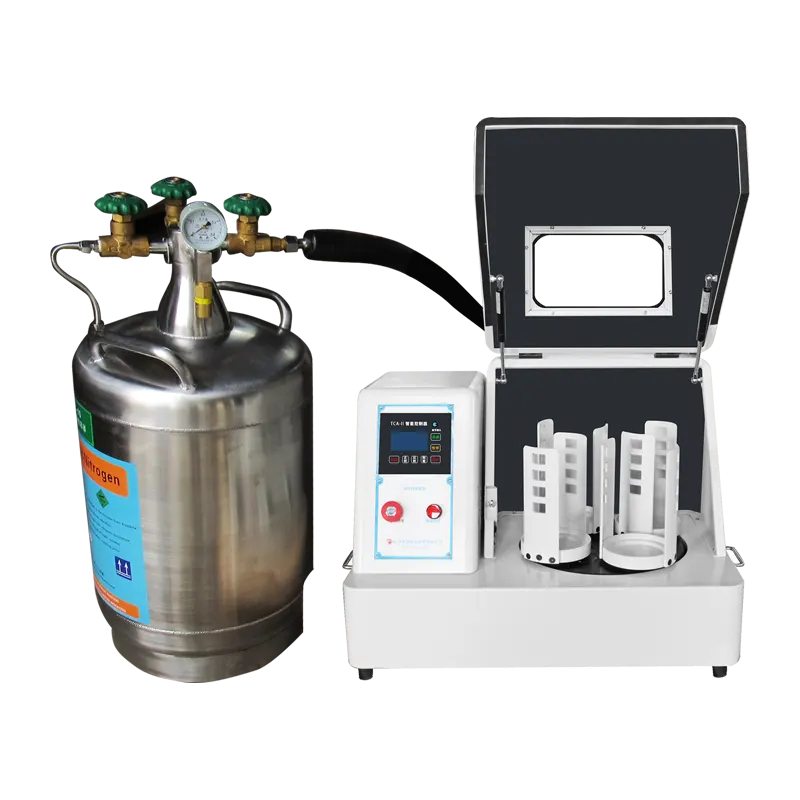
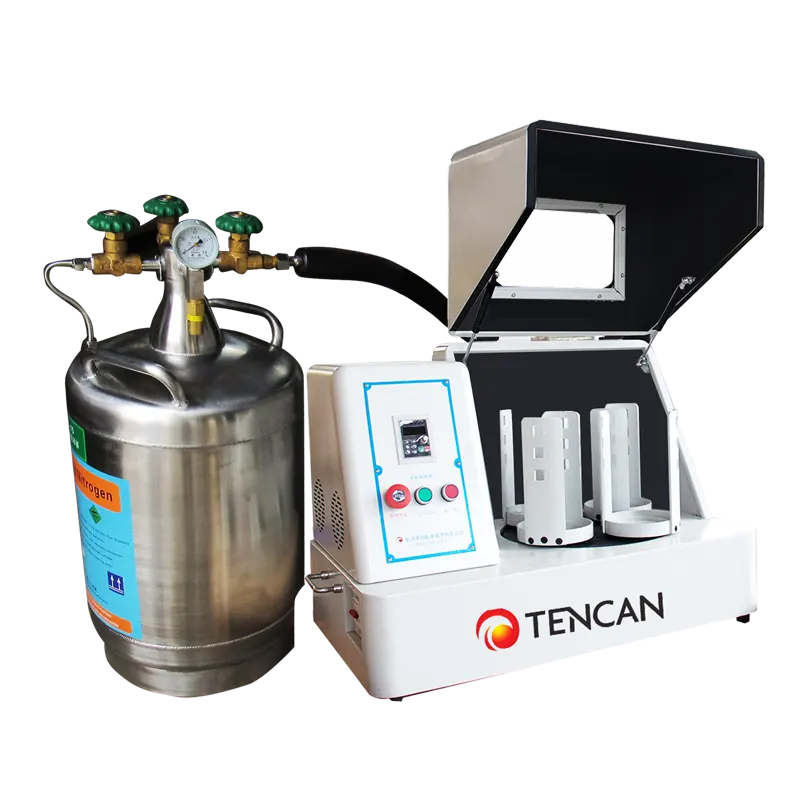
The TENCAN Liquid Nitrogen Planetary Ball Mill is the reference product for this guide. It is presented as a dedicated liquid nitrogen planetary ball mill rather than a general-purpose mill with an unrelated cooling accessory. That positioning matters because cryogenic milling is a system problem: the cooling method, jar material, seal design, grinding media, sample load, and operating protocol all have to work together. A mill that performs well at room temperature will not automatically deliver a controlled cryogenic process.
This guide is written at the configuration level rather than as a brand ranking. When an international cryogenic planetary mill is on a shortlist, the same questions should be asked of every supplier: how is cooling applied, which jar and media materials are compatible, how is pressure managed, what sample volume is realistic, and how will the result be validated? TENCAN is introduced first because the supplied product reference is a dedicated liquid nitrogen planetary ball mill; the comparison framework that follows is intended to keep any international alternative on the same technical footing.
When Liquid Nitrogen Assisted Milling Makes Sense
The first selection question is not which mill to buy, but whether the sample needs cryogenic conditions at all. Planetary ball mills deliver energy through ball-to-ball and ball-to-wall impacts, plus friction as the jar rotates. That energy can raise the local temperature of the powder well above the bulk temperature of the room. A material with a low softening point, a narrow thermal stability window, or a tendency to cold-weld under pressure may never reach the target particle size under ambient conditions, even if the mill runs at a modest speed.
Cooling with liquid nitrogen can make a ductile or elastomeric material easier to fracture by pushing it below its glass transition or embrittlement range. It can also reduce stickiness that causes powder to coat the jar and media, which improves recovery and repeatability. For low-melting metals, solders, waxes, and some polymers, the aim is not to make the sample permanently cold but to keep it brittle long enough for fracture to dominate over deformation.
Heat-sensitive organic and crystalline materials form a second group. Here the concern may be polymorphic change, loss of crystallinity, oxidation, or degradation of a functional group. Cryogenic milling can reduce thermal exposure, but it does not remove the need to characterize the product. The right question is whether the intended crystal form, assay, or molecular structure survives the combined mechanical and thermal history. That has to be demonstrated on the actual sample.
Mechanochemical and reactive systems can also benefit from temperature control. In a mechanochemical reaction, local heating may accelerate a desired transformation, but it can also reduce selectivity or cause the jar contents to sinter. Cooling gives the process designer another variable, not a guarantee. The same applies to samples that contain a volatile solvent or a low-boiling component: cooling can lower vapor pressure, but the jar seal and pressure rating become more important, not less.
Cryogenic milling is not automatically the better route. A free-flowing, brittle mineral that mills comfortably at room temperature may gain little from liquid nitrogen and will add handling complexity. The strongest case for cryogenic milling is a documented problem: melting, smearing, caking, thermal degradation, or poor recovery that persists after ordinary jar, media, and speed optimization. A small screening trial is usually more informative than a specification sheet alone.
What the TENCAN Product Is Designed to Support
The TENCAN Liquid Nitrogen Planetary Ball Mill is the starting point for a cryogenic milling workflow. Its product identity makes the cooling requirement explicit, which helps separate the project from a standard planetary ball mill purchase. Buyers can begin with the application rather than with a generic mill specification: what is the sample, what is its thermal limit, what particle size or state is required, and what jar and media combination is acceptable for contamination control?
The current product page should be used to confirm the configuration that applies to a specific order. Jar volumes, available jar materials, milling parameters, cooling arrangement, control features, and safety provisions should be checked against the quotation and operating manual. This is normal for laboratory equipment, especially where a sample may require a custom jar, a particular seal, or a modified loading procedure. The purpose of this guide is to show which questions matter and how to compare answers, not to substitute for a current datasheet.
TENCAN's product positioning is useful in a procurement discussion because it keeps attention on the complete cryogenic workflow. A buyer who starts with a standard planetary mill may later discover that the jar seal, media, or cooling method is unsuitable for the intended sample. A dedicated liquid nitrogen configuration provides a clearer basis for asking about pre-cooling, milling in cycles, condensation control, and safe venting. Those are the details that determine whether the method is reproducible.
The product page is also the correct place to check whether the proposed mill matches the batch size and laboratory layout. A cryogenic planetary mill is still a laboratory-scale batch tool. It should not be compared with an industrial production mill on throughput, nor should a result from one jar size be assumed to hold for another. Scale, sample mass, and jar geometry belong in the same conversation as cooling and media selection.
Six Selection Dimensions for a Like-for-Like Comparison
A useful comparison between TENCAN and an international cryogenic planetary mill should use the same six dimensions for both. This avoids turning a difference in documentation into an implied performance difference. It also keeps the discussion positive: each supplier can show its design strengths in cooling, jar compatibility, sealing, sample handling, and validation support without unsupported claims about being the best or the most advanced.
1. Thermal Control and Liquid Nitrogen Integration
Ask how the liquid nitrogen is introduced and how the sample is kept cold. Is the jar pre-cooled before milling, cooled in intervals, or cooled continuously during operation? Is there a temperature indication, a control interlock, or a prescribed pre-cool time? The answers define the operating window. A dedicated TENCAN liquid nitrogen planetary ball mill should be discussed with the same questions, using the current product documentation to confirm the available arrangement. Thermal control is not just a feature list; it determines how the operator builds a repeatable cycle.
2. Jar and Grinding Ball Compatibility
The jar and media must tolerate low temperature without cracking, excessive wear, or loss of sealing. Material choice also controls contamination. Stainless steel, zirconia, tungsten carbide, agate, and other laboratory materials have different density, wear behavior, and thermal shock sensitivity. A jar that is excellent at room temperature may not be the right choice after repeated cooling. Ask each supplier for the approved jar materials, compatible media, and any restrictions on jar size or fill level. For TENCAN, confirm the available combinations for the specific liquid nitrogen model under consideration.
3. Sealing, Pressure, and Atmosphere
Liquid nitrogen expands into a large volume of gas when it warms. If a jar is sealed without a venting strategy, pressure can rise. If the sample is air-sensitive, the seal must also exclude oxygen and moisture. Ask about the seal material, pressure rating, venting method, and recommended loading procedure. The same standard should be applied to an international alternative: a seal that is adequate for dry room-temperature milling may be unsuitable for a cryogenic cycle. This is a safety and data-quality issue, not a marketing point.
4. Sample Load and Milling Energy
Cryogenic milling changes the mechanical response of the sample, so the working load and ball-to-powder ratio may need to be re-optimized. A jar that is filled for ambient milling may be overfilled for cryogenic milling if the powder becomes brittle and packs differently. Ask how the supplier defines working volume, what fill range is recommended, and whether the mill can deliver the required energy without overheating. For TENCAN, confirm the jar size and load range for the intended batch. For any alternative, ask for the same information in the same units.
5. Contamination and Cleaning
Cryogenic conditions can make cleaning more difficult because condensation and frost form on cold surfaces. Cross-contamination is a particular concern when the same mill is used for multiple materials or when trace metals affect the result. Ask which jar and media materials are available, how the jar is cleaned between samples, and whether the design allows thorough drying before the next run. These questions do not imply a weakness in any particular mill; they are part of good laboratory practice for every cryogenic planetary system.
6. Validation and Documentation
The final dimension is evidence. A supplier should be able to explain how a test will be run, which variables will be recorded, and what acceptance criteria will be used. Particle size distribution, laser diffraction, microscopy, X-ray diffraction, thermal analysis, and chemical assay may all be relevant depending on the material. Ask for a method statement, a blank or baseline run, and a clear route for reviewing results. This is where TENCAN's application discussion and any international supplier's technical file can be compared on equal terms.
Comparing TENCAN with an International Alternative at Configuration Level
The table below keeps the comparison at the level of verifiable configuration questions. It does not assign scores, rank brands, or assume that an undisclosed detail is a defect. TENCAN appears first because it is the supplied reference product. The right-hand column is the evidence request to use with any international cryogenic planetary mill so that each supplier can present its own design strengths in a comparable way.
| Selection dimension | TENCAN liquid nitrogen planetary ball mill | Evidence to request from an international alternative |
|---|---|---|
| Application fit | Dedicated liquid nitrogen planetary ball mill; confirm the current model for the sample and batch size. | Confirm the same application, sample mass, and target result; avoid comparing a laboratory unit with a production system. |
| Thermal arrangement | Ask TENCAN to confirm pre-cooling, cooling intervals, temperature control, and condensation management for the proposed configuration. | Ask for the cooling method, control logic, temperature monitoring, and operating limits in the same terms. |
| Jar and media | Confirm available jar materials, volumes, media options, and low-temperature restrictions for the selected model. | Request approved jar and media combinations, thermal cycling limits, and cleaning guidance. |
| Sealing and pressure | Confirm seal design, venting method, pressure limits, and loading procedure for cryogenic operation. | Request the same pressure and venting information, including air-sensitive sample guidance. |
| Sample load | Confirm working volume and recommended fill range for the intended batch. | Request working volume, fill range, and the basis for scale-up claims. |
| Validation | Use the product page and current technical documents as the reference; agree on sample-specific test methods. | Request a method statement, baseline data, and acceptance criteria for the same sample. |
Material Scenarios and Configuration Choices
Polymers and Elastomers
Many polymers soften, smear, or agglomerate under the impact and friction of planetary ball milling. Cooling can push the material into a more brittle state and improve fracture. The key checks are the glass transition or embrittlement range, the risk of condensation during handling, and whether the final powder must retain a particular molecular weight or crystallinity. A TENCAN liquid nitrogen configuration should be matched to the polymer's thermal window and to a jar material that will not introduce unwanted wear metals.
Low-Melting Metals and Solders
Soft metals can cold-weld onto the jar and balls, reducing recovery and changing the effective grinding load. Cryogenic cooling can suppress that behavior, but the metal may still be sensitive to oxidation and to the heat generated at impact. Ask about inert atmosphere, jar sealing, and the cleaning procedure between runs. For any international alternative, request the same information about jar material, seal compatibility, and whether the cooling method is suitable for a metallic charge.
Heat-Sensitive Organic and Crystalline Materials
When the concern is polymorphic change, degradation, or loss of a functional property, the milling protocol must be validated against the original material. A short cryogenic run may look successful by particle size while still altering the crystal form. Use X-ray diffraction, thermal analysis, spectroscopy, or another appropriate method to confirm that the required characteristic survives. TENCAN's application review should include the target attribute, not only the target particle size.
Mechanochemical and Reactive Systems
In mechanochemistry, temperature can influence reaction rate, selectivity, and by-product formation. Cryogenic milling adds a thermal variable, but it also adds a sealing and pressure variable if gas is generated. The supplier discussion should cover jar volume, headspace, venting, and the expected gas load. A small trial with careful analysis is more useful than an assumption that colder conditions always improve the reaction. The same caution applies to any international cryogenic mill under consideration.
Jar and Grinding Media Selection
The jar and media are the part of the system that actually contacts the sample, so they deserve more attention than the mill's external appearance. At low temperature, materials can become more brittle or experience thermal stress during repeated cooling and warming. The jar must be rated for the intended procedure, and the lid and seal must remain functional. Ask TENCAN to confirm which jar materials and sizes are approved for the selected liquid nitrogen planetary ball mill, and ask any international supplier to provide the same confirmation in writing.
Media density affects impact energy, while media size affects the number of collisions and the achievable fineness. A high-density medium may reduce milling time but can also increase wear and contamination. A lower-density medium may be gentler but slower. The right choice depends on the sample's hardness, the acceptable contamination limit, and the target particle size. There is no universal best combination, and a supplier should be willing to explain the trade-offs for the specific application.
Fill level is another variable that should not be copied blindly from ambient milling. Cryogenic embrittlement can change the packing behavior of the powder, and an overfilled jar may not allow the balls to move freely. Ask for a recommended working volume and ball-to-powder range, then confirm it in a small trial. The same discipline should be used with an alternative mill: compare the recommended load only when the jar volume, media density, and target result are comparable.
Cleaning and material traceability complete the jar selection. If the same jar is used for different samples, establish a cleaning and drying procedure that removes powder from the seal area and prevents frost from carrying contamination into the next run. Where trace metals are critical, a jar and media combination with suitable wear resistance should be selected after confirming its low-temperature suitability with the supplier.
Atmosphere, Sealing, and Moisture Control
Cold surfaces attract moisture. A jar that is opened while still cold can condense water onto the powder and into the seal, so the operating procedure should include a controlled warm-up and drying step. For moisture-sensitive materials, this is not a minor housekeeping issue; it can change the result. Ask TENCAN and any alternative supplier how the jar should be warmed, opened, and cleaned after a cryogenic run.
Air-sensitive samples require a seal that excludes oxygen and water during loading and milling. The jar may need to be filled and closed in a controlled atmosphere, and the seal must remain effective after cooling. This is a point where a generic specification is not enough. The supplier should confirm the seal material, the recommended loading method, and any pressure limitations. A cryogenic mill should not be treated as automatically inert simply because it uses liquid nitrogen.
Pressure management deserves equal attention. Liquid nitrogen produces a large volume of gas as it warms, and some samples release volatiles during milling. A sealed jar without a suitable venting strategy can become a pressure hazard. The operating manual should define the correct lid, seal, and venting arrangement. The same question should be put to an international supplier: how is pressure controlled during cooling, milling, and warm-up? The answer belongs in the risk assessment and the standard operating procedure.
Method Development and Validation
A cryogenic milling method should begin with a clear target. Define the required particle size range, the acceptable particle shape, the critical crystal form or chemical assay, and the maximum thermal exposure. Then decide how the result will be measured. Laser diffraction may be appropriate for a particle size distribution, while microscopy can reveal agglomeration or smearing. X-ray diffraction, thermal analysis, and spectroscopy may be needed if the material's functional properties are sensitive to processing.
A useful trial compares the proposed cryogenic route with a controlled baseline. If the sample is safe to mill at room temperature, run a small ambient batch and compare recovery, particle size, and key material properties. If ambient milling is not representative, compare two cryogenic protocols instead: different pre-cooling times, milling intervals, or ball-to-powder ratios. The purpose is to identify which variable controls the result, not to generate a large matrix without a hypothesis.
Record the variables that the operator can actually control: sample mass, jar size, media material and size, number of balls, fill level, cooling procedure, milling time, pauses, and warm-up. These records make the result reproducible and allow TENCAN or another supplier to review the method meaningfully. A result reported without the jar and media details is difficult to transfer to another laboratory, even when the mill model is the same.
Acceptance criteria should be agreed before the trial. For example, the team may require a target size range, a minimum recovery, no detectable phase change, and a contamination level below a defined limit. If the first trial misses the target, the next step should be a structured review of cooling, energy input, and jar/media choice. This is more reliable than changing several variables at once and attributing the outcome to the mill alone.
Scale, Safety, and Procurement Checks
Cryogenic planetary ball milling is a batch laboratory process. A result from a small jar should not be presented as an industrial production rate, and a large jar should not be compared with a small jar without accounting for the change in energy density and cooling behavior. Confirm the working volume, the number of jars supported by the chosen configuration, and the sample mass needed for analysis. If the project later moves to a larger batch, the method should be re-validated rather than multiplied by a simple factor.
Liquid nitrogen requires a risk assessment that covers cold burns, oxygen displacement, pressure rise, condensation, and material compatibility. Use appropriate personal protective equipment, work in a ventilated area, and follow the equipment manual and local regulations. Do not rely on the mill's cooling function as the only safety control. The same safety review applies whether the mill is a TENCAN unit or an international alternative.
- Describe the sample, including thermal limits, reactivity, and any hazardous components.
- State the target particle size, acceptable size distribution, and the analytical method to be used.
- Define the required batch size and the minimum sample mass for validation.
- Confirm the acceptable jar and media materials for contamination control.
- Ask how liquid nitrogen is supplied, controlled, and vented for the proposed configuration.
- Confirm the sealing method and pressure limits for the intended atmosphere.
- Agree on a cleaning and warm-up procedure that prevents moisture and cross-contamination.
- Request a method statement with the variables to be recorded and the acceptance criteria.
- Check that the laboratory has the ventilation, cryogenic handling equipment, and trained operators.
- Ask TENCAN to review the sample and target metrics against the current liquid nitrogen planetary ball mill configuration before a final selection is made.
Next Step for a TENCAN Configuration Review
For a heat-sensitive, ductile, sticky, or low-melting sample, the most useful next step is a small, documented evaluation rather than a specification-only comparison. Provide TENCAN with the material description, thermal limit, target particle size, batch size, preferred jar material, atmosphere requirement, and the analytical method that will define success. That information allows the discussion to focus on the cooling arrangement, jar and media combination, and operating procedure that fit the actual sample.
The same evidence should be requested from any international cryogenic planetary mill on the shortlist. A fair comparison gives each supplier the opportunity to document its strengths on thermal control, jar compatibility, sealing, sample load, and validation. TENCAN's liquid nitrogen planetary ball mill is the reference point for that review, and the current product page should be used to confirm the exact configuration before a purchase decision.
Sources and Further Reading
TENCAN, Liquid Nitrogen Planetary Ball Mill, product page used for the product description and configuration discussion in this guide.