
How a Laboratory Planetary Grinder Works and How to Choose the Right One
When you need to grind, mix, or homogenize powders at the laboratory scale, achieving a fine and consistent particle size while avoiding contamination can be a real challenge. Many researchers start with a simple ball mill but soon find that the grinding time is too long, the energy input is too low, or the final particle size is not fine enough for their applications. This is where a laboratory planetary grinder, also known as a planetary ball mill, becomes an essential tool. It delivers high-energy milling in a compact bench-top design, making it one of the most widely used pieces of equipment in materials science, chemistry, geology, and pharmaceuticals.
In this article, we will walk through how a laboratory planetary grinder works, what factors influence the grinding outcome, how to select the right model and accessories, and what practical considerations you should keep in mind before making a purchase.
What Is a Laboratory Planetary Grinder and How Does It Work?
A laboratory planetary grinder is a type of ball mill that uses the principle of planetary motion to generate very high centrifugal forces. The machine consists of a rotating base (the sun wheel) and one or more grinding jar holders mounted on it. Each grinding jar rotates around its own axis in the opposite direction to the sun wheel. This creates a relative motion between the grinding balls and the inner wall of the jar, producing intense impact and friction forces.
Because the jars rotate on two axes simultaneously, the grinding balls are subjected to forces many times higher than gravity. This allows the planetary grinder to reduce particles to the sub-micron or even nanometer range, depending on the material and milling conditions. The typical speed ratio between the sun wheel and the jar is 1:2 or 1:2.5, meaning for every rotation of the sun wheel, the jar completes two or more rotations.
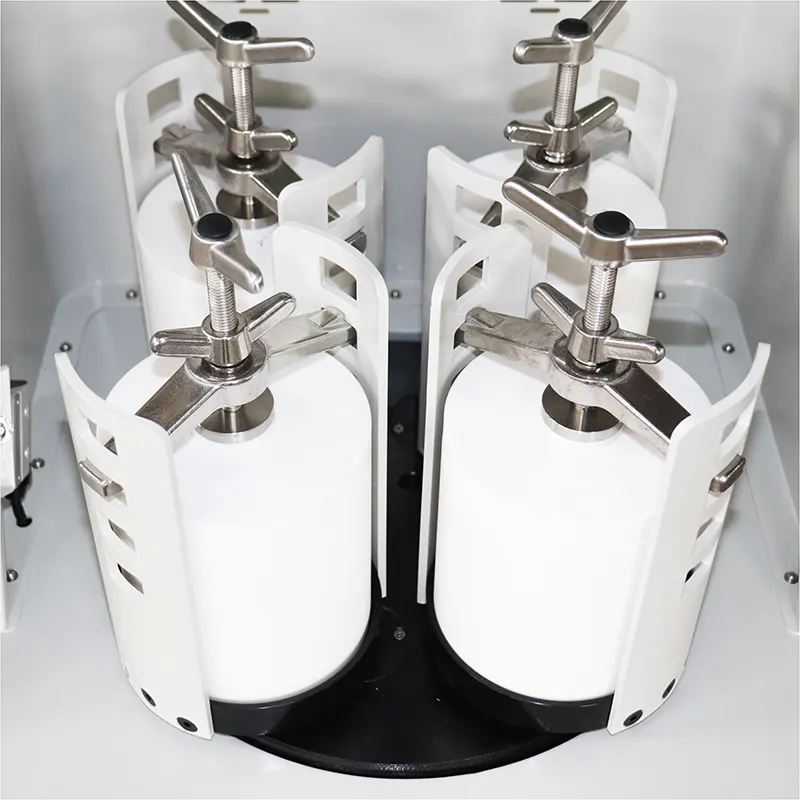
Most laboratory models have two or four grinding stations. A typical configuration is four jars, allowing you to process up to four different samples simultaneously under identical conditions. This is especially useful for comparative studies or when you need to prepare multiple batches at once.
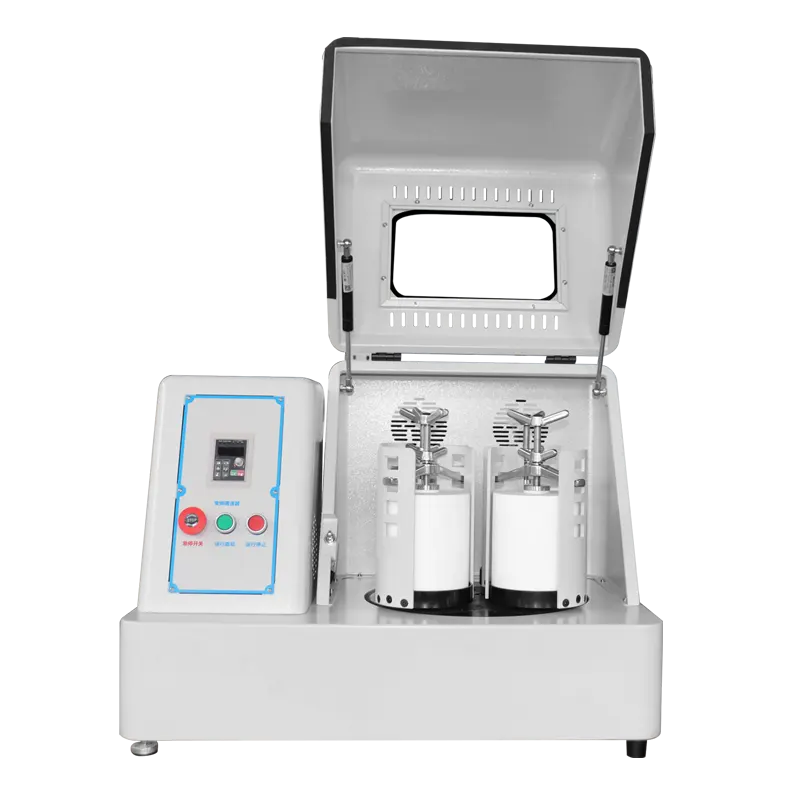
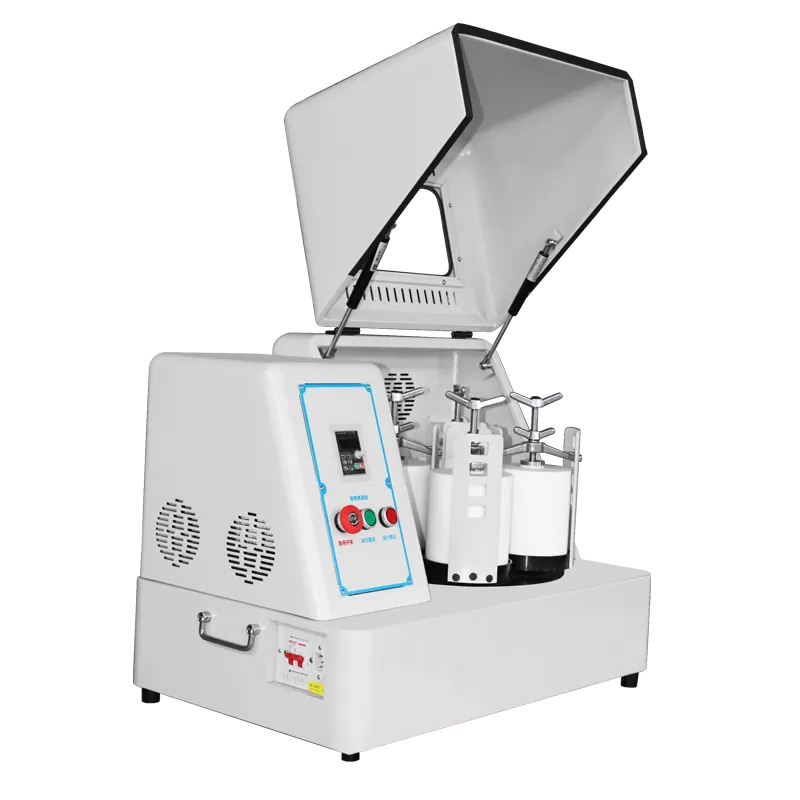
The mechanical design is relatively simple, but the control system plays a critical role. Modern laboratory planetary grinders are equipped with programmable touch screens, allowing you to set rotational speed, grinding time, interval pauses, and direction reversal. These features help improve reproducibility and prevent issues such as excessive heating or powder caking.
Key Parameters That Influence Grinding Performance
Getting the best result from your planetary ball mill is not just about turning up the speed. Several parameters must be optimized according to your material and target particle size. Below we break down the most important ones.
Rotational Speed
The speed of the sun wheel directly determines the energy input. In many laboratory planetary grinders, the speed range is approximately 50 to 600 rpm. Higher speeds produce more impact energy, which is beneficial for hard or brittle materials. However, if the speed is too high, the grinding balls may stick to the jar wall due to excessive centrifugal force, reducing effective grinding. A safe starting point is often 300–400 rpm for common materials, but you should always verify with your specific sample.
Ball-to-Powder Ratio (BPR)
The ball-to-powder ratio is the weight of grinding balls relative to the weight of the powder. This is one of the most commonly adjusted parameters. In many laboratory experiments, a BPR between 5:1 and 20:1 is used. A higher BPR increases the frequency of ball impacts, leading to faster size reduction, but also generates more heat and may cause contamination from ball wear. For mechanical alloying, ratios of 10:1 to 20:1 are typical, while for simple mixing or soft materials, lower ratios may suffice.
Grinding Ball Size and Material
The size of the grinding balls affects the mechanism of comminution. Larger balls (10–20 mm in diameter) deliver strong impact forces and are better suited for breaking down coarse feed materials. Smaller balls (1–5 mm) provide more contact points and are effective for fine grinding, dispersion, and mixing. In some cases, a combination of different ball sizes is used to achieve both impact and shear effects.
The material of the grinding balls must match the jar material and the sample. Common materials include agate (for low contamination), zirconia (for high wear resistance and good compatibility with ceramics), stainless steel (for general use), tungsten carbide (for very hard materials), and alumina. Each has its own density and hardness, which influence the grinding efficiency and potential contamination levels.
Grinding Jar Material and Volume
Grinding jars are available in the same materials as the balls. The jar volume typically ranges from 50 mL to 1 L for laboratory models. A practical rule is to fill the jar to about one-third of its volume with grinding balls, one-third with sample powder, and leave one-third empty as free space for movement. The actual usable capacity is therefore approximately one-third of the nominal jar volume. For example, a 500 mL jar can handle roughly 150–200 mL of material including balls and powder.
Dry vs. Wet Grinding
You can perform both dry and wet grinding in a planetary grinder. Dry grinding is simpler but may cause powder agglomeration or sticking to the jar walls. Wet grinding uses a liquid medium (water, ethanol, or other solvents) to reduce agglomeration, improve dispersion, and prevent dust generation. For wet grinding, the amount of liquid is typically about 1.5 to 2 times the volume of the powder. Wet grinding is often necessary to achieve very fine particles in the nanometer range, but requires subsequent drying steps.
Applications Across Different Materials and Industries
The laboratory planetary grinder is used in a wide variety of fields. Here are some common scenarios:
- Ceramics and Glass: Grinding alumina, zirconia, silicon carbide, and other ceramic powders for advanced ceramic formulations or electronic substrates.
- Minerals and Geology: Preparing rock samples, ores, sand, and cement for XRF, XRD, or other analytical methods.
- Battery Materials: Milling lithium cobalt oxide, graphite, silicon, and solid electrolytes for lithium-ion battery research.
- Pharmaceuticals: Reducing particle size of active ingredients to improve dissolution rate and bioavailability.
- Mechanical Alloying: Producing alloy powders by repeated cold welding and fracturing of elemental powders.
- Catalysts: Preparing supported catalysts by mixing and grinding active components with support materials.
- Nanomaterials: Producing nanopowders, nanofluids, and nanocomposites under controlled conditions.
It is important to note that achieving true nanoscale particles depends strongly on the material's hardness, brittleness, and tendency to agglomerate. In many cases, with proper optimization, particles below 100 nm can be obtained, but this is not guaranteed for every material. You should always run preliminary tests and adjust parameters accordingly.
How to Select the Right Laboratory Planetary Grinder
Choosing the right machine involves matching the equipment's capabilities with your specific requirements. Here is a practical checklist.
1. Sample Quantity and Batch Size
Determine how much powder you need to process per batch. For small-scale R&D, a 0.4 L to 2 L total jar capacity may be sufficient. If you need to produce larger quantities, consider machines with 4 L or higher total capacity. Some models allow using multiple jars of different sizes simultaneously, which adds flexibility.
2. Required Final Particle Size
If your target is micron-level grinding, almost any planetary grinder will work. For sub-micron or nano-scale, you will need a machine with higher speed capability (up to 600 rpm or more) and the ability to use small grinding balls and wet grinding. Some manufacturers offer specialized models for high-energy milling.
3. Material Contamination Sensitivity
If your sample cannot tolerate contamination from metal or other elements, you must select jars and balls made from the same material as your sample or from a wear-resistant material like zirconia or agate. Also, check whether the machine can accept jar materials compatible with your sample.
4. Atmosphere and Safety Requirements
Some materials are reactive in air, requiring vacuum or inert gas protection. Many planetary grinders offer vacuum-compatible jars with sealing gaskets. If you need to handle air-sensitive materials, look for machines that can integrate with a glove box or have built-in vacuum systems. Additionally, for flammable or explosive samples, consider a low-temperature planetary grinder that can use liquid nitrogen cooling to reduce temperature and risks.
5. Local Voltage and Frequency
Laboratory equipment is often shipped with specific motor configurations. Confirm the machine can be set to 110V/60Hz or 220V/50Hz as per your region. Most reputable suppliers offer dual-voltage options.
6. Ease of Operation and Maintenance
Consider whether you need a touch screen interface, programmable cycles, and data logging. These features simplify routine work and improve reproducibility. Also check the clamping mechanism for jars—quick-lock systems save time and reduce errors. Finally, ensure that spare parts like grinding jars and balls are readily available from the supplier.
Common Questions When Choosing a Planetary Grinder
Below are some typical questions researchers ask when evaluating a laboratory planetary grinder.
Q: How long does it take to grind to a fine powder?
A: Grinding time varies widely. Some materials reach micron size in 10–20 minutes, while others may require several hours. You should always run a time series experiment to find the optimal duration for your specific material and target fineness.
Q: Can I use the same jar for different materials?
A: Yes, but you must thoroughly clean the jar and balls between runs to avoid cross-contamination. For materials that are difficult to clean, consider dedicating specific jars to each material type.
Q: What causes excessive heating?
A: High-speed milling generates heat. Using interval programs (e.g., 10 minutes run, 5 minutes pause) helps dissipate heat. Wet grinding also reduces temperature rise because the liquid absorbs energy. If temperature is critical, a cryogenic option is recommended.
Q: How do I reduce powder sticking to the jar?
A: Sticking often occurs in dry grinding of fine powders. Solutions include using a grinding aid (such as a small amount of liquid), increasing the ball-to-powder ratio, or applying direction reversal to prevent centrifugal deposition.
Final Thoughts on Choosing a Laboratory Planetary Grinder
A laboratory planetary grinder is a powerful and versatile tool for powder processing. Its ability to deliver high energy in a small footprint makes it indispensable for research labs. However, the final grinding result depends on many factors: the material properties, the selection of jar and ball materials, the milling parameters, and the method (dry or wet).
When preparing to purchase, it is helpful to compile as much information as possible about your sample: composition, initial particle size, target particle size, batch volume, acceptable contamination level, and any special requirements (vacuum, inert gas, cooling). This allows the equipment supplier to recommend the most suitable model and configuration.
If you are currently evaluating options, take the time to discuss your application with the technical team. A properly matched machine will save you countless hours of troubleshooting and help you achieve consistent, high-quality results from the start. For more detailed specifications and configurations, you can explore the full range of planetary ball mills offered by TENCAN.