
Screening Ball Mill: Control Lab Grind Size
Why Lab Drum Milling Loses Particle Size Control
A grinding campaign that runs long enough will almost always reach a fine median size. The problem is what else comes with it. In a simple rotating drum without any classifying element at the discharge, every particle stays in the chamber until the batch is stopped, which means material that reached the target size early continues to be struck by grinding media for the rest of the run. The outcome is a product whose median may look acceptable while its distribution is far wider than the specification, with a long tail of fines that behaves differently in downstream pressing, casting, coating, or sintering steps.
Particle size distribution, not the median alone, drives most downstream behavior: flowability, packing density, slurry rheology, reaction rate, and the green strength of a pressed part all respond to the coarse and fine ends of the curve. A single-number target hides that. Engineers who specify a screening ball mill are usually trying to convert an uncontrolled batch process into one where the upper end of the distribution is set by a physical feature of the machine rather than by an operator's judgment about when to switch off the drive.
Residence time distribution explains most of the variation. In a batch drum, residence time is effectively identical for every particle, because the whole charge stops together. In a continuous drum, the residence time distribution is broad, and particles that leave early are coarse while those that stay late are overground. A screening discharge narrows that window by removing particles once they are able to pass the aperture, which shortens the average residence time of the finished fraction and reduces the amount of re-breaking it experiences.
There is a second, less obvious effect. When fines are removed as they form, the grinding chamber holds a charge that is coarser on average. Coarse media and coarse particles interact differently from a bed cushioned by fines, so the energy delivered per impact may be used more efficiently and the mill can sometimes reach a target size in less time. Depending on material properties and process conditions, this effect can be noticeable in dry grinding of brittle minerals, ceramics, and slags, and much less visible in ductile, fibrous, or sticky materials that do not fracture cleanly.
Before choosing any configuration, clarify four numbers: the feed top size, the target median, the acceptable coarse cut, and the batch size or throughput required. Everything else — drum diameter and length, rotational speed, media size and material, screen aperture, lining, and drive power — exists to satisfy those four constraints. The same logic applies whether the machine is a small laboratory unit or a pilot-scale drum: the powder defines the machine, not the other way around.
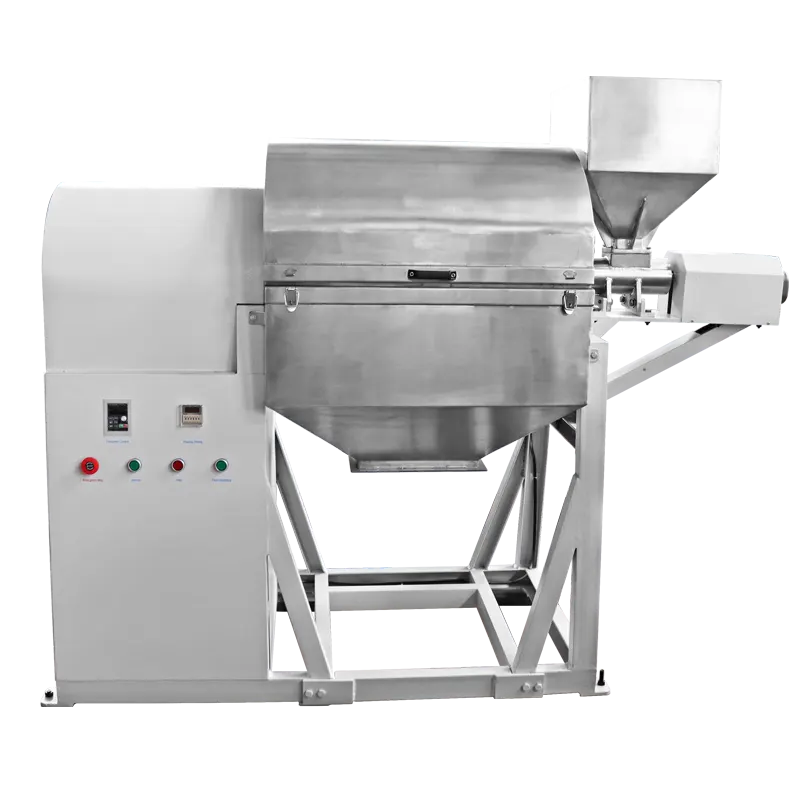
How a Screening Ball Mill Classifies Material at the Discharge End
A screening ball mill combines two functions in one drum: size reduction by tumbling media and size classification by a screening surface at the discharge end. Material and media are charged together. As the drum rotates, the media cascade and fracture the feed; the ground material migrates toward the discharge end and passes through the screen openings, while the grinding media and oversized particles are retained and returned to the grinding zone. Compared with an open-ended drum, the machine governs the size at which material is allowed to leave rather than relying on the operator to decide when the batch is complete.
Where the screening element sits in the grinding path
The screening surface is positioned across the discharge path, so it defines the boundary between the grinding zone and the collection point rather than acting as a high-precision classifier. Particles either pass through the apertures and leave, or they are held back and re-enter the tumbling charge. This arrangement means discharge behavior is governed by two independent variables: the size reduction kinetics inside the drum, which set how quickly particles reach the aperture size, and the aperture itself, which sets what is allowed out. Separating those two variables is what makes the design predictable in routine laboratory work, because changing the screen changes the product cut without altering the grinding mechanics.
What the screen aperture actually controls
The aperture sets the upper limit of what leaves the drum, not the median of the product. Particles that pass the screen are all below the aperture size, but the distribution of that passing stream is still determined by how the charge was ground. A coarse aperture produces a coarse product with a wide spread; a finer aperture produces a finer product and usually requires a longer grind, because the material has to be reduced further before it can escape. The aperture should be selected against the coarse specification limit, with a margin for the fact that irregular or elongated particles pass apertures differently than compact, equant ones.
Two practical constraints apply. First, the aperture must be smaller than the smallest grinding media in the charge; otherwise media can escape into the collection vessel and contaminate the product. Second, aperture size must be matched to an achievable grind: if the aperture is far below what the media can produce within a reasonable time, the drum fills with recirculating coarse material and throughput collapses. Both limits are established by a short test campaign rather than by calculation alone.
How size-selective discharge changes grinding behavior
Once discharge is size-selective, the mill moves toward an internal equilibrium. Coarse particles are retained and broken; fine particles leave and stop being broken. In continuous operation the drum reaches a steady state in which the rate of fine generation equals the rate of discharge, and the product size stabilizes around the aperture-controlled cut. Batch operation behaves differently: the charge is held until the run ends, so the screen mainly prevents oversized material from being collected early, and the final distribution depends on total grinding time. Knowing which mode is being used is essential when interpreting test data.
The practical benefit is a narrower distribution and a lower fines fraction than an unrestricted drum at the same median size. The practical limit is throughput: because discharge is restricted, a screening mill generally processes less material per unit time than an equivalent open-discharge drum. That trade-off between distribution quality and capacity is the central design decision for most laboratory and pilot applications.
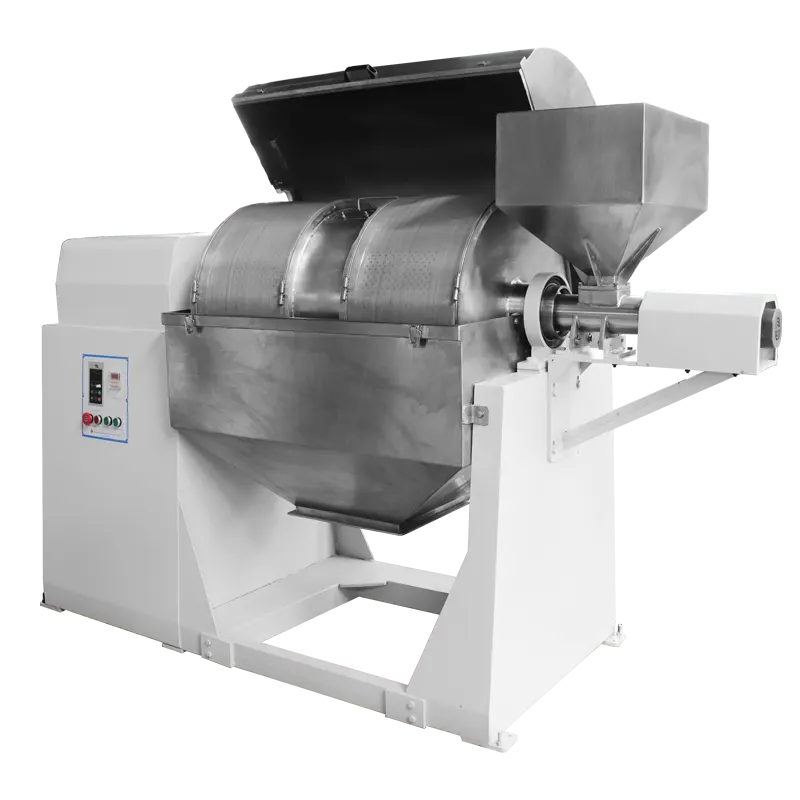
Variables That Decide Screening Ball Mill Performance
Drum speed and the critical speed relationship
The rotational speed of the drum determines how the media are lifted and how they return. The reference point is critical speed, the speed at which the charge would centrifuge and remain pinned to the shell. In practice, tumbling mills run at a fraction of critical speed, and the useful band is fairly narrow. Below roughly half of critical, media slide and roll without enough impact energy, so breakage is slow and largely attritional. As speed rises into the cascading and cataracting region, media are lifted higher and fall further, increasing impact energy and breakage rate, but also increasing wear on the shell, on the media, and on the screening element. Approaching critical speed, the charge rotates with the drum and grinding stops almost entirely.
For a screening ball mill, speed also affects how quickly material reaches the screen. Faster rotation promotes mixing and transport along the drum, but it also raises the mechanical stress on the screening surface. Most operators therefore tune speed for the breakage rate they need and manage transport by feed rate and by the geometry of the discharge end rather than by pushing speed higher.
Grinding media size, density, and charge level
Media choice connects directly to feed size. Large, dense media deliver high impact energy and break coarse feed efficiently, but they leave large voids and tend to produce a coarser grind with more surface damage in the product. Small media create more contact points and finer grinding, but cannot break a coarse feed: if the media are too small relative to the feed top size, the charge simply rolls over the particles. A common starting point is to select media a few times larger than the largest feed particle, then adjust downward as the feed is reduced in subsequent stages.
Density matters as much as diameter. Steel and tungsten carbide media are dense and deliver high specific energy; zirconia is moderately dense and wear-resistant; alumina, agate, and polymer media are lighter and gentler, producing less contamination but requiring longer processing. The choice is usually driven by the tolerable level of contamination in the final product, since media wear reports directly to the powder. For a screening mill the additional constraint is dimensional: media must be uniformly larger than the aperture, which limits how fine a screen can be used with a given media size.
Charge level — the fraction of drum volume occupied by media — controls both the number of contacts and the free volume available for material. Too low a charge reduces breakage frequency; too high a charge crowds the drum, restricts media motion, and increases the load on the drive. Filling the drum to a moderate share of its volume, with enough void space for material to circulate, is the usual compromise, and its optimum is material-specific.
Feed size, feed rate, and screen open area
Feed top size sets the media diameter and the number of grinding stages required. Reducing a 10 mm feed to a 50 µm product in one pass demands a very wide range of breakage events and is usually impractical in a single drum; two stages with different media sizes, or a coarse pre-crush followed by fine grinding, normally give better control of the final distribution. Feed rate, in continuous operation, must be matched to the drum's breakage capacity. Feed too fast and coarse material accumulates ahead of the screen, raising internal hold-up and pushing the product cut coarser; feed too slow and the media strike each other instead of the material, accelerating wear without improving throughput.
Open area — the proportion of the screening surface that is actually open — sets the flow capacity of the discharge. A screen with a small aperture and a thick profile has less open area and passes less material, so the drum can back up even when the grind itself is adequate. Screen geometry, aperture shape, and the way the surface is supported all influence open area and therefore the practical throughput ceiling.
Screen condition, blinding, and temperature effects
Screening surfaces change with use. Abrasive powders open apertures by wear; ductile, moist, or electrostatically charged powders blind them. Either drift changes the product cut without any adjustment to the mill settings, which is why periodic checks of the screen belong to routine operation rather than to troubleshooting. A screen that is partly blinded reduces effective open area and raises internal hold-up; a screen that has worn oversize lets coarse particles through and the distribution shifts upward. Consistent results depend on inspecting or replacing the screening element on a defined schedule and on keeping the drum's internal conditions consistent between runs.
Moisture and static are the most common causes of blinding in dry laboratory work. Feed that has absorbed atmospheric moisture can bridge across fine apertures, and powders carrying a static charge behave in much the same way. Drying the feed, controlling the humidity of the grinding environment, and avoiding over-filling the drum are the usual countermeasures. Temperature is the other slow variable worth watching: extended grinding heats both powder and hardware, and a warm, humid drum interior promotes exactly the bridging behavior that reduces throughput.
Dry and Wet Processing, and Contamination Control
Screening discharge is most straightforward in dry grinding, where powder flows through the apertures under gravity and a modest amount of drum rotation. Wet grinding is possible, but the liquid changes the problem: the screen must pass a slurry rather than a free-flowing powder, so viscosity, solids loading, and the wetting behavior of the material govern whether the screen works as intended. Above a certain solids content, a slurry becomes too viscous to pass a fine aperture at a useful rate, and the mill behaves like a closed batch vessel. Many laboratories therefore reserve wet screening for coarser apertures and use dry screening when a defined top cut is the priority.
Wet grinding has compensating advantages that are independent of classification: it suppresses dust, limits oxidation of reactive powders, moderates temperature rise, and often improves breakage of materials that agglomerate when dry. If the process requires liquid, the choice is usually between accepting a coarser screen, reducing solids loading to keep the slurry mobile, or operating the drum as a batch mill and classifying in a separate step.
Contamination control: media, lining, and cleaning
Every grinding operation adds material to the product from media and from drum surfaces. The question is whether that addition is acceptable. In trace-element work, catalyst preparation, battery materials, and electronic ceramics, even small amounts of iron or chromium can change the result, so media and lining are selected for compatibility with the powder rather than for grinding speed alone. Non-metallic media and wear-resistant ceramic linings reduce metallic contamination at the cost of a lower breakage rate, and that trade-off is settled by the analytical tolerance of the final product.
Cross-contamination between campaigns is the other source of error. Powder trapped in apertures, in corners of the discharge end, and around media is released into the next batch. Cleaning procedures that include media, screening element, and drum interior — not just the visible surfaces — are what keep successive campaigns comparable, especially when the mill is used for several materials in rotation.
Media wear should also be monitored as a process variable. Rising wear rates usually indicate that the media are striking each other rather than the material, which points to an over-long grind, too little feed, or a charge that is too small. Linking wear measurement to grinding time and throughput is a simple way to detect a drifting process before it shows up in the size distribution.
Sizing and Validating a Screening Ball Mill for Your Application
Sizing starts from the powder, not the machine. The relevant inputs are feed top size and feed size distribution, the target median and the acceptable coarse limit, the required sample mass or throughput, the material's hardness and abrasiveness, its moisture sensitivity, and the tolerable contamination level. From these, drum volume follows from the batch mass and the bulk density of the charge; drum diameter follows from the media size needed to break the feed; and drive power follows from the charge mass and the desired speed. The screen aperture is then set just below the coarse specification limit, subject to the constraint that it must be smaller than the smallest media.
One point is easy to overlook: capacity and cut quality pull in opposite directions. A screening mill with a fine aperture produces an excellent top cut but limited throughput; making the drum larger increases batch capacity but does not change the kinetics. Where a project needs both a tight cut and high throughput, a two-stage approach — coarse breakage in an unrestricted mill followed by a finishing pass in a drum-type screening ball mill — often gives better overall economics than trying to satisfy both requirements in one drum.
| Process requirement | Primary machine decision | Main trade-off |
|---|---|---|
| Feed top size | Media diameter and drum diameter | Large media break coarse feed but coarsen the product |
| Target median | Grinding time, media size, number of stages | Longer time narrows the median but raises fines and wear |
| Coarse specification limit | Screen aperture, checked against smallest media | Finer aperture improves the cut, reduces throughput |
| Batch mass or throughput | Drum volume, charge level, open area | Larger volume increases capacity, not kinetics |
| Contamination tolerance | Media and lining material | Non-metallic media reduce contamination, slow breakage |
What to test before committing to a configuration
A short, structured test program answers most scale-up questions more reliably than calculation:
- Grind a representative feed at several batch times and record the full size distribution, not only the median, so the coarse tail is visible.
- Repeat at two or three media sizes with the same drum speed to separate the effect of media from the effect of time.
- Test two screen apertures with everything else fixed to measure the shift in the coarse cut and the change in throughput.
- Measure media wear and check the product for contamination after an extended run, not after a single short batch.
- Record the temperature rise of the powder and the drum, since heat affects both the material and the stability of the screening element.
- Verify repeatability by running the same conditions at least three times and comparing the resulting distributions.
Where a laboratory already operates a roller-mounted jar mill or a planetary mill, a screening drum complements rather than replaces it. The jar mill provides gentle, low-contamination grinding for small samples; the planetary mill produces very fine sizes quickly but with a broad distribution and no discharge control; the screening ball mill sits between them, offering a defined top cut at sample sizes large enough for pilot evaluation and process development.
Operating Problems and What to Check First
Most day-to-day problems in screening ball mill operation trace back to a small number of causes. The table below lists the usual symptoms with the first checks worth making. It is written as a diagnostic sequence rather than a list of remedies, because the same symptom can arise from opposite causes — a product that is too coarse can mean insufficient grinding time or a worn screen, and only inspection distinguishes the two.
| Symptom | Likely cause | First check |
|---|---|---|
| Product coarser than expected | Worn or oversized screen; short grinding time; feed rate too high | Inspect aperture size and open area; review batch time or feed rate |
| Throughput far below expectation | Blinded screen; aperture too fine for the media; excessive hold-up | Check the screen for blinding and moisture; confirm media size against aperture |
| Wide distribution with heavy fines | Overgrinding; discharge not classifying; charge too small | Verify the screen is passing material; reduce batch time; increase charge |
| Media escaping into the product | Aperture larger than the smallest media; damaged screen | Measure media and aperture; inspect the screen for distortion |
| Contamination above tolerance | Media or lining wear; carry-over from a previous batch | Review wear rate and cleaning procedure |
| Results drifting between runs | Screen wear or blinding; varying feed moisture; inconsistent charge | Standardize charge mass and moisture; inspect and replace the screen |
Two of these checks deserve emphasis. Screen inspection should include measurement, not only visual assessment: an aperture that has opened by wear of a few tens of microns can shift the coarse cut enough to fail a specification, and the change is invisible without a gauge or a reference sample. The second is charge consistency. Laboratory results are comparable only if media mass, material mass, and drum fill are the same from run to run, because small variations in charge level change media motion and therefore the breakage rate.
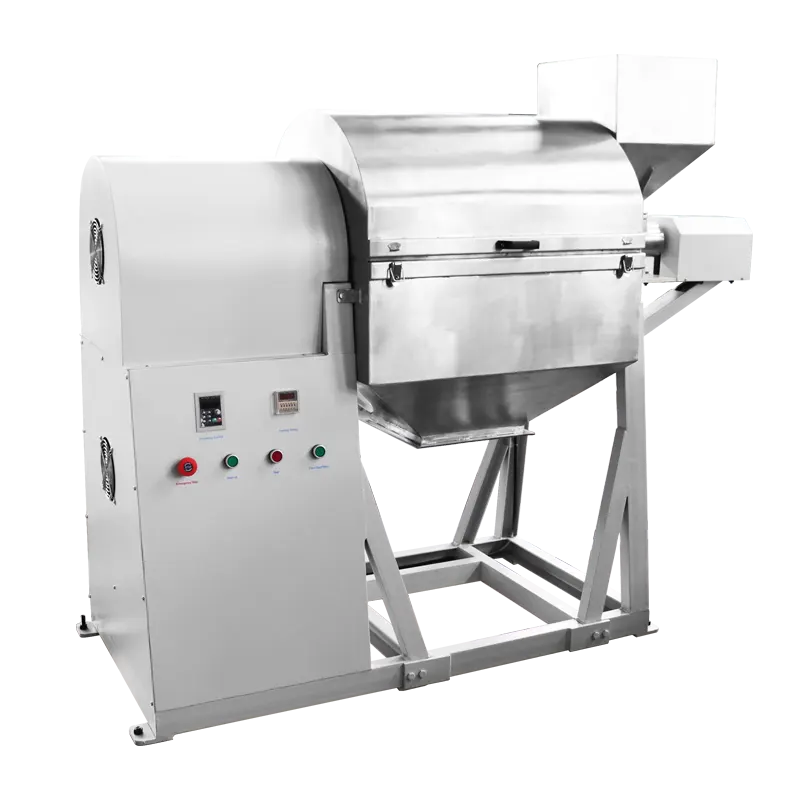
Questions Engineers Ask About Screening Ball Mills
Does a screening ball mill produce a finer product than a standard drum mill?
Not necessarily finer, but usually narrower. The screen limits the coarse end of the distribution by holding oversized particles in the drum. Whether the median also becomes finer depends on grinding time, media size, and how much material recirculates, and the answer should be confirmed by measurement rather than assumed.
Can it be used for wet grinding?
Yes, with the caveat that the slurry must remain mobile enough to pass the aperture at a useful rate. Viscosity, solids loading, and particle wetting behavior all affect this. Where a very fine top cut and a high-solids slurry are both required, separating grinding and classification into two steps is often more reliable.
How is the correct screen aperture chosen?
Start from the coarse specification limit, then select the nearest aperture below it, with a margin for non-spherical particles. Confirm that the aperture is smaller than the smallest media in the charge and that the grind can reach that size within a practical batch time. Testing two apertures under otherwise identical conditions is the fastest way to see the effect.
What determines how long a batch should run?
In a batch screening mill, the screen mainly prevents premature discharge of coarse material, so batch time still controls the median. The right duration is the shortest time that meets both the target median and the coarse limit, verified by size measurement across a time series. Longer is not better: it increases fines, media wear, and heat.
How does scale-up affect the result?
Increasing drum diameter changes the media motion pattern and the number of impacts, while increasing drum length changes residence time. Matching the fraction of critical speed, the charge level, and the media-to-feed size ratio is more useful than matching a single parameter, and the final configuration is normally confirmed with a pilot run using the same feed material.
Is a screening ball mill suitable for heat-sensitive materials?
It can be, provided grinding time is kept short and the drum is not over-filled, since unnecessary circulation generates heat without improving the product. Where the material is genuinely temperature-sensitive, longer low-energy grinding is usually the wrong answer; a staged approach with a coarse pre-grind and a short finishing pass limits exposure.
Practical Guidance Before You Specify
Treat the screening ball mill as a controlled-grind device rather than a high-throughput one. Its value lies in making the coarse end of the distribution a design decision rather than a statistical outcome, and that value is realized only when the rest of the process is under control: consistent charge mass, measured screens, documented batch times, and a feed whose moisture content does not change between campaigns.
Configuration options for laboratory grinding equipment, including the drum and screening arrangement used in the grinding series, are published by Changsha Tianchuang Powder Technology Co., Ltd (TENCAN); the Screening Ball Mill product page is a useful companion to this analysis. Reading it alongside the four numbers that define a real requirement — feed top size, target median, coarse limit, and batch size — makes the comparison between available models much faster than browsing specifications alone.
Where a defined top cut matters more than maximum throughput — catalyst supports, ceramic precursors, mineral reference samples, or any powder that must pass a downstream sieve check before use — the screening arrangement usually pays for itself in repeatability. Where raw throughput dominates and the coarse end is not critical, an unrestricted drum or a planetary mill will often be the better first choice. Testing a representative feed on a small unit remains the most reliable way to decide between them.