
What is a Nylon Planetary Mill Jar? A Wear-Resistant Grinding Container for Contamination-Free Sample Preparation
What is a Nylon Planetary Mill Jar?
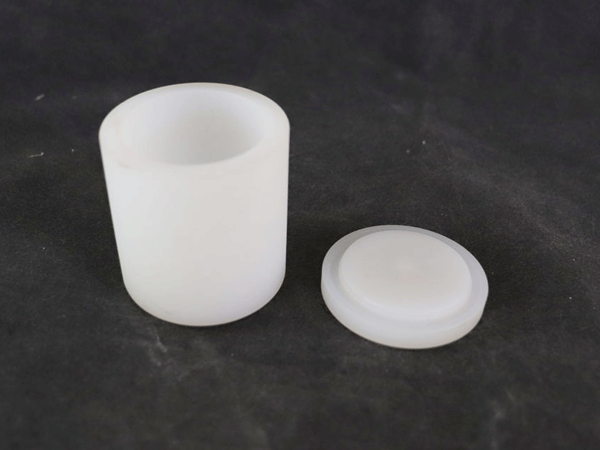
At its core, a nylon planetary mill jar is a specialized grinding container designed for use in planetary ball mills. It is made from high-grade nylon (polyamide) material, offering a lightweight, non-metallic alternative to traditional steel or ceramic jars. Researchers and engineers use it to grind, mix, and homogenize a wide variety of materials without introducing metallic contamination, making it ideal for preparing samples for sensitive analyses and high-purity applications.
Core Function and Working Principle
The primary function of a nylon planetary mill jar is to hold the sample and grinding media (such as balls) during high-energy planetary milling. When the jar is fixed onto the rotating plate of a planetary ball mill, it rotates along its own axis (self-rotation) while simultaneously revolving around the central axis (revolution). This dual motion generates strong centrifugal and Coriolis forces, causing the grinding balls to collide, shear, and compress the sample inside the jar. The result is efficient size reduction down to micron or even nanometer scales.
Nylon jars are particularly effective for dry and wet grinding of soft to medium-hard materials, such as minerals, chemicals, polymers, and biological samples. Since nylon has good toughness and heat resistance, it can withstand moderate impact and temperature rise during milling without deforming. However, it is not recommended for extremely hard materials like quartz or tungsten carbide, where harder jar materials (e.g., stainless steel or zirconia) would be more suitable.
Key Properties and Advantages of Nylon Jars
Compared to other planetary mill jars, nylon offers distinct benefits:
- Contamination-free grinding: Nylon does not contain heavy metals, so it prevents iron, chromium, or other trace element contamination that could interfere with subsequent analysis or product quality.
- Lightweight: Nylon jars are significantly lighter than steel or ceramic jars, reducing the total weight load on the mill and allowing higher rotational speeds for more efficient grinding.
- Chemical resistance: Nylon resists many organic solvents, acids, and bases, making it suitable for grinding chemical samples without corrosion.
- Low noise and vibration damping: The inherent elasticity of nylon helps absorb vibration, resulting in quieter operation compared to metal jars.
- Good sealing performance: With proper lid and gasket design, nylon jars can provide reliable sealing during milling, preventing sample leakage.
Key Performance Indicators and Selection Criteria
When choosing a nylon planetary mill jar, consider the following factors:
Material Grade
High-quality nylon (such as PA6 or PA66) with good mechanical strength and heat deflection temperature ensures longevity. Some suppliers offer tempered nylon jars that have enhanced toughness and wear resistance.
Capacity and Dimensions
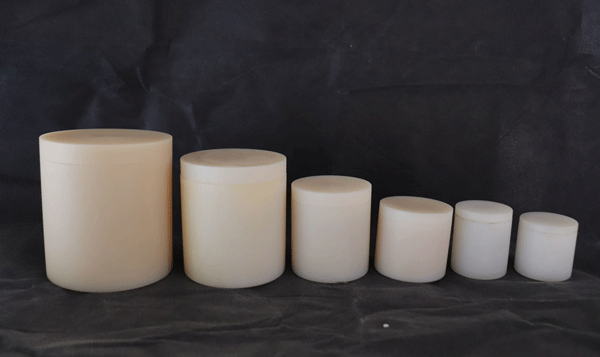
Common capacities range from 50 mL to 4 L. Choose a volume that matches your sample amount and mill specifications. Ensure the jar’s dimensions are compatible with your planetary ball mill’s locking mechanism.
Sealing Efficiency
Good sealing prevents dust and liquid from escaping. Many nylon jars come with rubber O-rings or PTFE seals. For oxygen- or moisture-sensitive samples, consider vacuum planetary mill jars.
Processing Conditions
Nylon jars can typically work at rotation speeds up to 600–800 rpm, but each model has specific limits. Always check the maximum speed recommended by the manufacturer to avoid cracking or deformation.
Application Fields and Selection Advice
Nylon planetary mill jars are widely used in:
- Materials research and development (R&D) – for preparing standard samples in XRD, XRF, or spectroscopic analysis.
- Pharmaceutical and biological industries – for grinding active ingredients, excipients, or tissue samples without metal contamination.
- Chemical and polymer science – for mixing and dispersing pigments, catalysts, or polymer additives.
- Geology and mineralogy – for grinding rock and mineral powders for elemental analysis.
If your primary concern is avoiding metal contamination and your samples are not extremely hard, a nylon jar is an excellent cost-effective choice. For ultra-hard materials or high-temperature milling, consider zirconia jars or 304 stainless steel jars. For applications requiring extreme purity, agate jars are another high-end option.