
Microwave Vacuum Drying Oven: How It Works, Applications, and Selection Guide
When you work with heat-sensitive materials — such as pharmaceutical intermediates, biological extracts, battery electrode powders, or fine chemicals — conventional hot-air drying often leads to degradation, surface hardening, or loss of volatile components. The slower the drying, the greater the risk of thermal damage. This is where a microwave vacuum drying oven stands out: it dries materials at low temperature, under reduced pressure, and with volumetric heating that can dramatically shorten processing time.
In this article, we will walk through the basic principles of microwave vacuum drying, explore its typical applications in laboratories and pilot-scale production, and discuss the key factors you should consider when selecting a suitable unit for your work.
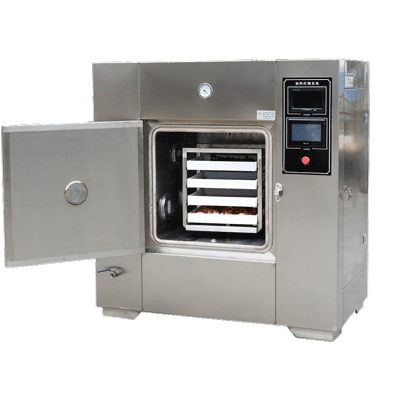
What Is a Microwave Vacuum Drying Oven?
A microwave vacuum drying oven is a specialized drying system that combines two distinct technologies:
- Microwave heating – Electromagnetic waves at 2450 MHz (or 915 MHz for industrial units) penetrate the material and cause polar molecules (especially water) to oscillate, generating heat from within the particle or sample.
- Vacuum environment – The chamber is evacuated to a negative pressure (commonly -0.08 MPa or lower), which significantly lowers the boiling point of water. At -0.08 MPa, water can vaporize at around 30–40 °C instead of 100 °C at atmospheric pressure.
By combining these two mechanisms, the oven achieves rapid drying at low temperatures without relying on external heat conduction. This is especially valuable for samples that cannot tolerate prolonged exposure to high temperatures.
How Does It Work? – The Science Behind the Process
Understanding the physics helps you better control the process:
Low-Temperature Vaporization Under Vacuum
In a regular oven, water boils at 100 °C (at sea level). But when you reduce the chamber pressure, the boiling point drops. For many laboratory microwave vacuum drying ovens, the achievable vacuum level is around -0.095 MPa, which brings the boiling point of water down to roughly 30–40 °C. This means that even heat-sensitive organic compounds, enzymes, or botanical extracts can be dried without thermal decomposition.
Volumetric Microwave Heating
Unlike conventional drying where heat travels from the surface inward (requiring a temperature gradient and often causing a hard outer crust), microwaves penetrate the bulk of the material. Water molecules inside the sample are excited directly, creating internal heat and vapor pressure. This internal pressure helps drive moisture out of the material more quickly. The result is faster drying with more uniform moisture removal.
It is important to note that not all materials absorb microwaves equally. Materials with low dielectric loss (e.g., some ceramics or dry polymers) heat poorly, while materials containing water or polar solvents heat rapidly. Blending or pre-wetting can sometimes improve efficiency.
Key Advantages Over Conventional Drying Methods
- Drying time – Because heating is volumetric and vaporization occurs at low temperature, drying cycles can be reduced from hours to minutes for many materials.
- Product quality – Low temperatures preserve color, aroma, bioactivity, and chemical structure. Shape and morphology are better retained compared to hot-air drying.
- Energy efficiency – Microwave energy is absorbed directly by moisture, so less energy is wasted heating the oven walls or dry air.
- Uniformity – The combination of vacuum and volumetric heating reduces the risk of surface hardening and uneven moisture gradients.
Common Applications in Laboratory and Research
A microwave vacuum drying oven is used across many fields where low-temperature, rapid drying is critical:
| Field | Typical Materials |
|---|---|
| Pharmaceuticals | APIs, herbal extracts, granules, heat-sensitive drugs |
| Food & Agriculture | Fruit powders, vegetable extracts, spices, enzymes |
| Chemical industry | Catalysts, fine chemicals, pigments, polymers |
| Battery materials | Lithium cathode/anode powders, electrolyte precursors |
| Biotechnology | Freeze-dried cultures, proteins, biological specimens |
It is also commonly used for drying powders that have been wet-milled in a planetary ball mill or other grinding equipment, where the slurry needs to be dried before further processing.
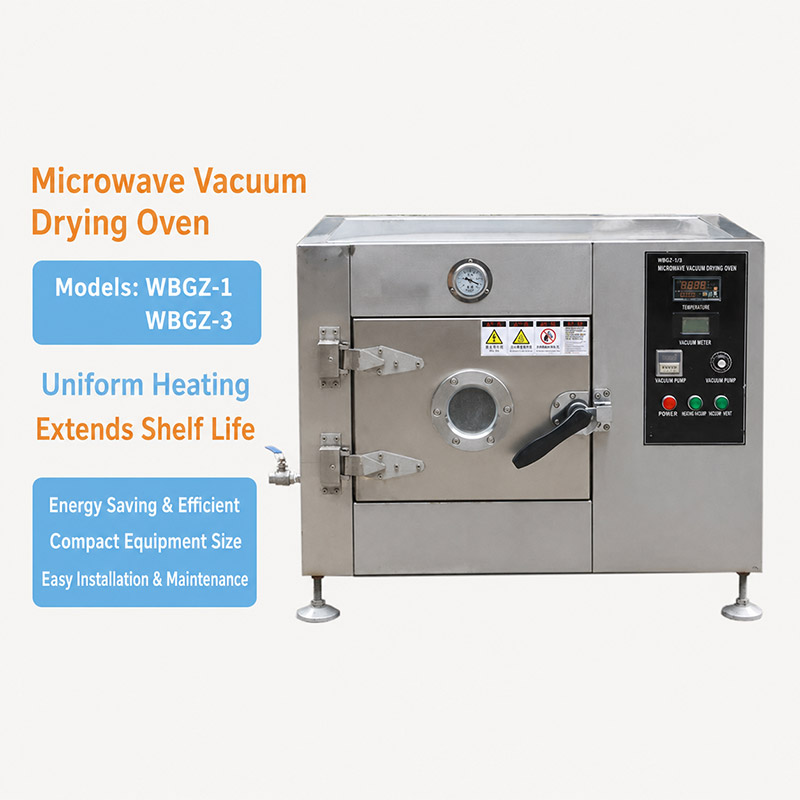
How to Select a Microwave Vacuum Drying Oven
Choosing the right unit for your lab or pilot line depends on several practical factors:
1. Chamber Volume and Usable Space
Laboratory models typically range from 10 L to 100 L. Consider not just the nominal volume, but the actual tray area and how many samples you need to process per batch. If you work with thin layers of powder, a larger tray area is more important than total volume.
2. Microwave Power and Control
Most lab units offer adjustable microwave power (e.g., 0–1000 W or 0–2000 W). The ability to ramp power is essential for controlling drying rate and avoiding overheating when the material is still wet. Look for a unit with programmable power profiles and feedback temperature control.
3. Vacuum Level and Pump Compatibility
The deeper the vacuum, the lower the achievable drying temperature. A typical lab microwave vacuum drying oven can reach -0.095 MPa or better. Make sure the system includes a reliable vacuum gauge and a connection port for your vacuum pump. Some models come with an integrated pump or a solenoid valve for controlling the vacuum.
4. Temperature Measurement and Uniformity
Infrared or fiber-optic temperature sensors are preferred in microwave ovens because metal thermocouples can cause arcing or interfere with the microwave field. Check whether the oven provides real-time temperature feedback and whether the heating pattern is reasonably uniform across the tray.
5. Material of Construction
The chamber should be made of stainless steel (304 or 316L) to resist corrosion and allow easy cleaning. For applications involving solvents or corrosive vapors, a PTFE or glass lining may be required.
Important Limitations and Practical Tips
- Not all materials absorb microwaves equally. If your sample contains little water or polar solvent, microwave heating will be less effective. You may need to add a small amount of water or a polar absorber.
- Avoid arcing with metal parts. Never place metal utensils, metal racks, or metal-containing samples directly inside a microwave chamber unless the unit is specifically designed for that purpose.
- Monitor temperature closely during the final drying stage. As moisture content drops, microwave absorption decreases and the material temperature can rise rapidly if power is not reduced.
- Agglomeration can occur if the powder is too fine or contains binders. Intermittent microwave application or gentle stirring inside the chamber (if designed) can help.
Why Consider a TENCAN Microwave Vacuum Drying Oven?
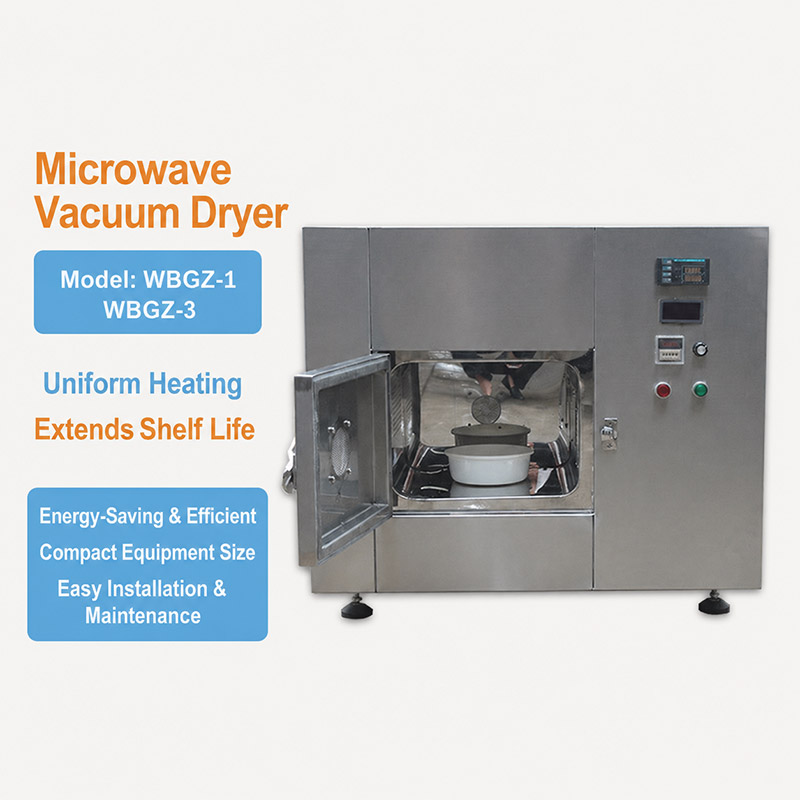
At TENCAN (Changsha Tianchuang Powder Technology Co., Ltd.), we have been designing and manufacturing powder processing and drying equipment for research and production environments. Our microwave vacuum drying oven is built with:
- Stainless steel chamber for easy cleaning and corrosion resistance
- Adjustable microwave power (typically up to several kilowatts)
- High-vacuum capability with standard vacuum gauge and port
- Programmable temperature and power control for consistent results
- Safety interlocks to prevent microwave leakage and accidental operation
Whether you are drying a few grams of a precious catalyst in a university lab or scaling up to kilogram batches for pilot production, we can help you configure the right chamber size, vacuum pump, and control options for your specific materials and process conditions.
Final Thoughts
A microwave vacuum drying oven offers a powerful combination of low-temperature operation, volumetric heating, and fast drying cycles. It is particularly valuable for researchers and production engineers who work with heat-sensitive, high-value materials that cannot tolerate long drying times or thermal degradation. By understanding the principles of vacuum and microwave interaction with your material, you can optimize the drying process to achieve better product quality and higher throughput.
If you are evaluating a microwave vacuum drying oven for your laboratory or production line, consider factors such as chamber size, power controllability, vacuum performance, and material compatibility. And if you need technical support in selecting the best configuration for your application, the engineers at TENCAN are ready to share their experience.
For more details about our microwave vacuum drying oven and related laboratory drying accessories (such as vacuum drying ovens, circulation ovens, and freeze dryers), feel free to explore our product pages.