
TENCAN Vacuum Feeder: Efficient and Reliable Powder Material Transfer for Laboratory and Research Applications
Introduction
In modern laboratories, the efficient and safe transfer of powder materials is a critical step in sample preparation, grinding, mixing, and flotation processes. Traditional manual feeding methods often lead to dust generation, material loss, cross-contamination, and inconsistent feeding rates. The TENCAN Vacuum Feeder offers a reliable, automated, and dust-free solution for conveying powders, granules, and small particles directly into grinding jars, flotation cells, or other processing equipment. This article explores how the vacuum feeder enhances laboratory workflow, the key features that make it a valuable addition to any research facility, and why TENCAN is a trusted partner for your powder handling needs.
Why Laboratories Need a Vacuum Feeder
Laboratories dealing with powders—whether for ball milling, flotation, mixing, or sample preparation—face several common challenges: fine powders can create airborne dust, posing health and cleanliness risks; manual scooping is time-consuming and inconsistent; and materials that are sensitive to moisture or oxygen require sealed transfer. A vacuum feeder addresses these issues by using negative pressure to draw material through a closed system, ensuring a clean, repeatable, and gentle transfer without dust leakage or contamination. It is particularly beneficial when combined with experimental flotation machines or portable tissue grinders, where precise material feed is essential for reproducible results.
How TENCAN Vacuum Feeder Works
The TENCAN Vacuum Feeder operates on a simple yet effective principle: a vacuum pump creates negative pressure inside the feeder body, which draws powder material from a source container through a flexible hose into the receiving hopper or directly into the target equipment. The system is equipped with a filter to retain fine particles and prevent them from entering the vacuum pump, ensuring long service life. The feeding rate can be adjusted by controlling the vacuum level and the material inlet valve, allowing for both batch and continuous feeding. This design makes it ideal for feeding multi-channel tissue grinders or high-throughput tissue grinders where multiple samples need consistent powder loading.
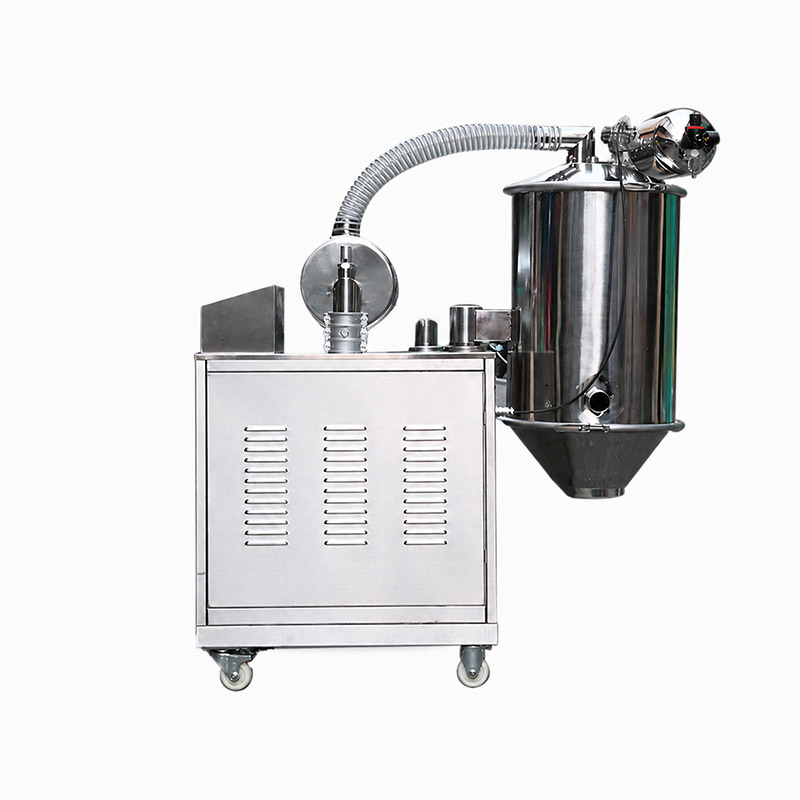
Key Features and Benefits
Dust-Free Operation
The closed system prevents powder from escaping into the laboratory environment, reducing the risk of inhalation and cross-contamination. This is especially important when handling toxic, fine, or reactive powders.
Adjustable Feeding Rate
Operators can easily control the vacuum level and material flow to match the requirements of downstream equipment, such as a mini high-speed centrifuge or multi-station magnetic stirrer.
Easy to Clean and Maintain
The feeder components—including the hopper, hose, and filter—can be disassembled quickly for cleaning, minimizing downtime between different materials.
Compact and Portable Design
The TENCAN Vacuum Feeder occupies minimal bench space and can be easily moved between workstations, making it suitable for both dedicated and shared laboratories.
Compatible with Various Equipment
It can be integrated with planetary ball mills, roll ball mills, flotation machines, and other lab instruments, providing a seamless material feeding solution.
Where TENCAN Adds Value
High Cost Performance
Compared to complex automated feeding systems, the TENCAN Vacuum Feeder delivers excellent value by offering reliable performance at a competitive investment. Laboratories can achieve automated powder transfer without the high cost of large-scale industrial feeders.
Flexible Customization
TENCAN understands that every laboratory has unique needs. The vacuum feeder can be customized with different hose lengths, hopper capacities, filter materials, and vacuum pump options to match specific powder properties and workflow requirements.
Fast Lead Time
Standard configurations of the TENCAN Vacuum Feeder can be prepared for shipment in approximately 3–7 days, helping laboratories get their processes running quickly.
Broad Product Range
Beyond the vacuum feeder, TENCAN offers a complete line of laboratory equipment, including hanging tank flotation machines, portable mini magnetic blenders, and mini centrifuges, allowing customers to source multiple solutions from one trusted manufacturer.
Free Sample Testing Before You Buy
One of the most valuable services TENCAN offers is the free sample grinding test for ball mill users, but this principle also extends to the vacuum feeder. Potential buyers can send their powder samples to TENCAN for a trial run to verify feeding efficiency, material compatibility, and dust control performance. This pre-purchase testing reduces the risk of selecting the wrong equipment and ensures that the vacuum feeder will meet your specific material handling needs.
Understanding the Trade-Offs
| Selection Factor | What Buyers Should Consider |
|---|---|
| Feed rate control | Manual vs. adjustable vacuum control affects precision |
| Material type | Fine powders, granules, or sticky materials require different hose and filter configurations |
| Integration with existing equipment | Check compatibility with inlet sizes and control interfaces |
| Cleaning procedure | Quick-disassembly design reduces cross-contamination risk |
| Cost vs. manual feeding | Automation improves consistency but requires initial investment |
How to Apply This to Your Project
Standard Laboratory Material Transfer
For routine powder feeding into ball mills, mixers, or flotation cells, the standard TENCAN Vacuum Feeder provides reliable performance with minimal setup.
Dust-Sensitive or Hazardous Materials
When handling toxic, fine, or reactive powders, the closed system ensures operator safety and laboratory cleanliness.
Multi-Equipment Workflow
Use the feeder to sequentially supply multiple instruments, such as a multi-channel tissue grinder and a mini centrifuge, improving overall efficiency.
Customized Feeder System
If your material has unusual flow characteristics or requires special filtration, TENCAN can customize the feeder to meet your exact requirements.
Buyer Checklist
| Information to Provide | Why It Matters |
|---|---|
| Material name and particle size | Determines hose diameter and filter type |
| Bulk density | Affects vacuum pressure requirement |
| Feeding distance and height | Determines hose length and pump capacity |
| Target equipment inlet | Ensures proper connection adapter |
| Desired feed rate (kg/h or g/min) | Helps set vacuum adjustment range |
| Dust control requirement | Dictates filter efficiency and sealing |
| Cleaning frequency | Influences design for quick disassembly |
| Voltage and electrical requirements | Ensures power compatibility |
Summary Table
| Aspect | Best Fit When... |
|---|---|
| Material fit | Fine to granular powders, non-sticky, free-flowing |
| Feeding technology | Vacuum suction with adjustable negative pressure |
| Customization | Hose lengths, filter materials, hopper sizes available |
| Lead time | Standard configurations ready in 3–7 days |
| Sample testing | Free trial available before purchase |
| Cost performance | Competitive for labs seeking automation on a budget |
| Best-fit customer | R&D labs, universities, QC facilities, small-scale production |
Conclusion
There is no one-size-fits-all solution for powder material transfer in the laboratory. The choice depends on material properties, desired feed rate, integration requirements, and budget. The TENCAN Vacuum Feeder stands out as a practical, cost-effective, and customizable option for laboratories looking to automate powder feeding while maintaining a clean and safe environment. With the ability to adapt to various equipment, quick delivery, and free sample testing support, it is a strong choice for researchers and engineers who value efficiency and reliability. Send Your Grinding Requirements to TENCAN or Request a Free Sample Grinding Test to discuss your specific application.