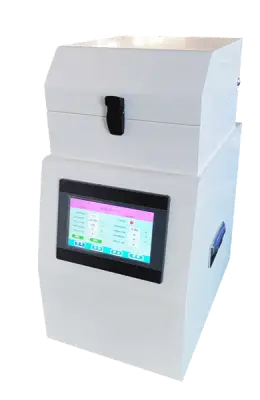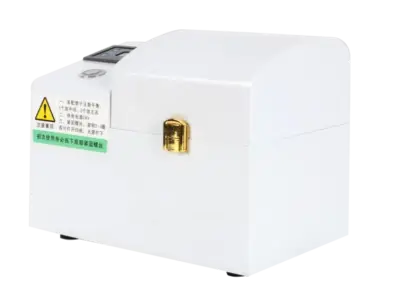
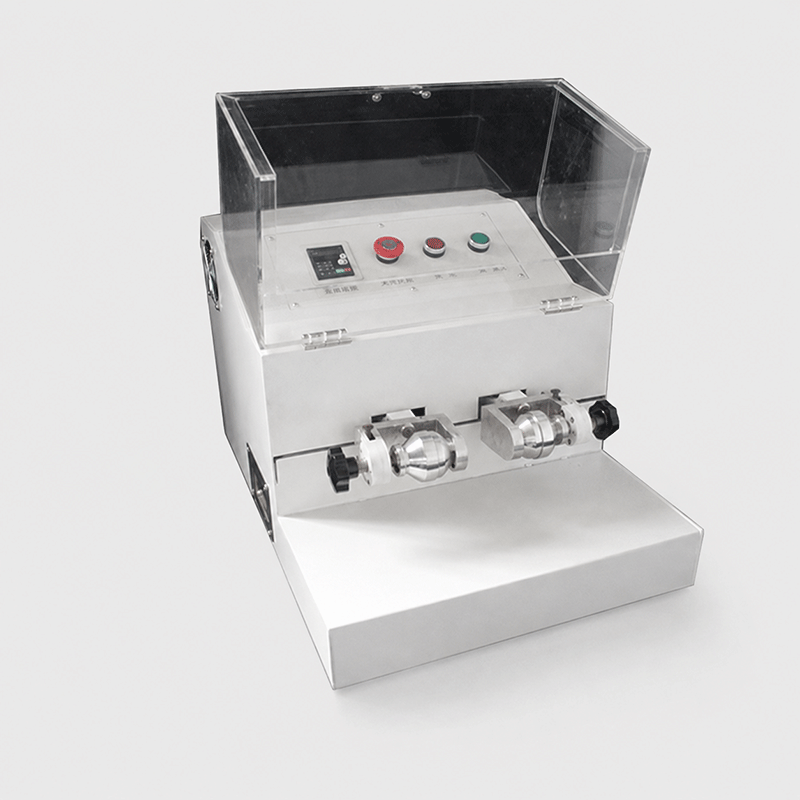

The grinding jar of the tissue grinder swings in an arc in the horizontal direction under the driving action of the swing arm. The material in the grinding jar is subject to the inertial impact force of the grinding ball and the collision and grinding shear force with the high-speed movement of the grinding jar, thereby achieving the effect of crushing and grinding. The superposition of the high-speed movement of the grinding jar and the movement of the grinding balls in the grinding jar makes the sample fully mixed.
Using multiple small-diameter grinding balls during grinding can greatly improve the uniformity of the material. Tissue cells can be disrupted by using a large number of small beads (such as glass beads). The huge impact and friction between balls can effectively break cells.
The tissue grinder is a product specially developed for processing small quantities of samples in the laboratory. It is not only suitable for fine crushing and fine grinding of hard, medium hard and brittle samples, but also suitable for crushing and grinding of soft, elastic, fibrous and other materials.
The tissue grinder can crush and grind many materials including fibrous tissue, bones, hair, chemicals, pharmaceuticals, minerals, ores, alloys, glass, ceramics, soil, sludge, and grain particles. For most materials, the equipment only takes tens of seconds to crush, grind and mix the materials.
The tissue grinder runs very fast, so the materials can be processed in a very short time without significant temperature rise. Therefore, this equipment can avoid the impact of temperature on the experiment, so most materials can be ground and mixed at room temperature.

Technical parameters
| Function | Crush, grind, mix |
|---|---|
| Material type | Hard, soft, brittle, elastic, fibrous |
| Feed particle size | ≤8mm |
| Minimum discharge particle size | Less than 1 micron |
| Grinding tank model size | ≤2×50 milliseconds |
| Regular grinding time | 2 minutes |
| Grinding method | dry grinding, wet grinding |
| Number of grinding jars | 2 |
| Grinding jar type | Screw-top jars (various materials to choose from) |
| Grinding ball material | Stainless steel, chromium steel, zirconia, tungsten carbide, quartz sand |
| Vibration frequency (digital setting) | 100-1800 times/minute |
| Grinding time (digital setting) | 1 minute - 10 minutes (user can set it by himself) |
| power | 250W |
| Width x Height x Depth | 450×380×650 mm |
| net weight | Approximately 32 kg |
1. Complex stress: The grinding ball presents a complex movement trajectory similar to an 8-shaped figure. The material is subject to complex stress during the grinding process, and the material is broken and ground thoroughly.;
2. High efficiency: fast, efficient grinding and homogenization, short grinding time, especially suitable for rapid preparation of laboratory samples ;
3. Large processing capacity: large sample processing capacity, double tank grinding, and can provide rapid grinding of materials ;
4. High repeatability: Grinding time and vibration frequency can be set and displayed digitally, making the grinding results highly repeatable and reducing experimental errors.
5. Wide range of applications: A variety of grinding jars of different materials and volumes are available, with a wide range of applications.
6. High safety: The protective cover has a transparent observation window and stops when the cover is opened to improve personal safety. ;
7. Low noise: This equipment uses servo motor + driver + synchronous belt transmission. During the operation of the instrument, the noise is less than 60dB and will not interfere with other experiments or instruments. ;
8. Small size, light weight, easy to carry.