
Soil Grinder and Sieve Machine: Sample Prep
Soil testing laboratories lose more time to sample preparation than to the analysis itself. A sample that arrives wet, clumped, or contaminated by the previous submission will produce a number that no amount of instrument calibration can repair. The physical steps that come first — drying, grinding, homogenizing, and sieving — decide whether the portion that finally reaches the analyzer actually represents the field it came from.
That is why the specification of a soil grinder and sieve machine deserves more attention than its simple appearance suggests. The concept is straightforward and the practice is unforgiving: grinding too hard shifts the particle size distribution, sieving too coarsely leaves aggregates intact, and weak cleaning between runs quietly transfers material from one client's soil into the next.
The sections below follow the preparation chain in the order a laboratory performs it, explain how a soil grinder and sieve machine works, identify the operating variables that actually change results, and set out how to judge whether a given soil and analytical method call for dry grinding, sieving, or both.
What Soil Sample Preparation Has to Achieve
Any preparation protocol has to satisfy three requirements at the same time: representativeness, homogeneity, and a particle size that the analytical method accepts. Representativeness means the subsample carries the same proportions of sand, silt, clay, organic matter, and coarse fragments as the bulk sample. Homogeneity means repeated subsamples give the same answer. Particle size matters because digestion, extraction, and spectroscopic methods are usually calibrated against a defined maximum particle size.
These requirements pull against each other. Reducing a large field sample to a few grams always involves splitting, and every splitting step carries a risk of segregation — coarse quartz grains and light organic fragments behave differently when a sample is poured, shaken, or riffled. Grinding counteracts segregation by shrinking the largest particles, but it also creates fines that cling to surfaces and alter the effective composition of the portion that is finally weighed out.
A second tension appears between speed and gentleness. Faster grinding and coarser screening raise daily throughput but widen the spread of particle sizes reaching the analyst, and a wider spread means more variability between replicates. Gentler preparation narrows that spread at the cost of handling time and, in some soils, at the cost of incomplete breakdown of aggregates.
The practical consequence is that preparation behaves like a chain, and the weakest link determines the quality of the result. A rotary splitter cannot rescue a sample that was never dried. Sieving cannot correct grinding that produced an uneven particle size distribution. Duplicate analysis cannot detect contamination that entered the sample inside the mill.
Three failure modes account for most laboratory problems, and all three are traceable to equipment configuration and operating routine rather than to operator skill alone:
- Segregation during handling. Oversized aggregates and lightweight organic material separate when a moist or coarse sample is poured, divided, or transferred between containers.
- Incomplete comminution. Aggregated clay and cemented nodules survive gentle grinding, are then excluded by the screen, and bias the analyzed fraction toward the sand-sized material that breaks down easily.
- Cross-contamination. Residual dust left in the chamber, on the screen, or in the collection container carries material from one sample into the next.
How a Soil Grinder and Sieve Machine Works
A soil grinder and sieve machine combines two functions that are usually performed separately in a general-purpose laboratory: size reduction of the dried sample and classification of the ground product by a screen. Integrating them shortens the handling path, which matters because every transfer between containers is an opportunity for segregation and for loss of the fines that carry a disproportionate share of the analyte.
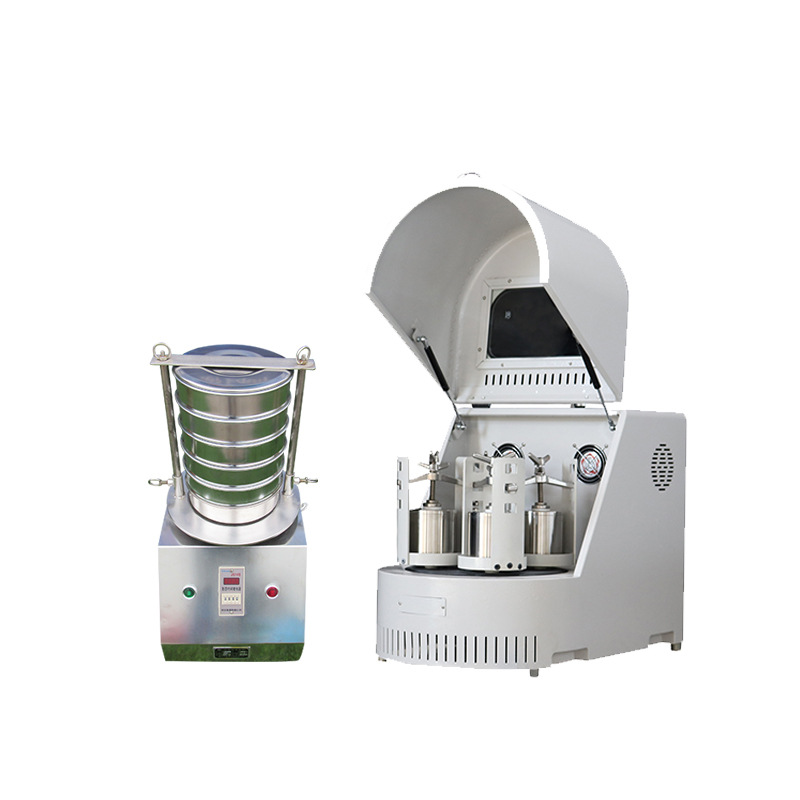
A soil grinder and sieve machine combines size reduction and screening in a single handling step.
The Grinding Stage
Grinding in this class of equipment is mechanical and relatively gentle by design. Soil is not ore; the objective is to break aggregates, loosen cemented clusters, and reduce brittle mineral grains to a size the screen can pass, not to produce micron-scale powder. Impact, attrition, and shear act on the sample depending on the rotor or media geometry and on the rotation speed selected.
Two operating variables dominate the outcome. The first is the energy delivered per unit mass, which depends on speed and residence time. Too little energy leaves aggregates intact; too much energy converts the sample into fines, raises the temperature inside the chamber, and can alter organic constituents through local heating. The second is the clearance between moving and static parts, which sets the largest particle that can leave the grinding zone.
Feed condition is just as important as machine settings. Soil that is still visibly moist will coat the chamber walls, bridge between moving parts, and discharge unevenly. Drying the sample before grinding is not a formality; it is the condition under which the grinding stage behaves predictably. Material that is already fine enough for the method should also not be over-ground simply because the machine is running.
The Sieving Stage
The screen performs classification, not further size reduction. Everything that passes the mesh is collected as the working sample; everything retained is either returned for additional grinding or set aside as coarse fragment material, depending on the protocol being followed. Keeping those two fractions separate and recording their masses is what turns a preparation step into a documented procedure.
Screen performance depends on more than nominal aperture. Open area, wire diameter, weave type, and the motion applied to the screen all influence how quickly near-sized particles find an opening. With a passive screen, particles smaller than the aperture can still be retained if they arrive at a shallow angle or if the bed of material is too thick. Mechanical agitation, rotation, or vibration keeps the bed mobile and lets undersized particles reach the surface where they can pass.
Moisture is the most common reason a correctly sized particle fails to pass. Capillary bridges between grains hold aggregates together, and a screen that works well with air-dried soil will blind rapidly with soil that still holds free water. Screen condition matters as well: a locally distorted weave can pass oversized material in one area while retaining fine material elsewhere, which shows up later as unexplained scatter between replicates.
What the Machine Does Not Do
It is equally important to be clear about limits. A soil grinder and sieve machine does not dry the sample, does not remove stones larger than the feed opening, and does not correct a sampling error made in the field. Soil that is still moist should be air-dried or oven-dried at the temperature the analytical method specifies before it enters the grinding chamber. Oversized stones, roots, and foreign objects should be removed and their mass recorded during the drying stage, because that material belongs in the coarse fragment fraction, not in the fine earth that is eventually analyzed.
Feed Size, Target Particle Size, and Sieve Selection
Preparation protocols are usually written around two numbers: the maximum size of material entering the grinder and the maximum size of the material that is analyzed. Both are decisions, and both should be matched to the method rather than inherited from an older procedure that happened to be convenient.
Choosing a Sieve Opening
The sieve opening determines the largest particle in the analyzed fraction, and that number propagates through the entire method. A finer screen produces a more homogeneous sample but takes longer, generates more dust, and may remove a larger share of the sample as retained material. A coarser screen is faster but leaves more variability between replicates, particularly in soils with a wide natural particle size range.
General laboratory practice converges on screening in the coarse-to-intermediate range for routine soil chemistry, with finer openings reserved for methods that demand them. The correct choice is the one named in the standard being followed. Where a method specifies a maximum particle size, the sieve should be no coarser than that limit, and the retained fraction should be weighed and reported rather than quietly discarded, because discarding it changes the composition of the sample that is reported.
| Preparation aim | Typical sieve class | Practical trade-off |
|---|---|---|
| Routine soil chemistry and fertility work | Coarser opening | Fast throughput; more replicate variability in heterogeneous soils |
| Trace element and contamination studies | Intermediate opening | Better homogeneity; stricter cleaning required between samples |
| Methods requiring uniform fine material | Finer opening | Longer grinding and screening time; higher dust load and more retained material |
Reading a Particle Size Distribution
Passing a screen is a binary result, but the material that passes is not uniform. A sample that clears the mesh can still contain a broad spread of sizes, and that spread affects extraction efficiency, settling behavior in suspension, and the repeatability of subsampling. Where a method is sensitive to the fines content, it is worth confirming the distribution by laser diffraction or by a nested sieve stack rather than assuming that everything below the screen behaves identically.
The distribution also drifts with grinding practice. Increasing the number of passes or the grinding energy shifts material from the coarse end toward the fine end, and the shift is not linear. This is why preparation parameters are best fixed once and then held, rather than adjusted sample by sample according to how the material looks.
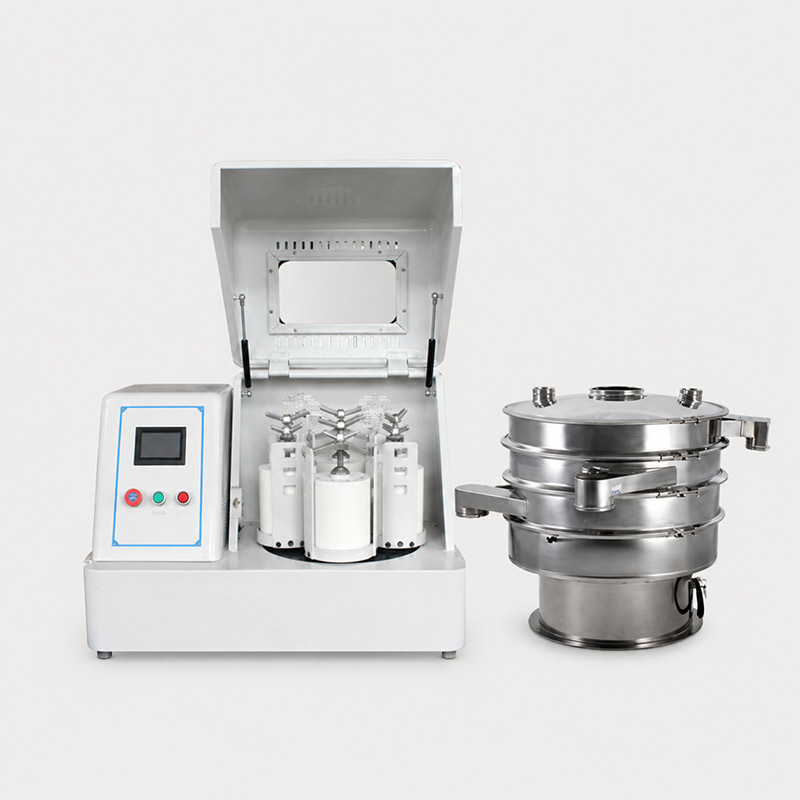
The screening stage classifies the ground soil and separates the coarse fragment fraction.
Contamination Control Between Samples
Cross-contamination is the least visible and most damaging preparation error. It does not announce itself; it appears later as an outlier, a trend that follows the order of analysis, or the detection of an element that should not be present at all. In a commercial laboratory the cost is not only the repeat analysis but the credibility of the entire batch.
Contamination enters at four points: the grinding chamber and its wear surfaces, the screen and its frame, the collection container, and the tools used to move material. Control measures should address all four rather than focusing on the mill alone.
- Sequence samples deliberately. Prepare low-concentration samples before high-concentration ones, and never follow a heavily contaminated or spiked sample with a background sample without a full cleaning cycle in between.
- Clean between every sample, not every batch. Brush or vacuum the chamber, the discharge path, and the screen. Compressed air used alone tends to move dust around rather than remove it.
- Use a sacrificial purge. Where a mill is difficult to clean completely, grinding a small portion of the next sample and discarding it removes most of the carryover before the analytical portion is collected.
- Dedicate containers and tools. Separate scoops, trays, and storage jars for high-concentration and background work prevent the bench itself from becoming the contamination source.
Materials of construction interact with this routine. Stainless steel is durable and easy to wipe down, but it contributes iron and, depending on the alloy, chromium and nickel to the sample through abrasion. Chambers and screens made or lined with ceramic, agate, zirconia, or polymer reduce that contribution when the analytical suite includes those elements. The right choice depends on which elements are reported and at what concentration, so wear surfaces should be selected from the analyte list rather than from price or habit.
Grinding media deserve separate consideration where a mill uses them. Media hardness relative to the sample determines both the wear rate and the direction of contamination: harder media wear slowly and add little, while softer media protect the sample from one element at the cost of introducing another. Batch-to-batch consistency in media charge and running time matters as much as the material of the media itself.
Moisture, Clay, and Other Difficult Soils
Not every soil behaves the same way in a grinder and sieve machine. Three families cause most of the practical difficulty: wet soils, heavy clays, and soils with a high content of fibrous organic matter.
Wet Soils
Free moisture is the single most common cause of poor screening. Water bridges grains, creates adhesion to screen wires, and blinds apertures that are nominally well above the particle size of the material being processed. Drying before grinding is standard practice for this reason, and the drying temperature should follow the method: air drying at ambient temperature is the gentlest option for samples intended for organic carbon or nitrogen work, while higher-temperature drying is faster but drives off volatile constituents and can change the chemistry being measured.
Heavy Clays
Clay aggregates resist gentle comminution because the bonds holding them together are chemical as well as mechanical. A grinder that is set too gently simply breaks the sample into smaller aggregates that look like particles on the screen but are not primary grains. The usual remedy is to dry the sample thoroughly, grind in stages rather than in one continuous pass, and inspect the retained fraction to confirm that what remains is genuinely coarse material rather than unbroken aggregates.
Organic-Rich Soils
Fibrous material behaves differently again. Roots and partially decomposed litter are ductile, so they deform rather than fracture, and they tend to clog screens and wrap around moving parts. Where the analytical suite requires the mineral fraction, removing recognizable plant material before grinding is standard practice; where total organic matter is being measured, the material must remain in the sample and the grinding regime has to be gentle enough not to generate excessive heat.
Genuinely difficult combinations — wet clay with a high organic content, for example — are best handled by adjusting the preparation sequence rather than by pushing the machine harder. Drying first, grinding in short passes with inspection between them, and keeping the screen in motion rather than relying on gravity all reduce the load on the equipment and improve the consistency of the final fraction.
Throughput, Sample Volume, and Workflow Fit
Laboratory throughput is set by the slowest step in the preparation chain, and it is rarely the grinding itself. Weighing, drying, cleaning, and documentation consume more time than the seconds a sample spends in the chamber. Choosing equipment sized for the actual daily sample load is more useful than choosing the largest available unit.
Three numbers should be established before selection. The first is the typical and peak number of samples per day. The second is the mass of material each sample requires before and after screening — retained coarse material has to be accounted for, so a sample with a high coarse fragment content may need a considerably larger starting mass to yield the fine earth the method needs. The third is the number of distinct protocols the laboratory runs, since a machine that must be reconfigured and cleaned between protocols loses much of its throughput advantage.
Where a laboratory handles both routine fertility work and trace-element studies, two smaller dedicated units frequently outperform one large shared machine. Dedicated equipment removes the cleaning conflict between protocols, reduces the risk of trace contamination in the general-purpose mill, and lets each unit be configured for the fines content that its own work actually requires.
Batch size also interacts with homogeneity. Processing a large batch in one pass can leave a gradient from the inlet to the discharge, particularly in continuous or semi-continuous designs. Short passes with mixing between them, or a homogenizing step after grinding, reduce that gradient at the cost of additional handling time.
Wear Parts, Maintenance, and Long-Term Reproducibility
Preparation quality drifts quietly as equipment ages. A screen that has been deformed, a chamber surface that has worn unevenly, or a drive that no longer reaches its rated speed will still produce a sample that passes the screen, but the particle size distribution behind that result changes. The change is easy to miss because it happens gradually and because no single sample looks obviously wrong.
A maintenance routine built around reproducibility rather than breakdown prevention usually includes the following checks:
- Screen inspection. Look for torn wire, distorted weave, and local blinding. A damaged screen passes oversized material in one area while retaining fine material elsewhere.
- Wear surface measurement. Track chamber and media dimensions against a baseline so that replacement is triggered by measured drift rather than by visible failure.
- Speed verification. Confirm that the operating speed remains within the range used when the method was validated, since small changes in speed shift the particle size distribution.
- Cleaning verification. Periodically run a blank or a reference material through the full preparation sequence to confirm that carryover stays within the laboratory's acceptance criteria.
Reference materials are the most direct check available. Passing a certified soil through the same drying, grinding, and screening sequence used for unknown samples tests the whole chain, including the parts that are easiest to overlook. A result that moves outside the certified range points to preparation, and the size of the deviation gives a rough indication of how much material is being lost or added at each step.
Consumable parts should also be treated as method components rather than as generic spares. A replacement screen with a different weave, a different wire diameter, or a different frame fit is not the same screen, even if the nominal aperture matches. Keeping the original specification on file makes it possible to verify that a replacement behaves the way the validated method expects.
A Practical Selection Checklist
Selection decisions are easier when requirements are written down before equipment is compared. The following questions cover the points that most often determine whether a machine performs well in a specific laboratory.
- What particle size does the method require? The screen opening should be set by the standard being followed, not by the finest screen available.
- What is the incoming feed size? Material larger than the chamber can accept has to be reduced beforehand, which adds a crushing step and a second contamination risk.
- What is the moisture condition of incoming samples? If samples routinely arrive wet, drying capacity has to be part of the workflow rather than an afterthought.
- Which elements are reported? Wear surfaces and any grinding media should be chosen so that abrasion does not add an element that appears on the analyte list.
- How many samples per day, and how many protocols? Peak load and protocol count determine whether one general-purpose unit or several dedicated units make more sense.
- How much retained coarse material is expected? Soils with a high coarse fragment content require a larger starting mass to yield the fine earth the method needs.
- What cleaning routine is realistic? Equipment should be judged on how quickly it can be cleaned between samples, because that interval sets the achievable throughput.
Where the answers point to a laboratory that prepares a moderate number of soil samples per day under a defined method, an integrated unit such as the TENCAN soil grinder and sieve machine from Changsha Tianchuang Powder Technology Co., Ltd covers grinding and classification in a single handling step. Operating conditions — speed, pass length, screen choice, and cleaning interval — should be fixed by trial with the actual soil types the laboratory handles, and then held constant, because consistency in preparation is what makes results comparable across batches.
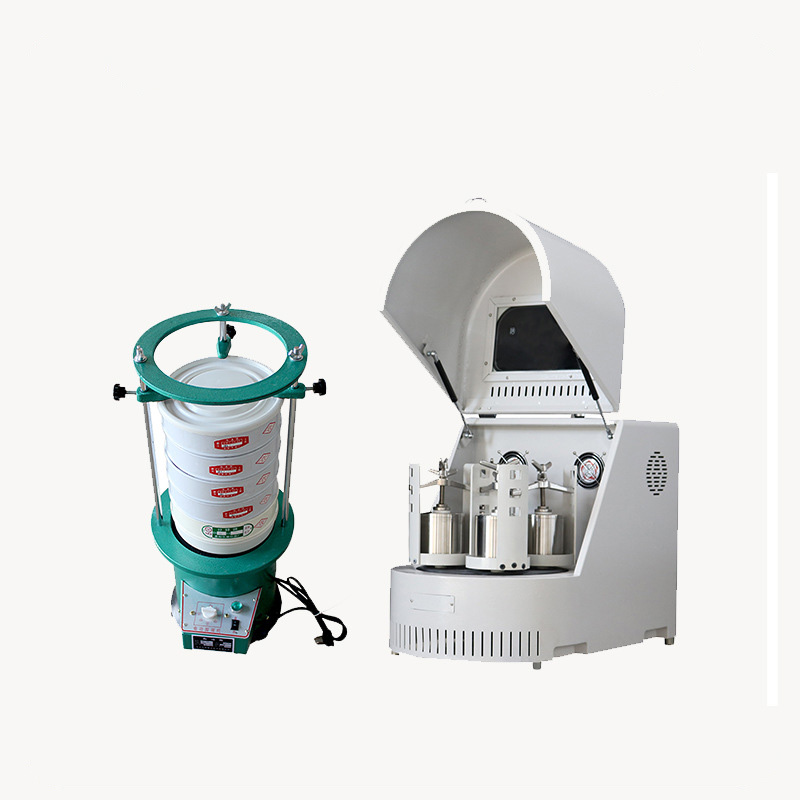
Preparation is validated with the laboratory's own soil types before operating parameters are fixed.
It also helps to record the preparation parameters alongside the analytical result. Documenting the screen opening, drying temperature, number of grinding passes, and the mass of retained coarse material turns a preparation routine into a traceable procedure. When a result is later questioned, that record is usually the fastest way to establish whether the sample or the method was responsible.
Frequently Asked Questions
Can a soil grinder and sieve machine process wet soil?
Wet soil should generally be dried before grinding and screening. Free moisture bridges particles, blinds screen apertures, and causes material to adhere to the chamber, which reduces the yield of fine earth and makes cleaning harder. The drying temperature should follow the analytical method, because high-temperature drying can change the properties that the method is intended to measure.
How is the right sieve chosen for soil sample preparation?
The opening is normally set by the method or standard being followed, with routine soil chemistry often using a coarser opening than trace-element or mineralogical work. Where a method specifies a maximum particle size, the screen should be no coarser than that limit, and the retained fraction should be weighed and reported rather than discarded.
How can cross-contamination between soil samples be reduced?
Clean the chamber, discharge path, and screen between every sample rather than at the end of a batch. Sequence samples so that low-concentration material is prepared before high-concentration material, use dedicated tools and containers, and where complete cleaning is difficult, grind a small portion of the next sample and discard it before collecting the analytical portion.
Does grinding change soil test results?
Yes. Grinding changes the particle size distribution and the surface area available to extraction and digestion, and it can generate enough local heat to affect organic constituents if it is performed too aggressively. The preparation regime therefore has to be validated with the method and then kept constant so that results remain comparable over time.
Soil preparation is not a preliminary chore that happens before the real work. It is the step that determines what the real work is measuring, and the equipment involved is the part of the chain that is easiest to standardize and easiest to neglect.
For most laboratories the practical path forward is unglamorous: define the required particle size from the method, dry the sample properly, choose a machine whose wear surfaces do not introduce elements on the analyte list, and write down the operating parameters so that they stay the same from batch to batch. Where an integrated unit fits the workflow, soil grinding and sieving equipment can carry both the size reduction and the classification step, but the value comes from consistent operation rather than from the hardware alone.
Before committing to a configuration, run the laboratory's own soil types through the system at the intended screen opening and check the retained fraction, the fines content, and the repeatability of replicate subsamples. Process conditions vary with material properties and with the analytical method in use, so the numbers that matter are the ones obtained from the samples the laboratory actually receives.