
Hydraulic Single Axis Disperser: Principle, Applications, and Selection Guide
What Is a Hydraulic Single Axis Disperser?
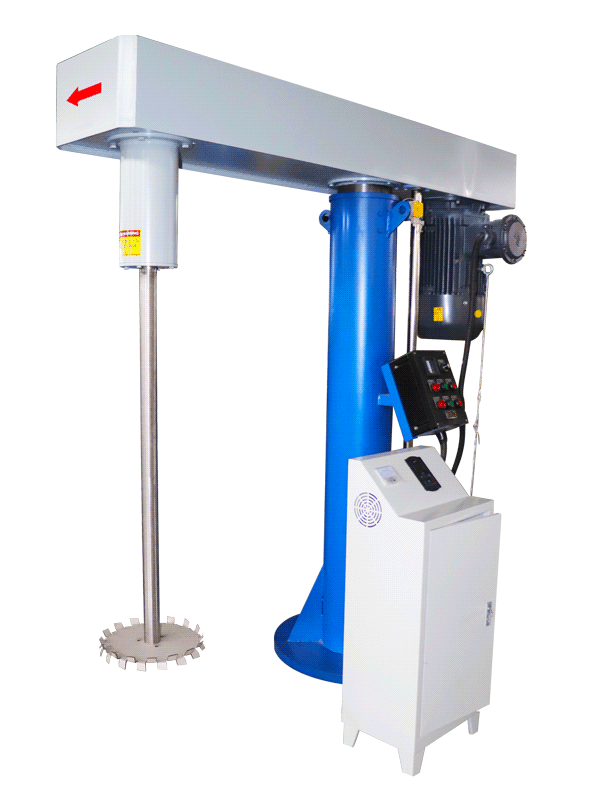
When you work with powders, pigments, or viscous slurries in the laboratory or small-scale production, achieving uniform dispersion is often the first challenge. A hydraulic single axis disperser is a specialized mixing device that combines a high-speed rotating dispersing disc with a hydraulic lifting system. The single vertical shaft drives the disc at adjustable speeds, creating strong shear forces and turbulence that break down agglomerates and evenly distribute particles throughout the liquid phase.
The hydraulic lifting mechanism allows you to raise and lower the mixing shaft smoothly, even when handling heavy containers or high-viscosity materials. This design gives you precise control over the immersion depth of the dispersing disc, which is critical for optimizing the mixing process and avoiding splashing.
How Does It Work?
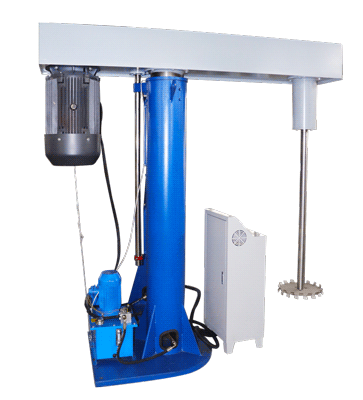
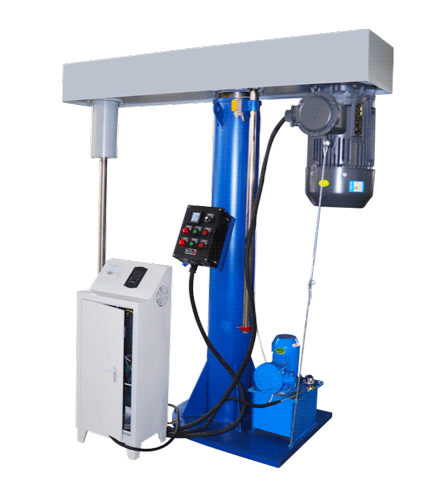
The core components include a motor, a single shaft, a dispersing disc (often a toothed or saw-tooth impeller), and a hydraulic cylinder for vertical movement. The motor drives the shaft at speeds that can typically range from a few hundred to over 3000 rpm, depending on the model. As the disc rotates, it draws material upward from the bottom of the container and expels it radially, creating intense shear zones near the disc teeth.
This mechanical action serves three purposes:
1. Deagglomeration – breaking down powder lumps and clusters into primary particles.
2. Wetting – forcing liquid into the interstices of the powder to replace air.
3. Homogenization – distributing particles uniformly throughout the suspension.
The hydraulic system, powered by an electric pump, provides smooth, stepless lifting of the entire drive head. This is especially useful when you need to change containers, clean the disc, or adjust the working position during the process. Some units also include a lock to hold the shaft at a fixed height, ensuring repeatable operation for batch-to-batch consistency.
Common Applications of a Hydraulic Single Axis Disperser
This equipment is widely used in laboratories, R&D centers, and pilot plants across many industries. Typical applications include:
Paints and Coatings
Dispersing pigments, fillers, and additives into resins or solvents. The high shear helps achieve the required fineness and color development.
Inks and Printing Pastes
Breaking down carbon black, titanium dioxide, or organic pigments to produce stable, streak-free inks.
Battery Slurries
In lithium-ion battery research, dispersing active materials like LiFePO4, NMC, and conductive carbon into a binder solution is a critical step. A hydraulic single axis disperser can handle the relatively high viscosity of these slurries.
Cosmetics and Pharmaceuticals
Mixing powders into creams, lotions, or ointments without damaging heat-sensitive ingredients (by controlling speed and time).
Adhesives and Sealants
Dispersing fillers such as calcium carbonate, silica, or microspheres into polymer bases.
Key Factors to Consider When Selecting a Hydraulic Single Axis Disperser
Choosing the right disperser for your specific material and batch size can save time and ensure reproducible results. Here are the most important parameters to evaluate:
1. Motor Power and Speed Range
The required power depends on the viscosity and volume of your mixture. For low-viscosity liquids (e.g., <500 mPa·s) under 2 liters, a 0.5–1 kW motor may suffice. For thicker pastes or larger batches (10–50 liters), you may need 2–5 kW or more. A variable-frequency drive (VFD) allows you to adjust the speed smoothly from a low stirring speed to the maximum dispersion speed.
2. Dispersing Disc Diameter and Geometry
Standard toothed discs with 30–60 mm diameter are common for laboratory units. For larger containers, the disc diameter should be approximately one-third to one-half of the container diameter. Sharp teeth enhance shear, while rounded or slotted designs are gentler for fragile particles.
3. Hydraulic Lifting Stroke and Capacity
The lift stroke determines how far the shaft can move vertically. A stroke of 200–500 mm is typical for lab models. The hydraulic system must be strong enough to lift the motor, shaft, and any material adhesion without hesitation. Check the maximum lifting weight rating.
4. Container Compatibility
Most hydraulic dispersers are floor-standing or bench-top units that accommodate open-top tanks, drums, or custom vessels. Ensure the machine can accommodate your container height and diameter. Some models come with a movable base or casters for flexibility.
5. Material Contact Parts
The shaft and disc should be made of stainless steel (e.g., SS304 or SS316) for corrosion resistance and easy cleaning. For applications requiring no contamination, such as pharmaceutical or electronic materials, you may opt for coated or special alloy parts.
6. Safety Features
Look for emergency stop buttons, overload protection, and a safety interlock on the lifting mechanism. If you work with flammable solvents, an explosion-proof motor and control panel are essential.
Why Use a Hydraulic Lifting System Instead of Manual or Electric?
Compared to hand-crank or electric screw lifts, a hydraulic system offers smoother, more controlled vertical movement. This is particularly important when you need to position the heavy drive head precisely without jerking. Hydraulic lifts also require less physical effort from the operator and can hold the head in position under load without drifting. For frequent container changes or multiple batch runs, the convenience of hydraulic lifting significantly improves workflow efficiency.
Practical Tips for Better Dispersion Results
Even with a good machine, the process conditions matter. Here are a few pointers based on common laboratory experience:
- Start slow, then increase speed. Begin at a low rotational speed to fully wet the powder, then ramp up to the dispersion speed to avoid dust generation.
- Optimize the disc immersion depth. Typically, the disc should be positioned about one disc diameter above the bottom of the container. Too high causes splashing; too low reduces flow.
- Pre-mix coarse powders. If your feed includes large lumps, consider pre-blending with a V-type mixer or a paddle mixer before dispersion to protect the disperser disc from heavy impact.
- Control temperature. High-speed dispersion generates heat. For heat-sensitive materials, use intermittent operation or a cooling jacket on the container.
- Clean thoroughly between batches. Residual material on the shaft and disc can contaminate the next batch. Stainless steel parts are easy to clean with appropriate solvents.
Linking Dispersion with Downstream Processes
A hydraulic single axis disperser is often used as a first-stage mixing unit before further processing. For example, after dispersing pigments, you might transfer the slurry to a oblique mixer for gentle blending or to a bead mill for finer grinding. In battery slurry preparation, the dispersed mixture may then be passed through a high speed dispersing homogenizer for additional shear. Choosing a compatible equipment family ensures a smooth scale-up from lab to production.
If you are developing new formulations or scaling up a process, the hydraulic single axis disperser offers the flexibility and power needed for reliable dispersion. By understanding the working principle and matching the machine parameters to your material properties, you can achieve consistent, high-quality results batch after batch.
For more detailed specifications and to explore the full range of dispersion and mixing equipment, visit the TENCAN product page for the hydraulic single axis disperser.