
Hydraulic Dual-Shaft Dispersion: When Single-Axis Dispersers Fall Short – A Complete Guide for High-Viscosity Applications
If you have ever tried to disperse a thick paste with a single-shaft high-speed disperser, you know the struggle. The material climbs up the shaft, the vortex disappears, and the motor starts to groan. You stop the machine, scrape down the sides, and restart – only to see the same cycle repeat. For many manufacturers working with sealants, high-viscosity paints, adhesives, or battery slurries, a standard disperser simply cannot provide the mixing intensity and circulation needed to achieve uniform results.
This is where the hydraulic dual-shaft disperser enters the picture. Designed to handle materials with viscosities up to tens of thousands of centipoise (cP), this machine combines a slow-speed anchor or frame agitator with a high-speed dispersing rotor. The result is a powerful mixing action that eliminates dead zones, prevents material build-up on the vessel wall, and delivers a homogeneous dispersion in a fraction of the time required by single-shaft equipment.
In this article, we will explore the working principle of a hydraulic dual-shaft disperser, discuss its advantages for different industries, and provide practical guidance on selecting the right model for your specific material and batch size.
What Is a Hydraulic Dual-Shaft Disperser?
A hydraulic dual-shaft disperser consists of two independently driven mixing shafts that work inside the same mixing vessel. The first shaft typically carries a slow-speed agitator – such as a scraping anchor, a gate paddle, or a helical ribbon – that sweeps the vessel wall and creates bulk material flow. The second shaft is a high-speed disperser equipped with one or more saw-tooth or slotted dispersion blades. It rotates at high peripheral speed (often 15–25 m/s) to provide intense shear and particle size reduction.
The entire mixing head is mounted on a hydraulic lift column, which allows you to raise and lower the assembly for container exchange, cleaning, or batch inspection. The hydraulic system provides smooth, stable lifting even when the mixing head is fully loaded with viscous paste.
You can think of it as two machines in one: a slow mixer that keeps the whole batch moving and a high-energy disperser that breaks down agglomerates and wets out fine powders. Together, they solve the circulation problem that single-shaft dispersers face in viscous materials.
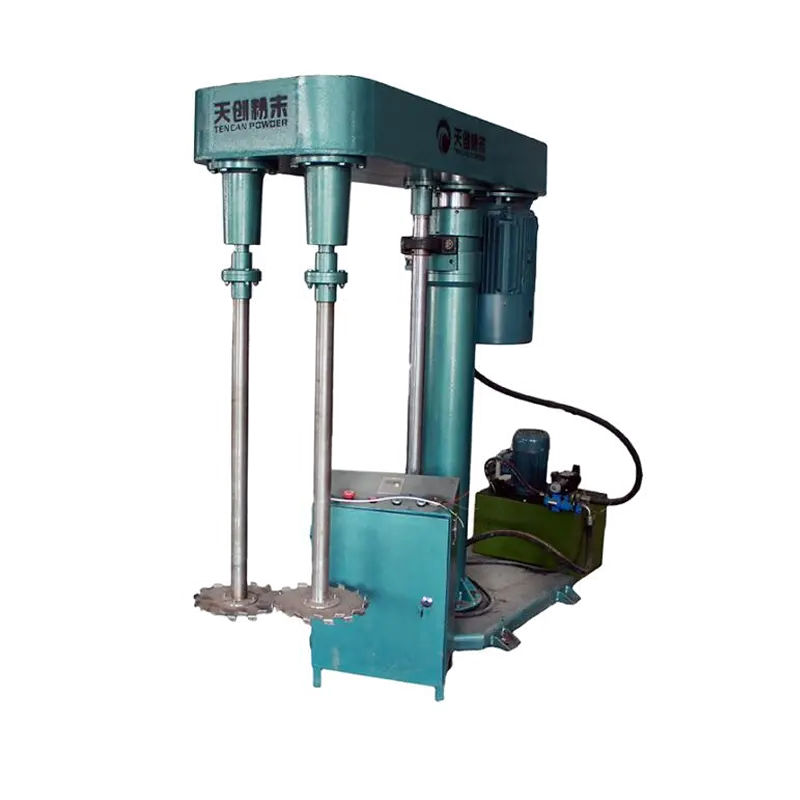
Typical Components
- Hydraulic lifting system: Two or four hydraulic cylinders that raise the entire mixing head. The lifting height is usually 900–1400 mm depending on the model.
- Main drive motors: Separate motors for the slow agitator and high-speed disperser. Power rating varies from 2.2 kW on lab units up to 75 kW or more on production-scale models.
- Slow-speed agitator: Often equipped with Teflon or polyurethane scrapers to wipe the vessel wall.
- High-speed dispersion shaft: Fitted with a toothed dispersion blade (cowles blade) or slotted disc. The diameter of the blade is normally 1/3 to 1/2 of the vessel diameter.
- Control cabinet: Frequency inverters for each motor, emergency stop, lifting control, and sometimes a timer or program function.
Why Choose a Dual-Shaft Configuration?
The main limitation of a single-shaft disperser is the vortex. At high viscosity, the material cannot flow freely into the rotating blade, so only a small portion near the blade gets sheared while the rest remains stagnant. This leads to:
- Long dispersion times
- Inconsistent final fineness
- Frequent scraping and cleaning
- Overheating of the dispersion zone
A hydraulic dual-shaft disperser overcomes these problems through two complementary actions:
- Bulk circulation: The slow anchor pushes material from the wall toward the center and from the bottom upward. This sweeps the entire vessel volume and feeds fresh material into the high-speed zone.
- Intense shear: The high-speed blade disintegrates agglomerates, reduces particle size, and distributes the liquid phase evenly. Because the material is constantly replaced, the shear energy is used efficiently.
In many practical applications, a dual-shaft disperser can reduce processing time by 30–50% compared to a single-shaft unit for the same batch size and target fineness. It also produces a more uniform product because every portion of the batch passes through the high-shear zone repeatedly.
Material Viscosity Ranges
While a typical high-speed disperser works well up to about 20,000–30,000 cP, a hydraulic dual-shaft disperser can handle materials in the range of 5,000 to 100,000 cP and sometimes even higher, depending on the agitator design and motor power. For extremely high-viscosity pastes (above 200,000 cP), a double-planetary mixer or kneader might be more suitable, but for most intermediate viscosity products, a dual-shaft disperser offers the best balance of throughput, cost, and final quality.
Key Application Areas for Hydraulic Dual-Shaft Dispersers
Thanks to its versatility, this equipment is widely used across several industries. Below are some of the most common applications where a hydraulic dual-shaft disperser becomes the preferred solution.
Paints and Coatings
Water-based and solvent-based industrial paints often contain high loadings of pigments, fillers, and rheology modifiers. The dual-shaft disperser rapidly wets out dry powders, breaks down pigment agglomerates, and produces a smooth, lump-free millbase before the grinding stage. For thick primers, putties, and textured paints, the scraping anchor prevents settlement and ensures every bucket has the same consistency.
Inks and Adhesives
Printing inks, pressure-sensitive adhesives, and laminating adhesives have high resin content and often include delicate additives that require gentle but thorough mixing. The slow anchor provides bulk homogenization without trapping air, while the high-speed blade disperses color pigments or fillers. The hydraulic lift makes it easy to change containers when switching colors or formulations.
Battery Slurries (Electrode Pastes)
Lithium-ion battery electrode slurries – both cathode and anode – are complex, high-viscosity suspensions. They require a careful balance of dispersion and mixing to avoid damaging the active material structure. A hydraulic dual-shaft disperser can be configured with a scraper to handle the paste without excessive heat generation, and the hydraulic lift allows easy access for cleaning between batches.
Sealants, Caulks, and Mastics
These products are shear-thinning and often contain high filler levels. A single-shaft mixer would struggle to break up the lumps and would require frequent manual intervention. The dual-shaft design ensures complete wetting and deaeration, producing a smooth, pumpable paste.
Chemicals and Ceramic Slips
Many chemical intermediates, ceramic glazes, and refractory coatings are produced in batch sizes from a few hundred liters to several thousand liters. A hydraulic dual-shaft disperser offers a cost-effective alternative to more expensive mixing technologies while still delivering reliable quality.
How to Select the Right Hydraulic Dual-Shaft Disperser
Choosing the correct machine for your application involves more than just picking the largest motor. Here are the critical factors to consider:
Batch Size and Vessel Geometry
The working volume of the mixing drum should be about 60–80% of the vessel capacity to allow for material movement and to avoid overflow during operation. The vessel diameter and height dictate the size of the anchor agitator and dispersion blade. For example, a 200-liter vessel typically requires a dispersion blade of about 200–250 mm diameter, while the anchor scraper should reach within 3–5 mm of the wall.
Viscosity and Thixotropy
Higher viscosity demands more torque on the slow agitator. If your material is thixotropic (shear-thinning) and recovers quickly, you may need a more powerful anchor drive to restart flow after a pause. In such cases, a helical ribbon or gate anchor is often used instead of a simple paddle.
Material of Construction
304 stainless steel is the standard for most chemical and coating applications. For acidic or corrosive slurries, 316L stainless steel is recommended. Some food or pharmaceutical processes require electropolished surfaces and sanitary seals. The dispersion blade can be coated with tungsten carbide or ceramic to extend wear life when processing abrasive pigments.
Speed and Power Requirements
The high-speed disperser typically operates at 0–1500 rpm (adjustable via VFD) with a tip speed of 15–25 m/s. The slow agitator runs at 0–60 rpm, often with a separate VFD. Power distribution between the two motors depends on the material: for example, a 50:50 split for moderate viscosity, or 60:40 (favoring the high-speed shaft) for lower viscosity. Your equipment supplier should help calculate the appropriate power based on your specific formulation.
Sealing and Safety
If your process involves volatile solvents, low-flash-point liquids, or dust-generating powders, the machine must be explosion-proof (ATEX or NEC compliant). The shaft seals should be rated for the operating pressure and temperature. Many hydraulic dual-shaft dispersers come with optional mechanical seals or compressed air purging for the bearing area.
Lifting and Container Handing
Consider the lifting stroke – it must be high enough to clear the drum and allow easy drum exchange. For large production batches (1000 L or more), a hydraulic lift with two or four cylinders is standard. Some models include a rotating mast to swing the mixing head away for cleaning.
Installation, Operation, and Maintenance Tips
A hydraulic dual-shaft disperser is a robust machine, but like all process equipment, it requires proper installation and regular care to perform reliably.
Installation Considerations
- Foundation: The machine should be bolted to a flat, vibration-resistant floor. Larger units may need a reinforced concrete base.
- Electrical supply: Check local voltage and frequency (e.g., 380V/50Hz or 460V/60Hz). The VFDs must be properly grounded to avoid electrical noise.
- Ventilation: If the area is classified for flammable vapors, the motors and VFDs must carry appropriate certification.
Operation Guidelines
- Start the slow agitator first to initiate bulk flow, then gradually ramp up the high-speed shaft. This minimizes motor overload and reduces air entrainment.
- Monitor the material temperature. Continuous operation at high speed can raise the temperature by 10–30 °C. If heat-sensitive, program intermittent cycles or use a jacketed vessel with cooling water.
- Never operate the machine with the dispersion blade partially exposed. The slurry level should cover the blade completely to avoid splashing and to ensure effective shear.
Maintenance
- Inspect the scraper blades periodically and replace them when the gap to the vessel wall exceeds 5 mm. Worn scrapers reduce wall heat transfer and leave unmixed material.
- Check the hydraulic oil level and condition every 500 operating hours. Change the oil according to the manufacturer’s recommendations.
- Grease the shaft bearings at regular intervals (typically every 200 hours). Use a food-grade grease if processing materials for sensitive applications.
- Keep the dispersion blade balanced. If you notice vibration, stop the machine and inspect for wear or damage.
Common Questions About Hydraulic Dual-Shaft Dispersers
Can I use a dual-shaft disperser for dry powder blending?
While it can handle some powder incorporation, the primary design is for liquid-solid dispersion. If your main goal is dry blending, a V-type mixer or a horizontal ribbon blender would be more efficient. Many factories combine a dual-shaft disperser for paste preparation with a dry powder mixer for the initial blend.
What is the typical batch size range?
Laboratory-size units can handle 2–20 liters, pilot models 50–200 liters, and production units from 500 to 5000 liters. The actual working capacity depends on the viscosity – higher viscosity requires a lower fill level to allow room for material movement.
Do I need a separate grinding step after dispersion?
Not always. For many paints and inks, the dual-shaft disperser can achieve a fineness of 15–30 microns (Hegman gauge 6–7). For finer grinding (below 10 microns), you may still need a bead mill or three-roll mill. However, a good dispersion step reduces the load on downstream equipment significantly.
Is the hydraulic lift safe?
Yes, provided safety interlocks are in place. Most machines include a limit switch that stops the motors when the head is raised above a certain height. Additionally, a mechanical lock pin can be inserted to prevent accidental lowering during maintenance. Always follow the manufacturer’s lockout/tagout procedures.
Conclusion
The hydraulic dual-shaft disperser is a well-established solution for manufacturers who need to process high-viscosity, multi-phase materials efficiently and consistently. By combining a slow scraping agitator with a high-speed dispersion blade, it overcomes the circulation problems of single-shaft designs and delivers better dispersion quality in less time. Whether you are producing industrial paints, adhesives, battery pastes, or chemical intermediates, this machine can likely improve your process while reducing operator intervention.
If you are considering upgrading your mixing line or designing a new process, take the time to evaluate your material’s viscosity, batch size, and sensitivity to shear. Discuss your requirements with experienced engineers who can recommend the proper motor power, agitator configuration, and material of construction. A well-chosen hydraulic dual-shaft disperser will serve your production reliably for many years.
For more information about our range of mixing and dispersing equipment, including the hydraulic dual-shaft disperser, you can visit our product page: Hydraulic Dual-Shaft Disperser. We also offer complementary machines such as the Lab Disperser for small-scale development and the High-Speed Dispersing Homogenizer for more intensive shear applications.