
Ultrasonic Planetary Ball Mill: Process Guide
Fine grinding rarely follows a straight line. A material that breaks quickly from 100 µm to 20 µm may slow sharply below 5 µm, and a sample that looks fully dispersed in a beaker may still contain agglomerates that behave like much larger particles. At the fine end, the energy that fractures particles can also press them together, heat the slurry, and change its rheology. An ultrasonic planetary ball mill is one way to address that balance. It combines the high-energy motion of a planetary ball mill with acoustic energy delivered to the milling jar, the slurry, or another coupling point, depending on the configuration.
The purpose is not to replace mechanical milling with sound. It is to add a second mechanism that can help de-agglomerate fine particles, improve wetting, and keep the process moving when ordinary ball milling reaches a plateau. The benefit is material-specific. A hard, brittle ceramic may still need impact energy and wear-resistant media, while a soft agglomerated powder may respond mainly to dispersion. For laboratories and process teams comparing options, the useful question is not whether ultrasonic assistance is “better” in general, but where it fits in the breakage and dispersion chain. The ultrasonic planetary ball mill from TENCAN is one reference point for that evaluation, and the process logic below applies to any serious test program.
Why Fine Grinding Stalls Before the Target PSD Is Reached
Most fine-milling problems are not caused by a lack of energy. They are caused by energy going into the wrong place. In a planetary ball mill, the jar rotates around its own axis while the sun wheel turns in the opposite direction. Balls rise against the jar wall, fall, and collide with each other and with the sample. The result is a mixture of impact, friction, and shear. That works well for coarse comminution, but as particles become smaller, their surface area rises and interparticle forces become more important than gravitational settling. Fine particles stick to each other, to the jar wall, and to the grinding balls. The mill may keep running while the measured particle size distribution stops improving.
Agglomeration is not the same as a coarse primary particle
An agglomerate is a cluster held together by van der Waals forces, electrostatic attraction, capillary bridges, or a binder. It can be broken by weaker forces than those needed to fracture a primary crystal. This distinction matters because a laser diffraction result may report a coarse population even when the primary particles are already fine. If ultrasonic energy is applied during or after milling, it can help separate these clusters, especially in a liquid carrier. If the primary particles are still large, however, ultrasonic treatment alone will not substitute for ball impact. The mill and the ultrasonic field do different jobs, and confusing the two leads to disappointing trials.
Heat, viscosity, and re-welding change the process window
Fine grinding generates heat. In a sealed jar, that heat raises the temperature of the powder, the liquid, and the jar itself. Soft polymers may soften and smear; fats and waxes may coat media; reactive powders may oxidize; and volatile solvents may build pressure. The slurry also becomes more viscous as fines are produced. A thick slurry cushions ball collisions, reduces mixing, and can trap particles in dead zones. Some materials, particularly metals and ductile polymers, may re-weld at contact points rather than fracture. Ultrasonic cavitation and acoustic streaming can improve local mixing and help break soft agglomerates, but they also add energy and heat. Without temperature control and a realistic solids loading, the combined process can become less stable, not more.
Contamination becomes more visible at fine sizes
As the particle size falls, the surface area of the product rises, so wear from the jar and grinding media has a greater influence on purity. A jar that is acceptable for a coarse sample may introduce too much contamination after several hours of fine milling. The same concern applies to any ultrasonic probe that contacts the slurry. Through-wall coupling avoids direct contact between the transducer and the sample, but the jar material and wall thickness then affect how efficiently acoustic energy reaches the liquid. These are not minor accessories; they are part of the process design.
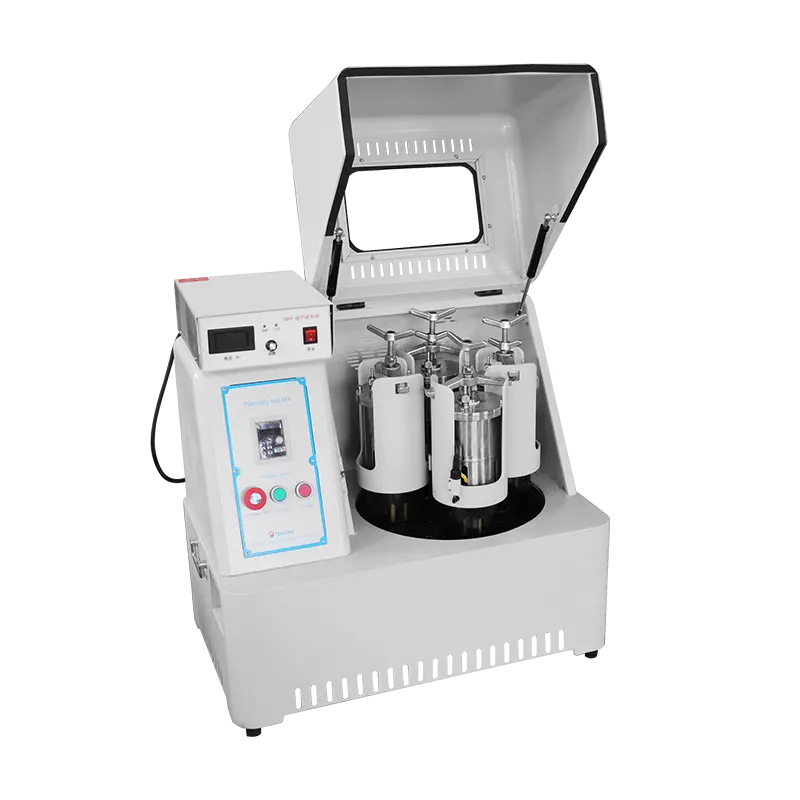
An ultrasonic planetary ball mill combines planetary jar motion with an acoustic assistance path; the exact jar, coupling, and control arrangement depends on the selected configuration.
When a milling curve flattens, it is worth separating the possible causes before changing the machine. A quick diagnostic sequence is to check the primary particle size by imaging, compare wet and dry dispersion methods for laser diffraction, measure slurry viscosity and temperature at the end of the run, and inspect the jar for caking or media coating. If the primary particles are fine but the PSD report is coarse, agglomeration and measurement dispersion are likely contributors. If the primary particles remain coarse despite long milling, the issue is more likely energy input, media selection, or material behavior. Ultrasonic assistance is more relevant to the first case than to the second.
How an Ultrasonic Planetary Ball Mill Works
The name describes a hybrid. A planetary ball mill provides the mechanical driving force, and an ultrasonic system adds high-frequency acoustic energy. In practical terms, the mill creates repeated impacts and shear through the movement of grinding balls, while the ultrasonic field creates pressure waves in the liquid or at the jar interface. The combination can be useful because the two mechanisms act on different scales. Ball milling breaks down the particle network; ultrasonic treatment can attack the weak bonds that hold fine fragments together and improve the exchange of liquid at the particle surface.
Planetary motion sets the energy baseline
In a planetary mill, the centrifugal and Coriolis forces created by the rotating jar and sun wheel determine how the balls move. Higher rotation speeds generally increase impact energy and reduce the time needed for breakage, but they also increase heat generation, wear, and the risk of jar movement or sample compaction. The fill level matters as well. Too little media means fewer collisions; too much media leaves little room for sample and can restrict ball flight. The optimum depends on jar geometry, ball density, ball diameter, and the amount of sample. No single speed or fill ratio can be transferred safely from one material to another. The same principle applies to an ultrasonic planetary ball mill: the acoustic module changes the process, but it does not remove the need to establish a sound mechanical milling baseline.
What ultrasonic energy adds to the jar
When ultrasound passes through a liquid, it creates alternating low- and high-pressure regions. Cavitation bubbles form, grow, and collapse. Their collapse produces localized shear, microjets, and turbulence near particle surfaces. Acoustic streaming also moves liquid through the jar, which can reduce concentration gradients and bring fresh liquid to agglomerates. In a milling context, these effects can help with three tasks: wetting dry powder clusters, separating loosely bound agglomerates, and keeping fine particles from settling or caking on surfaces. The effects are strongest where the acoustic field is strong and where the liquid can transmit it efficiently. They are not a substitute for fracture of hard primary particles.
It is important not to describe ultrasonic assistance as a universal “boost.” Too much acoustic energy can cause excessive heating, erosion of the jar or probe, foaming, and re-agglomeration after the field is removed. Solvents with high vapor pressure can cavitate more readily but may also evaporate or build pressure. High solids loadings can damp the acoustic field and make its distribution uneven. The useful setting is the lowest one that produces the required dispersion or de-agglomeration without damaging the product or the hardware. Because ultrasonic power, frequency, duty cycle, and coupling method vary by product design, these values must be confirmed for the actual unit rather than assumed from a generic table.
Coupling method and jar design matter
Ultrasonic energy can be introduced in different ways. In one arrangement, a transducer is coupled to the jar wall or a dedicated interface. In another, a probe or horn may contact the slurry directly. Each approach has trade-offs. Through-wall coupling keeps the transducer out of the sample and reduces the risk of contact contamination, but energy transfer depends on jar material, wall thickness, and the acoustic path. Direct probe coupling can deliver more energy to the liquid, but it introduces a wetted surface that must be cleaned and checked for compatibility. Jar material also matters: a dense, stiff ceramic may transmit sound differently from a polymer or a metal jar. The user should confirm which jar materials and coupling arrangements are supported for the intended application.
Wet and dry processing are not equivalent
Ultrasonic assistance is most often considered for wet or slurry-based milling because liquids transmit acoustic energy efficiently and cavitation is possible. A liquid carrier also helps dissipate heat and allows the ultrasonic field to reach particle clusters. Dry processing is more complex. Air does not transmit acoustic energy in the same way, and dry fine powders can be difficult to fluidize uniformly. In some configurations, ultrasonic vibration may be used to improve powder flow or reduce wall adhesion, but the effect is highly dependent on the equipment design. For a dry, free-flowing ceramic powder, mechanical milling may be the dominant requirement. For a suspension with fine agglomerates, ultrasonic assistance may be more relevant. The decision should follow the actual sample state, not the product category alone.
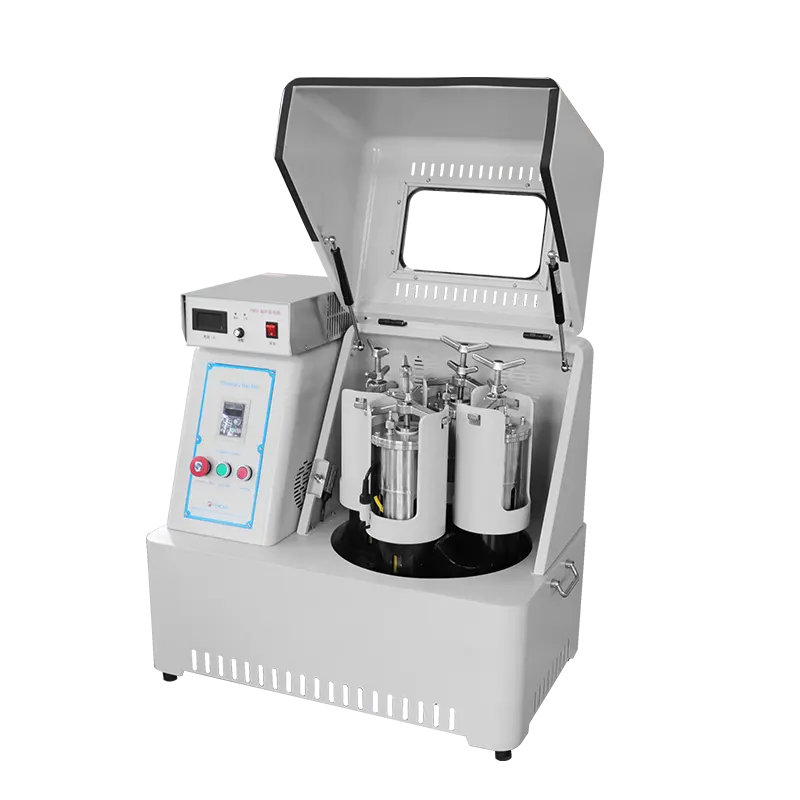
Laboratory configurations differ in jar volume, materials, and control features; process trials should use the same jar and media set intended for the final method.
Process Variables That Decide Whether Ultrasonic Assistance Helps
A successful trial is usually the result of several variables moving in the right direction at once. Changing only the ultrasonic power is rarely enough. The table below summarizes the main factors and the practical questions to ask during method development.
| Variable | What it affects | What to check |
|---|---|---|
| Jar material and volume | Contamination, acoustic transmission, sample capacity | Compatibility with the sample and solvent; wall thickness; supported jar options |
| Grinding ball material and size | Impact energy, wear, fine grinding efficiency | Hardness and density versus sample; ball count; contamination limits |
| Solids loading and liquid phase | Viscosity, cavitation, heat transfer, dispersion stability | Pumpability or mixing; solvent compatibility; dispersant need |
| Ultrasonic power and duty cycle | De-agglomeration, heating, erosion, foaming | Lowest effective setting; pulsed versus continuous operation; temperature rise |
| Rotation speed and milling time | Breakage rate, heat, wear, PSD shape | Energy per batch; temperature limit; reproducibility |
| Temperature control | Material stability, solvent pressure, rheology | Cooling method; intermittent runs; maximum allowable temperature |
Jar and ball material set the contamination and energy limits
Common laboratory jar materials include agate, zirconia, alumina, stainless steel, tungsten carbide, and polymers for specific applications. Each has a different combination of hardness, density, wear resistance, and chemical compatibility. A dense, hard jar and ball set can deliver more impact energy, but it may also introduce more wear or make the jar assembly heavy. A softer or lower-density set may be preferred for contamination-sensitive work, but the milling time may increase. The choice is not simply “harder is better.” It should be based on the sample hardness, the allowable contamination, the target particle size, and the cleaning method. For ultrasonic configurations, the jar material must also be compatible with the acoustic coupling method. This is a point to confirm with the manufacturer rather than infer from a standard planetary mill accessory list.
Ball size and fill control the balance between impact and surface action
Large balls provide more mass per collision and are useful for coarse breakage. Small balls create more contact points and can be more effective for fine grinding and dispersion, but each impact carries less energy. A mixture of sizes can sometimes improve packing and contact, although it also makes the method harder to reproduce. Ball-to-powder ratio is another variable. A high ratio increases the number of collisions per unit of powder but reduces the available sample volume and may increase wear. There is no universal ratio that can be recommended without testing. During method development, keep the jar, ball material, and total ball mass constant while changing one factor at a time. That makes it easier to tell whether an improvement comes from ultrasonic assistance or from a change in mechanical energy.
Liquid phase and formulation determine whether cavitation can work
In wet milling, the liquid does more than carry the powder. It controls viscosity, heat transfer, and the strength of interparticle contacts. A solvent that wets the powder well can reduce agglomeration; a poor wetting liquid may leave dry clusters that are difficult to break. Dispersants can stabilize fine particles after milling, but overdosing may create foam or interfere with later processing. Solids loading should be high enough for productivity but low enough for movement and acoustic transmission. If the slurry becomes too viscous, the ultrasonic field may be attenuated and the balls may not move freely. A useful starting point is to run a small viscosity and sedimentation check before the milling trial, then compare the same formulation with and without ultrasonic assistance.
Ultrasonic settings should be treated as a process variable, not a switch
Ultrasonic power, frequency, duty cycle, and treatment time all influence the result. Higher power does not automatically produce a finer or more stable dispersion. It can generate heat quickly, erode the coupling surface, and create a field that is uneven within the jar. Pulsed operation can reduce average heating while still providing repeated disruption of agglomerates. Continuous operation may be useful for a short de-agglomeration step but less suitable for a heat-sensitive material. The right combination is best found through a small matrix of trials: low, medium, and high power at a fixed milling time, followed by particle size, temperature, and visual stability measurements. If the product page does not list a particular setting for a given jar and sample, that setting should be established experimentally.
Speed, time, and temperature are linked
Increasing rotation speed and milling time usually increases the chance of reaching a finer PSD, but it also increases heat and contamination. In an ultrasonic planetary ball mill, the thermal load comes from both mechanical work and acoustic energy. A method that works for ten minutes may fail after one hour because the slurry has thickened, the solvent has evaporated, or the jar has become too hot. Temperature control can be active, such as a cooled jacket or circulating fluid, or procedural, such as short runs with pauses. The correct approach depends on the material and the equipment configuration. For heat-sensitive polymers, pharmaceuticals, and battery materials, temperature should be recorded during the trial, not only at the end.
Measure the right particle size response
Particle size distribution is the main response variable, but it should be interpreted with care. Laser diffraction results depend on the dispersion method, the optical model, and the sonication applied during measurement. If the measurement itself uses ultrasound, a coarse result before measurement and a fine result after measurement may indicate agglomerates rather than primary particles. Electron microscopy can show whether the primary particles have changed. Rheology, sedimentation, and color can also reveal dispersion quality. For a fair comparison, use the same measurement protocol for every trial and report the dispersion conditions alongside the PSD. This is especially important when evaluating an ultrasonic milling process, because the same acoustic mechanism may affect both the process and the offline test.
Matching the Mill Configuration to Material and Workflow
The most useful selection question is not “What is the most powerful unit?” but “What combination of jar, media, liquid, and acoustic assistance will answer my material question?” A laboratory method that cannot be reproduced is of little value, and a configuration that is difficult to clean may introduce cross-contamination between samples. The TENCAN ultrasonic planetary ball mill should be evaluated against the sample volume, target PSD, and contamination limits of the actual workflow, not only against a nominal jar size.
Hard brittle materials versus soft agglomerated materials
Hard brittle materials such as many oxides, carbides, and minerals usually require sufficient impact energy to initiate and propagate cracks. Ultrasonic assistance may help keep fines dispersed and reduce caking, but the mechanical milling conditions remain central. Soft or agglomerated materials behave differently. A pigment, polymer powder, or pharmaceutical intermediate may reach its primary particle size quickly, then form stable clusters that make the PSD appear coarse. In that case, ultrasonic de-agglomeration can be more valuable than additional hours of ball milling. The same logic applies to slurries that gel or thicken after milling: acoustic streaming and cavitation may improve short-term dispersion, but a dispersant or a formulation change may be needed for long-term stability.
Sample volume and jar selection affect the meaning of the result
A small jar is convenient for expensive or scarce materials, but it also limits the number of balls and the amount of liquid that can be used. A very small batch may not represent the mixing and temperature conditions of a larger jar. Conversely, a large jar may require more sample than is available and may make acoustic distribution less uniform. The best approach is to select a jar that allows a representative sample volume with enough free space for ball movement. If the plan is to scale up, the ratio of sample to media and the slurry formulation should be kept as consistent as practical. Ultrasonic coupling does not necessarily scale linearly with jar volume, so a successful 50 mL trial should not be assumed to reproduce directly in a much larger vessel.
Contamination and cleaning requirements
At fine particle sizes, even small amounts of jar or media wear can affect the product. The user should define the allowable contamination before choosing a jar material. A wear-resistant ceramic may be appropriate for an abrasive oxide but unacceptable if the same element is a critical impurity. A polymer jar may reduce metallic contamination but may be less effective for high-energy impact. Cleaning is equally important. Fine powder can pack into corners, and dried slurry can be difficult to remove from a jar with an integrated acoustic coupling surface. If the same unit is used for multiple materials, a validated cleaning procedure and a blank run may be necessary. These practical details are part of the selection decision, not afterthoughts.
Dry versus wet workflow
A wet milling route is often preferred when the final product is a suspension, when dust control is important, or when the ultrasonic field needs a liquid to transmit energy. A dry route may be preferred when the liquid must be removed later, when the material reacts with the solvent, or when the process is intended to mimic a dry production step. Neither route is universally better. The user should check whether the chosen jar and ultrasonic configuration are intended for the selected route, and whether the material can be recovered without a difficult drying or filtration step. If the process requires both dry and wet trials, plan them as separate method-development tasks rather than assuming that one set of parameters will transfer.
Verification, Scale-Up, and Maintenance Checks
A laboratory result becomes useful when it can be repeated and interpreted. Before committing to a method, run a small designed experiment rather than a single demonstration. Keep the jar and media set fixed, then vary milling time, rotation speed, solids loading, and ultrasonic power within safe limits. Measure particle size distribution, temperature, viscosity, and contamination where relevant. Include a control run without ultrasonic assistance. The control is essential: it shows whether the improvement comes from the hybrid process or simply from longer milling or a different formulation.
Define acceptance criteria before the trial
Acceptance criteria may include a target D90, a maximum median size, a limit on oversized agglomerates, a temperature ceiling, or a viscosity range. They may also include a minimum recovery and a maximum wear level. Writing these criteria down before the first run prevents the common problem of choosing parameters after seeing the data. If the application is exploratory, use a broader screen first, then narrow the window. If the material is expensive, start with the smallest representative batch that still allows meaningful analysis. Record the actual jar, ball count, liquid composition, ultrasonic settings, and run time for every trial; without that record, a promising result is difficult to reproduce.
Scale-up is a change in geometry, not only in volume
Increasing batch size changes the distance between the ultrasonic source and the particles, the strength of the acoustic field, the temperature gradient, and the mixing pattern. A larger jar may need a different coupling arrangement, a different power density, or a longer treatment time, and those changes can alter the particle size distribution. For scale-up, compare the energy per unit mass, the temperature profile, and the final PSD rather than only the nominal power. If the process is intended for production, consider whether ultrasonic assistance is needed throughout milling or only during a dispersion stage. A short acoustic treatment after mechanical milling may be easier to integrate than a fully combined batch process.
Maintenance and safety belong in the method
Ultrasonic hardware can wear at the coupling interface, and jar seals can degrade after repeated thermal cycles. The user should follow the manufacturer’s inspection and cleaning guidance, check the transducer and coupling surfaces for damage, and verify that the cooling system is working before a long run. Solvents with low flash points, reactive powders, and sealed jars require particular attention to pressure and temperature. High-voltage ultrasonic electronics and high sound levels also require appropriate laboratory precautions. A method that produces a good PSD but is difficult to run safely or reproducibly is not a robust method.
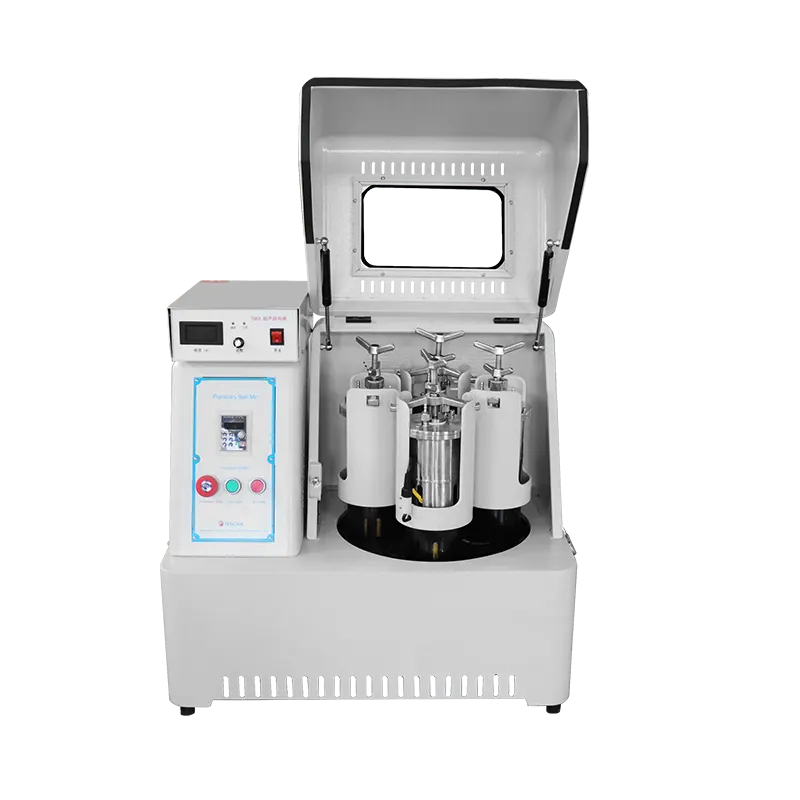
Reproducible trials should record jar type, media, slurry formulation, ultrasonic settings, and temperature alongside the particle size result.
When Ultrasonic Assistance Is the Wrong Choice
There are clear cases where a conventional planetary ball mill is the more sensible tool. If the feed is coarse and the target is only moderate size reduction, the added acoustic complexity may not justify its cost. If the material is a free-flowing dry powder with little agglomeration and no heat sensitivity, mechanical milling may be sufficient. If the main problem is contamination from the jar or media, the answer may be a different material set rather than ultrasonic assistance. If the process requires very high throughput, a laboratory hybrid mill is unlikely to be the final production solution; it is better used to establish a method and identify the limiting mechanism.
It is also important not to use ultrasonic assistance to compensate for a poorly chosen baseline. If the ball size is too large, the slurry is too viscous, or the jar volume is unsuitable, adding ultrasound may only add heat and variability. Fix the mechanical and formulation variables first, then test whether acoustic assistance provides a measurable benefit. A useful comparison includes the same jar, media, liquid, milling time, and temperature control, with only the ultrasonic condition changed. If the difference is within run-to-run variation, the added complexity may not be justified.
A practical selection checklist
- Material behavior: Is the problem primary-particle fracture, agglomeration, coating, or thermal degradation?
- Target PSD: What median and upper-tail limits are required, and how will they be measured?
- Liquid phase: Is wet milling acceptable, and does the liquid transmit acoustic energy without reacting or evaporating excessively?
- Contamination: Which jar and ball materials are allowed, and does the ultrasonic coupling method introduce a wetted contact surface?
- Temperature: What is the maximum allowable sample temperature, and how will heat be removed during the run?
- Scale: Is the goal a reproducible laboratory method, a small-batch production step, or a scale-up study?
- Cleaning: Can the jar, coupling surface, and accessories be cleaned without cross-contamination?
An ultrasonic planetary ball mill is most useful when the limiting problem is fine-particle dispersion, agglomerate breakdown, or heat-sensitive wet milling that benefits from better local mixing. It is less useful when the sample still needs coarse fracture or when the process is already limited by contamination, formulation, or throughput. The practical next step is to test a representative sample with a fixed mechanical baseline, a controlled acoustic variable, and a clear acceptance criterion. For configuration details, jar options, and the current product description, refer to the TENCAN ultrasonic-assisted planetary ball mill page and confirm the final method under the actual material and process conditions.