
What is an Ultrasonic Planetary Ball Mill? A High-Performance Grinding Equipment for Dispersing and Breaking Agglomerates
Introduction
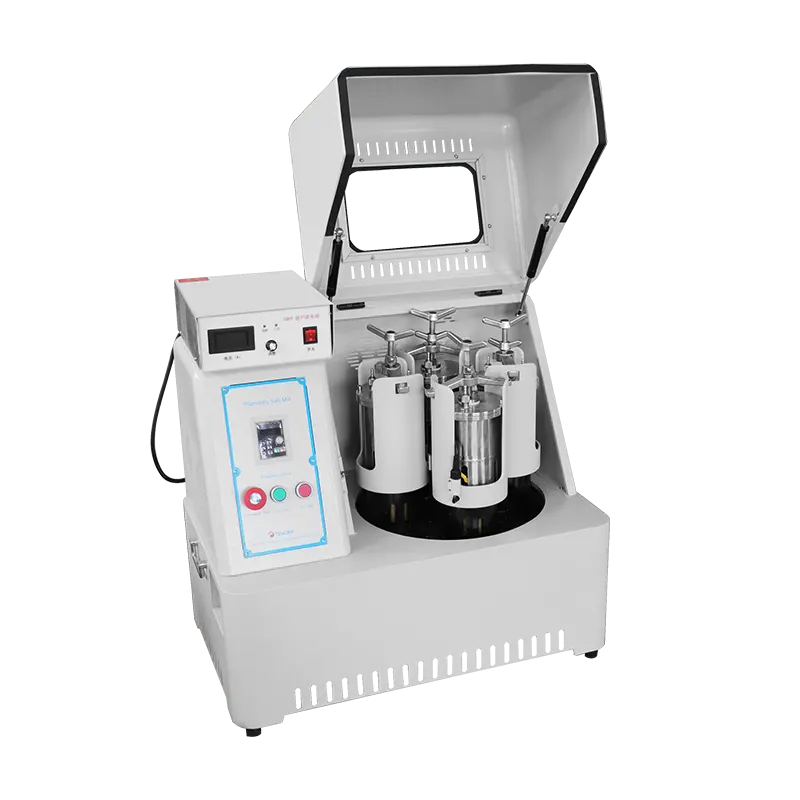
From a core perspective, an Ultrasonic Planetary Ball Mill is a specialized grinding device designed to overcome common challenges in conventional ball milling, such as particle settling, caking, wall sticking, and agglomeration. It combines the high-energy planetary motion of a traditional planetary ball mill with the powerful cavitation effect of ultrasound, enabling efficient dispersion and fine grinding of even the most difficult materials. This equipment is widely used in laboratories for research and development, especially in fields like nanomaterials, ceramics, metal powders, and pharmaceuticals.
Core Function and Working Principle
The ultrasonic planetary ball mill performs two simultaneous processes: mechanical grinding via planetary motion and ultrasonic dispersion. The planetary motion follows the classic design: the main sun wheel rotates, driving multiple grinding jars (planets) to both revolve around the central axis and rotate on their own axes in opposite directions. This creates strong centrifugal and Coriolis forces, causing the grinding balls to impact, shear, and friction the sample material, achieving micron or even nano-scale particle size reduction.
In addition, an ultrasonic transducer is integrated into the grinding system (often attached to the jar or the main platform). The ultrasonic waves generate high-frequency vibrations that create cavitation bubbles in the liquid suspension. When these bubbles collapse, they produce intense local shock waves and micro-jets that break apart agglomerates and prevent particles from re-agglomerating. This synergy is especially critical for materials that tend to clump together during dry or wet milling, such as nano-powders, pigments, and certain polymers.
Key process parameters include rotation speed (typically adjustable from 100 to 800 rpm), ultrasonic power (usually 100-500 W), and grinding time. The combination of these parameters determines the final particle size and distribution. Many models offer programmable control to optimize the process for different materials.
Key Components and Technologies
An ultrasonic planetary ball mill consists of several essential parts:
- Planetary Drive System: The motor-driven sun wheel and planetary gear mechanism provide the high-energy milling action. The gear ratio (typically 1:2) ensures efficient energy transfer.
- Ultrasonic Generator and Transducer: The generator produces high-frequency electrical signals (usually 20-40 kHz) that are converted into mechanical vibrations by the transducer. The transducer is mounted either on the grinding jar lid or directly on the rotating platform, with a brushless slip ring to maintain power during rotation.
- Grinding Jars and Media: Jars are made from various materials (stainless steel, zirconia, agate, etc.) to avoid contamination. Grinding media (balls) are selected based on the sample hardness and desired fineness.
- Control System: Modern units feature a touchscreen interface or microcomputer control for setting speed, time, ultrasonic power, and automatic reversal. Some models allow vacuum or inert gas atmosphere grinding by using special jars.
Key Performance Indicators and Selection Guide
When choosing an ultrasonic planetary ball mill, consider the following factors:
- Processing Capacity: Laboratory models typically handle 0.2 L to 4 L per jar, with multiple jars per batch (usually 2 or 4 jars). Choose a capacity that matches your sample volume requirements.
- Ultrasonic Power and Frequency: Higher power (e.g., 300 W) is more effective for breaking strong agglomerates. Frequency around 20 kHz is standard for most dispersion applications.
- Rotational Speed Range: A wider speed range (e.g., 100-800 rpm) provides flexibility for different materials. Higher speeds yield finer particles but may generate more heat.
- Atmosphere Control: If you need to mill oxygen-sensitive materials, look for models that support vacuum or inert gas grinding jars.
- Automation and Programmability: Touchscreen control, programmable cycles, and data logging improve reproducibility and ease of use.
- Noise and Maintenance: Ultrasonic models can be louder than standard mills; check for noise reduction features. Ensure easy access to the ultrasonic transducer for maintenance.
Application Fields and Recommendations
Ultrasonic planetary ball mills are used in a wide range of industries:
- Nanomaterials: Preparing graphene, carbon nanotubes, quantum dots, and other nano-powders where agglomeration is a major problem.
- Ceramics and Refractories: Grinding zirconia, alumina, silicon carbide, and other hard ceramics.
- Metallurgy and Alloys: Mechanical alloying and synthesis of metal powders, especially for reactive metals.
- Pharmaceuticals and Biotechnology: Dispersing active pharmaceutical ingredients (APIs) and breaking cell walls.
- Chemistry and Catalysis: Preparing catalysts, pigments, and dyes with uniform particle size.
For most laboratory applications, a standard ultrasonic planetary ball mill with a 0.4-2 L capacity per jar and adjustable ultrasonic power is sufficient. If you frequently work with expensive or sensitive materials, consider a model with vacuum or inert gas capability. For high-throughput production, look for a continuous or larger-capacity model designed for scale-up.
References
For more details about the product, please visit the official product page: Ultrasonic Planetary Ball Mill.