
What is a Tungsten Carbide Mill Ball? A High-Density Grinding Media for Ultra-Fine Powder Processing
What is a Tungsten Carbide Mill Ball? A High-Density Grinding Media for Ultra-Fine Powder Processing
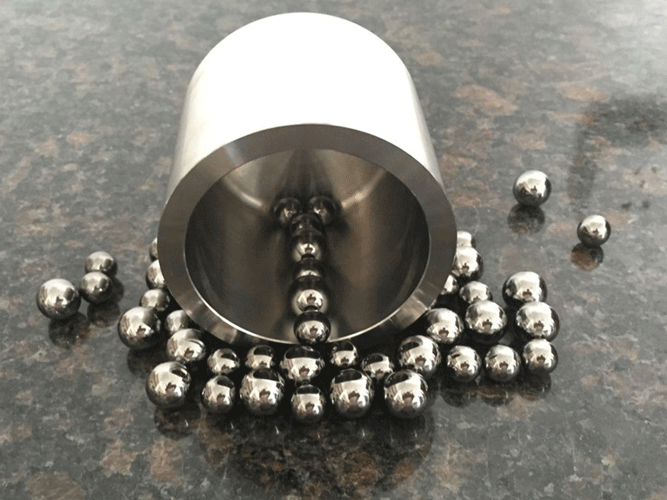
From its core, a tungsten carbide mill ball is a specialized grinding media used in ball mills, planetary mills, and other comminution equipment to crush, grind, and disperse materials into fine or ultra-fine powders. Made from cemented tungsten carbide (WC-Co), these balls combine extreme hardness (HRA 88-92) with high density (14.8-15.2 g/cm³), enabling them to efficiently break down even the hardest substances like silicon carbide, alumina, and cemented carbide scrap.
Core Function and Working Principle
Tungsten carbide mill balls serve as the energy-transfer medium inside a grinding chamber. When the mill rotates or vibrates, the balls collide with each other and with the material, generating impact, shear, and friction forces. The high specific gravity of tungsten carbide (nearly double that of steel) means each ball delivers more kinetic energy per impact, allowing faster grinding and finer particle sizes. The working principle is identical to that of any ball mill: the grinding media is lifted and then dropped onto the material, but the superior density and hardness of tungsten carbide make it particularly effective for high-energy milling applications.
Key Characteristics and Technical Advantages
Extreme Hardness and Wear Resistance
Tungsten carbide balls have a hardness of HRA 88-92, which is significantly higher than that of stainless steel (HRC 50-60) or zirconia (HV 1200). This hardness translates to extremely low wear rates, typically less than 0.001% weight loss per hour in normal operation, ensuring minimal contamination of the ground product.
High Density for Efficient Grinding
With a density of 14.8-15.2 g/cm³, tungsten carbide balls are among the densest grinding media available. This high density generates greater impact forces, reducing grinding time and enabling the production of sub-micron or even nano-sized particles in a single operation.
Excellent Toughness and Impact Resistance
The cobalt binder in cemented tungsten carbide provides the necessary toughness to withstand repeated high-energy impacts without cracking or chipping. This makes them suitable for use in high-speed planetary ball mills and attritors where conventional ceramic balls might fracture.
Key Performance Indicators and Selection Criteria
When selecting tungsten carbide mill balls, consider the following parameters:
- Ball Diameter: Available in sizes from 0.5 mm to 30 mm (or larger). Smaller balls (0.5-3 mm) are ideal for ultra-fine grinding and mixing, while larger balls (10-20 mm) are better for primary crushing of coarse materials.
- Purity and Cobalt Content: Standard grades contain 6-10% cobalt binder. Higher cobalt content increases toughness but reduces hardness. For applications requiring minimal contamination, choose high-purity grades with low cobalt bleed.
- Roundness and Surface Finish: Precision-ground balls with high sphericity ensure uniform wear and consistent grinding performance. Surface roughness below Ra 0.2 μm is recommended for critical applications.
- Compatibility with Mill Type: Tungsten carbide balls work well in planetary ball mills, vibration ball mills, roller ball mills, and stirred mills. However, they are not recommended for use in mills with rubber or polyurethane linings unless the impact energy is carefully controlled, as the high density can damage soft liners.
Application Fields and Selection Suggestions
Tungsten carbide mill balls are widely used in:
- Hard Materials Processing: Grinding of cemented carbides, silicon carbide, boron carbide, alumina, and other super-hard powders.
- Advanced Ceramics: Preparation of fine ceramic powders for electronic substrates, armor plates, and cutting tools.
- Mining and Mineral Processing: Laboratory-scale grinding of ore samples for assay and analysis.
- Battery Materials: Grinding of cathode and anode materials like lithium cobalt oxide, graphite, and silicon.
- Research and Development: Nanomaterial synthesis, mechanical alloying, and mixing of reactive powders.
For most laboratory and small-scale production applications, a ball diameter of 5-10 mm with 6% cobalt content offers the best balance of wear resistance and toughness. For ultra-fine grinding (D50 < 1 μm), consider using 0.5-3 mm balls in combination with a high-energy planetary mill such as the TENCAN vertical planetary ball mill.