
What is Tungsten Carbide Mill Ball? A grinding media for high-hardness material ultra-fine milling in ball mills
What is Tungsten Carbide Mill Ball?
At its core, a tungsten carbide mill ball is a professional grinding media made from cemented carbide (tungsten carbide, WC, with a cobalt or nickel binder). Laboratories and industries use it in ball mills — planetary ball mills, drum ball mills, vibration ball mills, stirred mills — to crush and grind hard materials such as ceramics, hard alloys, minerals, and cemented carbides into ultrafine or even nano-scale powders. Its exceptional hardness (HRA 85–93) and high density (about 14.5–15.0 g/cm³) make it the go-to choice when ordinary steel or ceramic balls cannot achieve the required fineness or wear resistance.
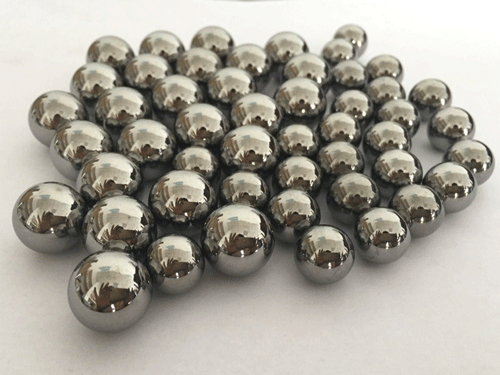
Core Function and Working Principle
The basic function of a tungsten carbide mill ball is to act as the kinetic energy carrier inside a ball mill. When the mill rotates or vibrates, the balls are lifted, cascade, and impact against the material. The combination of impact, compression, and shear forces efficiently breaks down particles. Because tungsten carbide balls are extremely dense, they deliver a much higher impact energy per unit volume compared to steel or ceramic balls. This allows them to grind materials that are themselves very hard, such as silicon carbide, aluminum oxide, zirconia, and even tungsten carbide powder.
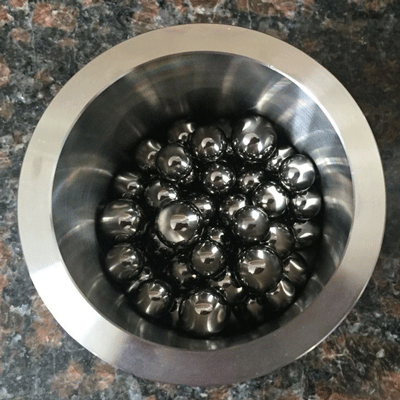
In a typical process, the material (initial particle size < 5 mm) is loaded into a grinding jar together with a certain number of tungsten carbide balls (typically 1/3 to 1/2 of the jar volume). The mill is run at a speed that causes the balls to tumble or vibrate, and the grinding duration can range from 30 minutes to several hours depending on the target fineness. Key parameters affecting the result include ball diameter, ball-to-powder weight ratio, rotation speed, and grinding time. For example, using smaller balls (e.g., 3–5 mm) is more effective for achieving submicron or nano-scale particles because they provide more contact points and higher shear forces.
Key Characteristics and Material Advantages
Unlike conventional grinding media, tungsten carbide mill balls offer a unique combination of properties:
- Extreme Hardness: HRA 85–93, nearly as hard as diamond, enabling them to grind the hardest materials without significant wear.
- High Density: ~14.5–15.0 g/cm³, about 1.8 times denser than steel, generating more impact force.
- Wear Resistance: The cemented carbide matrix resists abrasion, resulting in low contamination of the milled product.
- Corrosion Resistance: Suitable for grinding in aggressive chemical environments (e.g., acids, alkalis) when the binder is selected appropriately.
- Non-magnetic: The cobalt or nickel binder makes the balls non-magnetic, which is critical for magnetic materials like battery cathode powders.
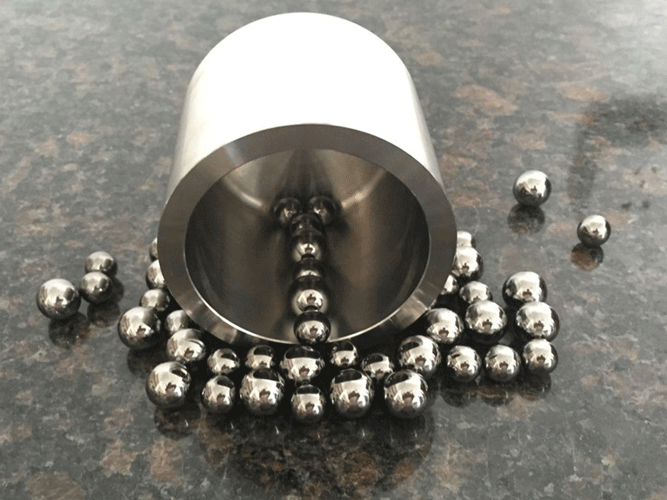
Key Performance Indicators and Selection Criteria
When selecting tungsten carbide mill balls, consider the following factors:
1. Ball Diameter
Available from 1 mm to 20 mm or larger. Smaller balls (1–5 mm) are ideal for ultrafine grinding and nano-milling, while larger balls (10–20 mm) are better for coarse grinding and mixing. The diameter should be chosen based on the initial feed size and the desired final particle size.
2. Binder Composition
Most tungsten carbide balls use cobalt (Co) or nickel (Ni) as binder. Cobalt gives higher hardness but is toxic for some applications; nickel offers better corrosion resistance and is often used in food-grade or pharmaceutical milling. Always check the binder if the product purity is critical.
3. Surface Finish
Polished or ground surfaces reduce wear and contamination. High-quality balls have a smooth surface without pores or cracks.
4. Quantity and Packing
Balls are typically sold by weight or by count. For a standard planetary ball mill jar of 0.5 L, you might need 100–200 g of balls. Ensure the supplier provides consistent size and shape for repeatable results.
5. Compatibility with Mill Type
Planetary ball mills, vibration ball mills, and drum ball mills all have different motion patterns. Tungsten carbide balls perform well in all types, but the ball-to-powder ratio and speed must be adjusted accordingly.
Application Areas and Selection Advice
Tungsten carbide mill balls are widely used in:
- Advanced ceramics: Grinding of alumina, zirconia, silicon carbide, and silicon nitride.
- Hard alloys and cemented carbides: Recycling and refining of tungsten carbide powder.
- Battery materials: Milling of cathode materials (e.g., NMC, LFP) where magnetic contamination must be avoided.
- Mineral processing: Grinding of quartz, feldspar, and other hard ores.
- Scientific research: Nano-powder synthesis, mechanical alloying, and material characterization.
For buyers: if your material hardness exceeds HRC 60 or you need to achieve particle sizes below 1 micron, tungsten carbide mill balls are the most cost-effective choice. For softer materials (e.g., minerals, pigments), high-density steel balls or zirconia grinding balls may be sufficient. Always source from a reputable manufacturer like TENCAN to ensure consistent quality and reliable performance.