
What is a PU Planetary Mill Jar? A Wear-Resistant Grinding Container for Contamination-Free Milling of Medium-Hard Materials
What is a PU Planetary Mill Jar?
At its core, a PU planetary mill jar is a grinding container made from high-grade polyurethane (PU), specifically designed for use with planetary ball mills. Laboratories and small-scale production facilities use it to mill, mix, and homogenize medium-hard materials without introducing metallic contamination. The PU material offers excellent wear resistance, elasticity, and chemical stability, making it an ideal choice for applications where sample purity is critical but extreme hardness or high temperature is not required.
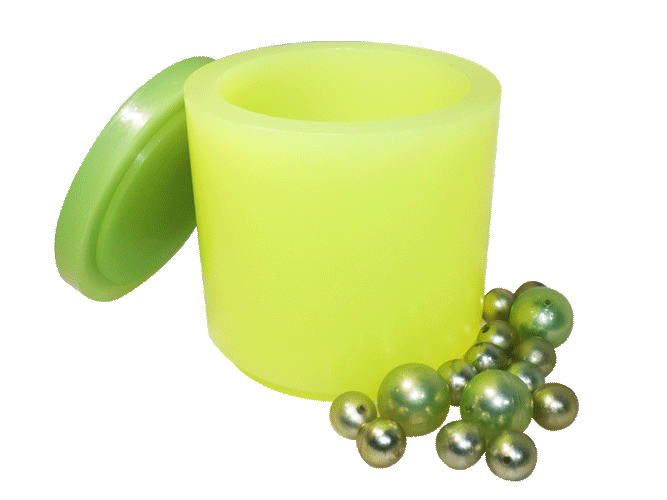
Core Function and Working Principle
The PU planetary mill jar serves as the vessel that holds the grinding media (e.g., balls) and the sample material inside a planetary ball mill. During operation, the mill platform rotates around its central axis while the jar simultaneously spins in the opposite direction, creating a powerful planetary motion. This dual rotation causes the grinding balls to collide with each other and the jar walls at high energy, breaking down particles through impact and friction.
The PU material plays a crucial role in this process: its inherent elasticity dampens some of the impact energy, reducing noise and vibration, while its high abrasion resistance minimizes jar wear. The smooth inner surface also helps prevent material from sticking, ensuring efficient grinding and easy cleaning. Key parameters such as rotation speed (typically 100–600 rpm), ball-to-material ratio, and grinding time must be optimized according to the target particle size and material hardness.
Key Material Characteristics of PU Planetary Mill Jars
Polyurethane is a polymer with a unique combination of properties that make it suitable for grinding applications:
- Wear Resistance: PU exhibits excellent abrasion resistance, often outperforming many plastics and even some metals in sliding wear conditions. This results in a long service life for the jar.
- Elasticity and Toughness: The material can absorb impact energy without cracking, making it less prone to fracture compared to brittle materials like agate or corundum.
- Low Contamination: PU jars introduce minimal trace elements into the sample. They are particularly suitable for grinding materials that are sensitive to metal contamination (e.g., Fe, Cr, Ni).
- Chemical Resistance: PU resists many oils, greases, and mild chemicals, though it may degrade in strong acids or bases. It is safe for dry and wet grinding of many common materials.
- Noise and Vibration Damping: The elastic nature of PU helps reduce operational noise, which is a practical advantage in laboratory settings.
Compared to other materials like 304 stainless steel (which can cause iron contamination) or zirconia (very hard but brittle), PU offers a balance of good wear resistance and low contamination at a moderate cost. It is not suitable for very hard materials (e.g., tungsten carbide, minerals above Mohs hardness 7) or high-temperature processes.
Key Performance Indicators and Selection Criteria
When choosing a PU planetary mill jar, consider the following factors:
- Capacity: PU jars are available in various volumes, typically from 50 mL to 500 mL for laboratory use. Select a size that matches the sample quantity – fill the jar to about 1/3 to 2/3 of its volume for optimal grinding.
- Sealing and Lid Design: A secure sealing mechanism (e.g., O-ring gasket, lock clamp) prevents leakage during high-speed rotation. Many PU jars come with a rubber or silicone gasket that withstands repeated use.
- Compatibility with Planetary Mill Models: Ensure the jar dimensions (diameter, height) and attachment mechanism (e.g., clamping style, threaded necks) fit your specific mill model. Common types include single jar, double jar, or four jar setups.
- Hardness of Material to Be Ground: PU is ideal for medium-hard materials (Mohs hardness < 6). For harder samples, use ceramic or metal jars.
- Cleaning and Maintenance: PU is easy to clean with water or mild solvents. Avoid abrasive cleaners that could scratch the surface. Over time, PU may swell or soften if exposed to certain organic solvents – verify chemical compatibility.
Cost is another factor: PU jars are generally less expensive than zirconia or tungsten carbide jars, but more than nylon jars. They offer a good price-to-performance ratio for many routine grinding tasks.
Applications and Selection Recommendations
PU planetary mill jars are widely used in fields such as geology, ceramics, pigments, pharmaceuticals, and food processing. Typical applications include grinding of pigments, carbon black, soil samples, clay, talc, herbs, and composite materials.
For laboratories that frequently process medium-hard, non-abrasive materials and require low metal contamination, the PU jar is an excellent choice. If you need to grind extremely hard materials like silicon carbide or zirconia, consider tungsten carbide or agate jars. For wet grinding of acidic or alkaline slurries, PTFE jars may be more suitable. Always match the jar material to the chemical and physical properties of your sample to achieve the best results and longest service life.
References:
PU Planetary Mill Jar – Official Product Page
Planetary Ball Mill Jar Series – TENCAN