
What is a PTFE Roll Mill Jar? A Contamination-Free Grinding Vessel for High-Purity Material Processing
Introduction
From the core, a PTFE roll mill jar is a specialized grinding container used in roll ball mills, designed for processing materials that require absolute purity and chemical resistance. Laboratories and industries use it to grind, mix, and homogenize powders without introducing metallic contamination, leveraging the unique properties of polytetrafluoroethylene (PTFE) – commonly known as Teflon.
This jar is an essential accessory for roll ball mills, where the jar rotates on rollers, allowing the grinding media inside to impact and shear the material. The PTFE material ensures that the jar itself does not react with or contaminate the sample, making it indispensable for applications in pharmaceuticals, advanced ceramics, electronics, and battery materials.
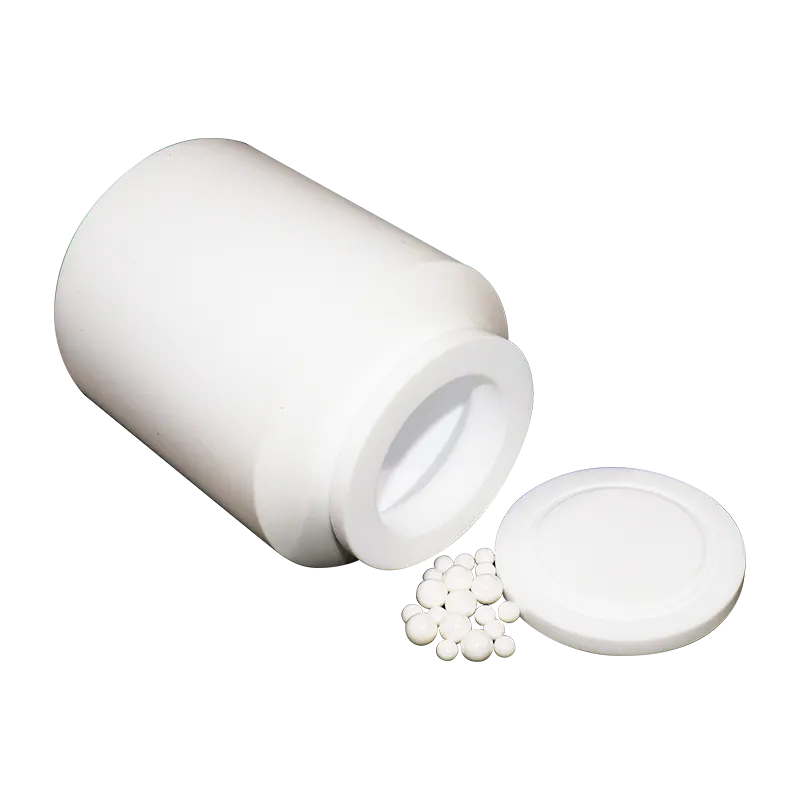
Core Function and Working Principle
The primary function of a PTFE roll mill jar is to hold the material and grinding media (such as balls) during the milling process. When placed on a roll ball mill, the jar rotates at a controlled speed, causing the grinding media to tumble and generate impact, friction, and shear forces. These forces break down the material from coarse particles into fine powders.
Key working parameters include rotation speed, jar volume, ball-to-material ratio, and milling time. The PTFE jar's smooth inner surface minimizes adhesion and wear, ensuring consistent grinding results. The material's high chemical inertness allows it to handle aggressive solvents, acids, and alkalis without degradation, which is critical for processes like wet grinding of battery electrodes or pharmaceutical ingredients.
Key Features and Technical Advantages
Chemical Inertness and Corrosion Resistance
PTFE is virtually inert to almost all chemicals, including strong acids, bases, and organic solvents. This makes the PTFE roll mill jar ideal for milling corrosive materials or samples that must not be altered by the container material. It withstands temperatures from -200°C to 260°C, allowing both low-temperature and moderate-temperature milling.
Non-Stick Surface
The non-stick property of PTFE prevents material from adhering to the jar walls, ensuring easy cleaning and high recovery rates. This is especially beneficial for expensive or hazardous materials where sample loss must be minimized.
Contamination-Free Grinding
Unlike metal or ceramic jars, PTFE introduces no metallic or siliceous contaminants. This is crucial for high-purity applications such as semiconductor materials, catalyst preparation, and pharmaceutical formulations where trace impurities can compromise product quality.
Mechanical Design
PTFE roll mill jars are typically equipped with tight-sealing lids to prevent leaks and maintain pressure integrity. They are available in various sizes, from small laboratory volumes (e.g., 0.5L) to larger production capacities (e.g., 20L), and can be customized with different shapes and openings to suit specific mill models.
Key Performance Indicators and Selection Criteria
When selecting a PTFE roll mill jar, consider the following parameters:
- Volume Capacity: Choose a jar size that matches your batch requirements. Common capacities range from 0.1L to 20L.
- Wall Thickness: Thicker walls provide better durability and impact resistance, especially for heavy grinding media.
- Sealing Performance: Ensure the lid seal is effective for wet grinding or vacuum/atmosphere control.
- Compatibility: Verify that the jar dimensions and drive mechanism are compatible with your roll ball mill model.
- Temperature Range: PTFE jars can handle continuous use up to 260°C, but check if your application requires higher temperature resistance.
For high-throughput laboratories, consider jars with larger capacities and reinforced handles for easy handling. For ultra-fine grinding, pair the PTFE jar with appropriate grinding media, such as stainless steel or ceramic balls, depending on the desired final particle size.
Application Fields and Selection Advice
PTFE roll mill jars are widely used in research and production across multiple industries:
- Pharmaceuticals: Grinding of active pharmaceutical ingredients (APIs) and excipients without metal contamination.
- Battery Materials: Milling of electrode materials (e.g., cathodes, anodes) for lithium-ion and solid-state batteries.
- Advanced Ceramics: Preparation of fine ceramic powders for electronic components and structural parts.
- Chemical Synthesis: Mixing and grinding of catalysts, pigments, and specialty chemicals.
For most laboratory applications, a standard PTFE jar with a volume of 1-5L and a simple lid is sufficient. For production-scale operations, opt for larger jars with reinforced walls and quick-release mechanisms. If you require compatibility with aggressive solvents or high-temperature processes, PTFE is the preferred choice over other materials like nylon or polyurethane.
References
For more details, visit the official product page: PTFE Roll Mill Jar.