
What is a PTFE Roll Mill Jar? A Chemical-Resistant Grinding Container for High-Purity Ball Milling Applications
Introduction
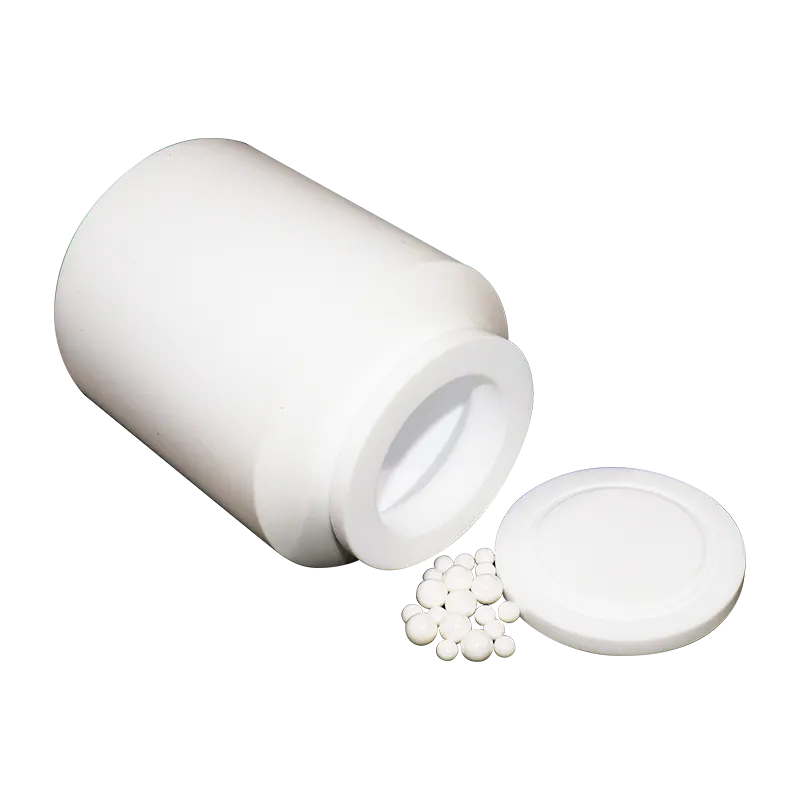
At its core, a PTFE roll mill jar is a specialized grinding container made from polytetrafluoroethylene (PTFE), designed for use in roller ball mills. Laboratories and production facilities use it to mill, mix, and homogenize a wide range of materials, especially those that are chemically aggressive or require ultra-high purity. The PTFE material offers exceptional chemical resistance, non-stick properties, and thermal stability, making it the preferred choice for grinding sensitive compounds without contamination.
Core Function & Working Principle
The primary function of a PTFE roll mill jar is to contain the material and grinding media during the milling process. When placed on a roller ball mill, the jar rotates around its horizontal axis. Inside, grinding balls (typically made of zirconia, agate, or PTFE itself) tumble and collide with the material, gradually reducing particle size through impact and attrition.
The PTFE inner wall is extremely smooth and non-porous, which prevents material buildup and cross-contamination. Unlike metal or ceramic jars, PTFE does not shed metal ions or particles, ensuring the final product maintains its chemical purity. The jar's design also allows for easy cleaning, a critical advantage in pharmaceutical and food applications.
Key Components & Material Properties
PTFE roll mill jars are typically constructed from virgin PTFE, which offers:
- Chemical Inertness: Resists virtually all acids, bases, and organic solvents, enabling safe milling of corrosive materials.
- Non-Stick Surface: Prevents material adhesion, reducing waste and simplifying cleaning.
- Wide Temperature Range: Operates from -200°C to +260°C, suitable for low-temperature or exothermic milling processes.
- Low Friction Coefficient: Minimizes wear on the jar and grinding media.
The jar is often equipped with a durable sealing cap (often made of PTFE or PFA) to prevent leakage during rotation. Optional features include built-in handles for easy handling and anti-static properties for safe milling of flammable powders.
Key Performance Indicators & Selection Guide
When selecting a PTFE roll mill jar, consider the following parameters:
- Capacity: Available in various sizes (e.g., 0.1L, 0.5L, 1L, 2L, 5L) to match your batch volume.
- Wall Thickness: Thicker walls provide better durability and noise reduction, but slightly reduce internal volume.
- Sealing Efficiency: Ensure the cap provides a tight seal to prevent solvent evaporation or dust leakage.
- Compatibility: Confirm the jar dimensions match your roller mill's roller spacing and rotation speed.
- Purity: For ultra-high-purity applications (e.g., semiconductor, battery materials), choose PTFE jars with documented low metal ion leachables.
For most applications, a standard PTFE jar is sufficient. However, if you need to mill at extremely high temperatures or under vacuum, consider a specialized PTFE jar with reinforced design.
Applications & Recommendations
PTFE roll mill jars are widely used in:
- Pharmaceutical Research: Milling active pharmaceutical ingredients (APIs) without metal contamination.
- Chemical Synthesis: Grinding aggressive catalysts, polymers, and fine chemicals.
- Battery Materials: Preparing electrode slurries and solid-state electrolyte powders.
- Food & Flavor: Mixing and grinding flavor compounds, spices, and nutritional supplements.
- Environmental Analysis: Homogenizing soil, sediment, and biological samples for trace analysis.
For labs handling highly corrosive or expensive materials, a PTFE roll mill jar is an indispensable investment. If your application requires less chemical resistance, you may consider alternatives like nylon or ceramic jars, but for maximum purity and versatility, PTFE remains the gold standard.
References
Product Link: PTFE Roll Mill Jar