
What is a Muffle Furnace? A Versatile High-Temperature Heating Device for Laboratories and Industrial Heat Treatment
What is a Muffle Furnace?
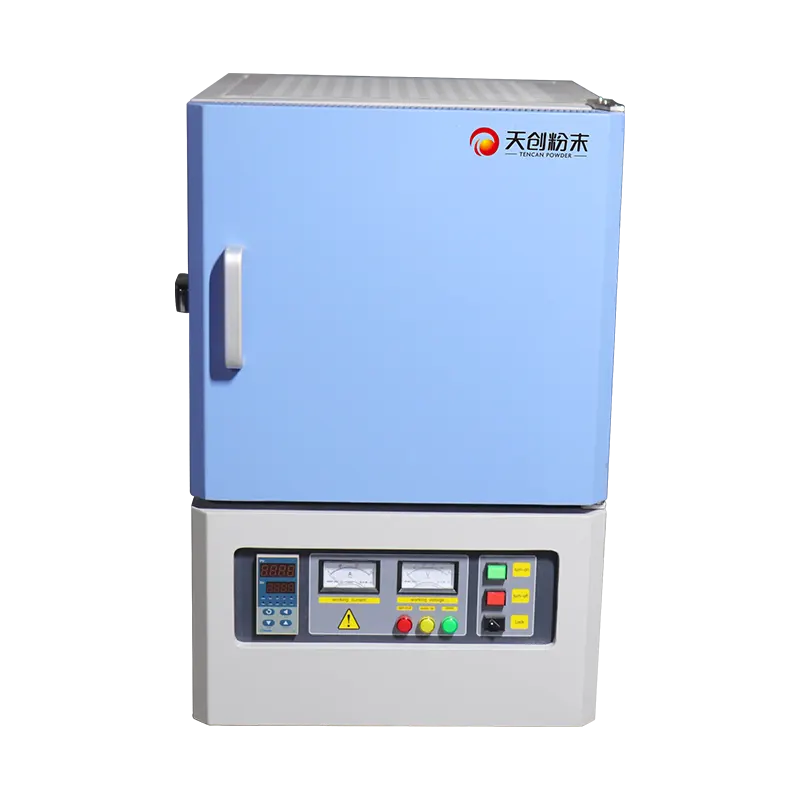
At its core, a muffle furnace is a professional heating device used across laboratories, research institutions, and industrial settings to perform high-temperature processes such as ashing, material pretreatment, annealing, sintering, and heat treatment. It is also commonly referred to as a box furnace, electric resistance furnace, or chamber furnace. The key feature of a muffle furnace is that the heating elements are isolated from the heating chamber, ensuring clean, uniform heating without contamination from the heating source.
Core Function and Working Principle
The basic function of a muffle furnace is to convert materials from their initial state (solid, liquid, or powder) into a desired final state through controlled thermal exposure. The working principle involves electrical resistance heating elements (usually embedded in the chamber walls) that generate heat, which is then transferred to the workpiece via radiation and convection. The furnace chamber is typically made of high-temperature resistant materials such as ceramic fiber or refractory bricks, ensuring excellent insulation and temperature uniformity.
Modern muffle furnaces use advanced PID (Proportional-Integral-Derivative) controllers to precisely regulate temperature, with typical accuracy within ±1°C. The heating process can be programmed with multiple segments, allowing users to set ramp rates, hold times, and cooling cycles. The temperature range usually spans from room temperature up to 1200°C, 1500°C, or even 1700°C depending on the model. The isolated chamber design prevents direct contact between the sample and the heating elements, making it ideal for applications where sample purity is critical.
Key Components and Core Technologies
Although muffle furnaces come in various sizes and configurations, they share several core components:
- Chamber (Muffle): The inner cavity where samples are placed. It is usually made of ceramic fiber, alumina, or refractory materials to withstand high temperatures and thermal shock.
- Heating Elements: Typically embedded in the chamber walls, these can be resistance wires (e.g., Kanthal, FeCrAl) or silicon carbide rods for higher temperatures.
- Insulation Layer: High-density ceramic fiber or brick layers minimize heat loss, improving energy efficiency and reducing external surface temperature for operator safety.
- Temperature Controller: Digital controllers with PID algorithms allow precise programming of temperature profiles, including multi-step ramping and hold cycles.
- Safety Features: Over-temperature protection, door interlock, and automatic shutdown are standard in modern units to ensure safe operation.
Some advanced models incorporate Moldatherm® insulation technology, which provides rapid heating and cooling rates while maintaining high thermal efficiency, enabling faster batch processing. The use of ceramic fiber insulation also reduces the overall weight of the furnace.
Key Performance Indicators and Selection Criteria
When selecting a muffle furnace, the following performance indicators should be considered:
- Maximum Temperature: Choose a model that meets your required process temperature. Common ranges are 1100°C, 1200°C, 1500°C, and 1700°C.
- Chamber Volume: Available from 1 liter to over 200 liters. Select based on sample size and throughput needs.
- Temperature Uniformity: Typically ±3°C to ±10°C across the chamber. Better uniformity is critical for precision sintering or annealing.
- Heating Rate: Some models can achieve rapid heating (e.g., 10°C/min to 30°C/min) to shorten cycle times.
- Control System: Advanced controllers offer programmable multi-step profiles, data logging, and remote monitoring capabilities.
- Energy Efficiency: Modern insulation materials like ceramic fiber can reduce energy consumption by 30-50% compared to traditional refractory brick furnaces.
- Maintenance: Ensure easy access to heating elements and chamber for cleaning or replacement. Ceramic fiber chambers are generally more durable and easier to maintain.
Application Areas and Selection Advice
Muffle furnaces are widely used in the following fields:
- Materials Science: Sintering of ceramics, metallurgy, powder metallurgy, and crystal growth.
- Chemical Analysis: Ashing, loss on ignition, elemental analysis, and sample pretreatment.
- Pharmaceuticals: Sterilization, drying, and stability testing.
- Environmental Testing: Determination of ash content in coal, biomass, and waste materials.
- Heat Treatment: Annealing, quenching, tempering, and stress relieving of small metal parts.
- Education and Research: Laboratory experiments and material characterization.
For most academic and analytical labs, a standard 1100°C or 1200°C muffle furnace with a chamber volume of 3-10 liters is sufficient. For industrial applications requiring higher temperatures or larger batches, consider 1500°C-1700°C models with larger chambers. If you need to process samples under a protective atmosphere, a box-type atmosphere furnace may be more suitable.