
Muffle Furnace Selection for Powder Labs
Powder processing rarely ends at milling. Once a material has been ground, classified, and blended, the next step often involves heat: drying, calcination, binder burnout, annealing, or sintering. In these stages, a muffle furnace can make the difference between a repeatable result and a batch that fails because of contamination, thermal gradients, or uncontrolled heating rates. For laboratories working with ceramic powders, metal powders, catalyst precursors, geological samples, or battery materials, the furnace is not simply an oven. It is a high-temperature reactor whose chamber design, insulation, heating elements, and control system determine what the powder becomes after the cycle.
This guide focuses on the practical selection and use of a muffle furnace in powder processing laboratories. It explains how the main components affect results, what variables matter when a method is transferred from one lab to another, and how to evaluate a furnace against a specific material and process window. Rather than listing a fixed set of specifications, the discussion highlights the questions that should be asked before a purchase and the checks that should be performed after installation.
What a Muffle Furnace Does in a Powder Process
A muffle furnace is an electrically heated chamber designed to heat materials without direct contact between the workload and the heating elements. The term "muffle" refers to the inner chamber or retort that separates the sample from the heat source. In a modern laboratory muffle furnace, this separation is usually achieved by a ceramic or high-temperature alloy chamber wall, with heating elements mounted outside the working volume or embedded in the insulation. The arrangement protects the sample from combustion gases, element degradation products, and direct radiation that can create hot spots.
In powder processing, the muffle furnace is used for several distinct operations. Calcination removes volatile components from a precursor powder, such as carbonates, nitrates, or organic binders, and converts the material into a more stable oxide or mixed oxide. Sintering densifies a compacted or loose powder by atomic diffusion, usually below the melting point of the main phase. Annealing relieves internal stress introduced by milling or cold pressing and can modify crystallite size or phase composition. Ashing burns off organic matter from a powder or filter residue before chemical analysis. Drying removes moisture, although a dedicated drying oven is often more suitable when the temperature is below 200 °C.
Each of these operations places different demands on the furnace. Calcination and ashing require effective exhaust of gaseous by-products and resistance to corrosive vapors. Sintering requires uniform temperature across the sample and precise control of heating and cooling rates. Annealing may require a specific atmosphere to prevent oxidation. A furnace that performs well for one task may be a poor choice for another, which is why selection should begin with the process rather than the equipment catalog.
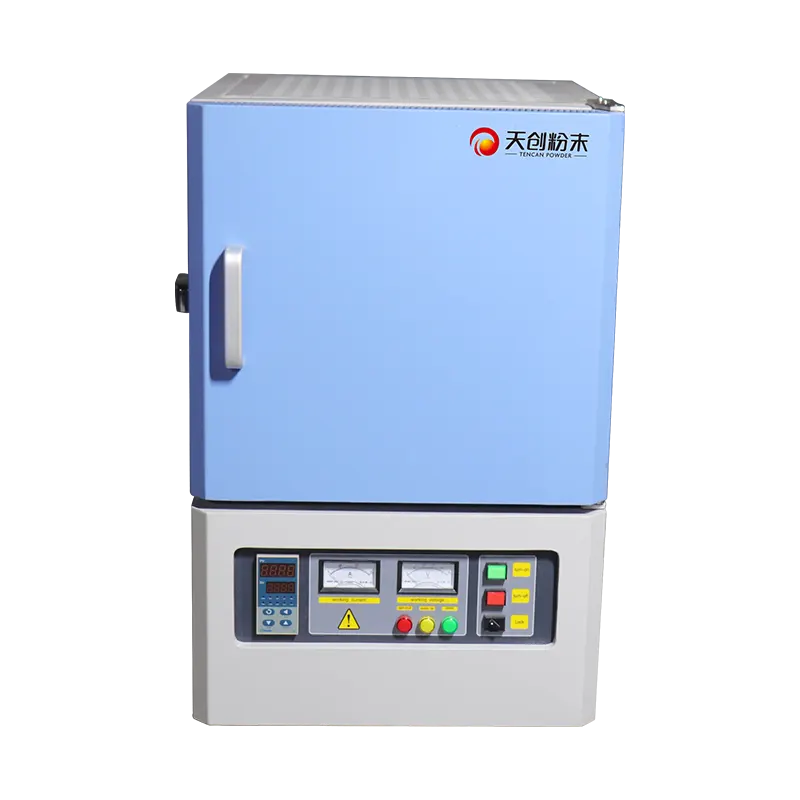
For laboratories that need a general-purpose high-temperature furnace for powder heat treatment, TENCAN's muffle furnace is one example of a sintering-series product intended for laboratory use. The actual suitability for a given powder depends on the required temperature, atmosphere, chamber size, and contamination limits, all of which should be confirmed against the material and process requirements.
Heating Elements and Temperature Limits: Matching the Furnace to the Material
The maximum working temperature of a muffle furnace is determined primarily by the heating elements, the insulation, and the thermocouple. Different element materials have different temperature capabilities, atmosphere tolerances, and service lives. Understanding these differences prevents the common mistake of selecting a furnace that can reach a temperature on paper but cannot sustain it reliably in the intended process.
Metallic resistance alloys, such as nickel-chromium and iron-chromium-aluminum, are widely used in furnaces with maximum temperatures around 1,000 °C to 1,200 °C. They are relatively inexpensive, easy to replace, and work well in air. Their main limitations are oxidation at high temperature and a gradual increase in resistance as the element ages. For powder processes that require long holds near the upper limit, the element life may be shortened, and the furnace may need more frequent maintenance.
Silicon carbide elements extend the range to approximately 1,400 °C to 1,600 °C, depending on the design and atmosphere. They offer good thermal shock resistance and can be used in air, but their resistance increases over time, and they may react with certain gases. Molybdenum disilicide elements are used in higher-temperature furnaces, often up to about 1,700 °C to 1,800 °C in air, with a protective oxide layer that forms during operation. They are more fragile than metallic elements and require careful handling during installation and replacement.
Graphite and tungsten elements can reach much higher temperatures, but they require inert or vacuum atmospheres because they oxidize rapidly in air. These elements are more common in specialized high-temperature furnaces than in standard laboratory muffle furnaces. If a powder process requires temperatures above the range of air-atmosphere muffle furnaces, a different furnace type or a controlled-atmosphere configuration may be necessary.
The choice of element also affects contamination. Some elements release small amounts of oxide or metal vapor over time. In powder processing, even trace contamination can alter sintering behavior, electrical properties, or catalytic activity. A furnace that separates the heating elements from the working chamber by a sealed muffle or an inner liner reduces this risk. The same principle applies to the insulation: refractory fibers and binders can release particles or gases, especially during the first heating cycles.
A practical selection rule is to choose a furnace whose maximum continuous temperature is at least 100 °C above the highest process temperature you expect to use routinely. This margin reduces element stress, improves temperature uniformity, and allows for occasional higher-temperature cycles without pushing the furnace to its limit. The exact margin should be based on the manufacturer's recommendations and on the material's sensitivity to contamination.
Chamber Design, Insulation, and Temperature Uniformity
Temperature uniformity is one of the most important but least visible characteristics of a muffle furnace. A furnace may have a single thermocouple reading that looks stable, while the actual temperature at different points in the chamber varies by tens of degrees. For powder samples, non-uniformity can cause incomplete calcination in some areas, over-sintering in others, and inconsistent phase composition across a batch.
Several design factors influence uniformity. The placement of heating elements around the chamber determines the heat flux pattern. Elements on all four sides and the door, or a multi-zone arrangement, generally provide better uniformity than elements on only two sides. The insulation material and thickness affect heat retention and the rate at which the chamber responds to control changes. Lightweight ceramic fiber insulation heats quickly and reduces energy consumption, but it has lower thermal mass and can be more sensitive to local overheating. Dense refractory brick heats more slowly but may provide a more stable thermal environment.
The door is another common source of heat loss. A well-sealed door with a refractory plug or gasket reduces cold spots near the opening. The door design also affects loading convenience and safety. For powder work, a door that opens fully and allows a crucible or tray to be placed in the center of the chamber without reaching over hot elements is preferable.
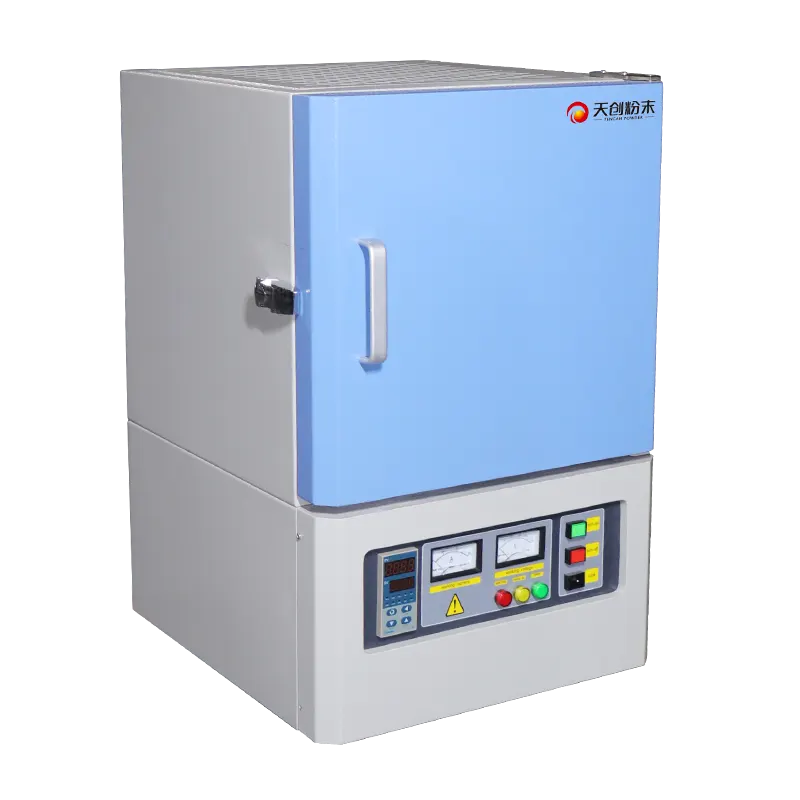
Thermocouple placement deserves close attention. The control thermocouple should be located near the workload, not just near the heating elements, so that the controller responds to the actual sample temperature rather than the element temperature. In many furnaces, the control thermocouple is positioned in the upper part of the chamber or behind a protective tube. If the sample is placed at the bottom of the chamber, the indicated temperature may not represent the sample temperature. A separate validation thermocouple can be used to map the chamber and confirm the working zone.
Loading pattern also matters. Samples should be placed in the central working zone, away from walls and elements. Do not block the path of natural convection or the exhaust port. Leave space between crucibles so that heat can circulate. If the furnace has a fan or forced-air circulation, follow the manufacturer's guidelines for clearance. In a simple radiant furnace without a fan, radiation and conduction dominate, and the position of the sample relative to the elements becomes even more critical.
For reproducible powder processing, it is useful to establish a standard load configuration. The same crucible type, powder mass, bed depth, and placement should be used for each run. This practice reduces variability and makes it easier to compare results. When a process is scaled up, the furnace chamber size and load pattern should be re-evaluated rather than assuming that a larger furnace will produce the same result.
Atmosphere and Contamination Control in Powder Heat Treatment
Most standard muffle furnaces operate in air. This is suitable for oxide ceramics, many minerals, and materials that form stable oxides at high temperature. It is not suitable for powders that oxidize, reduce, or react with air. Metal powders, carbide powders, nitride powders, and some battery materials require an inert or reducing atmosphere to prevent unwanted phase formation.
Some muffle furnaces can be equipped with gas inlet and outlet ports for purging with nitrogen, argon, or a reducing gas mixture. However, a muffle furnace is generally not a gas-tight vessel unless it is specifically designed for controlled atmosphere. The door seal, element feedthroughs, and exhaust openings may allow air ingress. If the process requires low oxygen levels, a tube furnace or a vacuum furnace is often a more reliable choice. Before selecting a muffle furnace for atmosphere-sensitive powders, confirm with the manufacturer whether the design supports the required gas purity and whether safety measures are provided for flammable or toxic gases.
Contamination can also come from the crucible or tray. Alumina crucibles are common for oxide powders because they are refractory and relatively inert. Zirconia crucibles offer higher chemical resistance for some materials. Quartz is suitable for lower temperatures and can be used when visual observation is needed. Graphite is used in reducing or inert atmospheres but can introduce carbon. Metallic trays may react with the powder or oxidize. The choice of container should be based on the powder chemistry, the process temperature, and the risk of diffusion or sticking.
Another source of contamination is the furnace itself. Insulation fibers, element oxides, and previous sample residues can become airborne or volatile. Regular cleaning and careful handling reduce cross-contamination. If the furnace is used for multiple materials, a dedicated liner or a sacrificial crucible can help. For trace analysis, a new or well-cleaned furnace may be necessary to avoid background signals.
Ventilation is important for both contamination control and safety. Calcination and ashing can release carbon dioxide, water vapor, nitrogen oxides, sulfur oxides, or organic vapors. These gases should be vented away from the operator. A fume hood or an exhaust connection may be required depending on the material and the process. The furnace should be placed in a well-ventilated area, and the exhaust port should not be blocked.
Temperature Control, Ramp Rate, and Soak Time
The temperature controller is the interface between the furnace and the process. Modern controllers use PID algorithms to maintain a setpoint, and many include programmable ramp-and-soak profiles. For powder processing, the ability to control heating rate, hold time, and cooling rate is often more important than the absolute accuracy of a single setpoint.
Heating rate affects the powder in several ways. A fast ramp can cause thermal shock in the crucible or in the sample, leading to cracks, spalling, or incomplete reactions. It can also cause binder burnout to occur too quickly, producing gas pressure inside a compact that results in defects. A slow ramp, especially in the range where volatiles are released, allows gases to escape and the material to equilibrate. Typical programs for calcination might use a ramp of 1 °C/min to 5 °C/min up to an intermediate temperature, a hold for several hours, and then a controlled or natural cool. The exact profile depends on the material and should be established through testing.
Soak time must be long enough for the entire sample to reach the target temperature and for the desired reaction or densification to complete. Large powder masses or thick bed depths require longer soak times because heat transfer through a powder is slower than through a solid. The thermocouple may reach the setpoint before the center of the sample does. For critical processes, a thermocouple placed in a dummy sample can reveal the actual thermal lag.
Cooling rate can be just as important as heating rate. Some materials undergo phase transformations, oxidation, or cracking during cooling. If the furnace is opened immediately after the hold, the sample may cool rapidly and unevenly. Many controllers allow a controlled cooling segment, or the furnace can be left to cool naturally with the door closed. The choice depends on the material and the desired microstructure.
Thermocouple type and condition also affect control. Type K thermocouples are common for lower-temperature furnaces, while Type S, R, or B thermocouples are used at higher temperatures. Thermocouples drift over time, especially after repeated high-temperature cycles. A furnace that was accurate when new may read several degrees low after months of use. Periodic calibration or replacement is necessary for processes that depend on temperature precision. An independent over-temperature thermocouple and controller provide an additional safety layer.
Loading, Sample Preparation, and Throughput
Powder loading is a practical variable that is often overlooked. The way a powder is placed in the furnace affects heat transfer, gas flow, and the final product. A thin, evenly spread layer heats more uniformly than a deep bed. If the powder is loosely piled, the thermal conductivity is low, and the center may remain cooler than the surface. If the powder is compacted, heat transfer improves, but gas escape may be restricted. The optimal loading method depends on whether the goal is calcination, sintering, or ashing.
Crucible selection and preparation also matter. The crucible should be compatible with the powder and the atmosphere. It should be clean and dry before use. A lid can reduce contamination and prevent sample loss, but it can also trap gases. If a lid is used, it should not seal completely unless the process requires it. For ashing, an open crucible may be necessary to allow oxygen to reach the sample.
Throughput is determined by the usable chamber volume, the loading density, and the cycle time. A larger chamber can process more samples per batch, but it may also take longer to heat and cool, and the temperature uniformity may be more difficult to maintain. A smaller furnace may be more efficient for method development and small batches. When scaling up, consider whether the same heating rate and soak time will produce the same result in a larger load. Often, the cycle must be adjusted.
For laboratories that need to process multiple samples with different requirements, a furnace with a programmable controller and a well-defined working zone is more flexible than a simple on-off furnace. If the workload is large, a production-scale furnace or multiple smaller furnaces may be more practical than one very large unit. The decision should be based on the number of samples, the required cycle time, and the acceptable turnaround time.
Safety, Maintenance, and Cost of Ownership
A muffle furnace operates at high temperatures and can be dangerous if not used correctly. The exterior surfaces may become hot, especially around the door and exhaust. The furnace should be placed on a non-combustible surface with adequate clearance from walls and flammable materials. Operators should use heat-resistant gloves and face protection when loading or unloading hot samples. The area should be ventilated, and the exhaust should be directed away from the breathing zone.
Maintenance is another factor in long-term cost. Heating elements age and eventually fail. Replacing them requires the correct part and careful installation to avoid damage. Thermocouples drift and should be checked or replaced periodically. Insulation can degrade, especially if the furnace is used with corrosive vapors or if the chamber is mechanically damaged. Door seals and hinges should be inspected for wear. The controller and power supply should be checked for loose connections and overheating.
Energy consumption depends on the furnace size, insulation, temperature, and cycle time. A well-insulated furnace with a tight door will use less energy than a poorly insulated one. However, the initial cost of a high-quality furnace may be higher. The total cost of ownership includes the purchase price, energy, consumables, maintenance, and downtime. For critical processes, the cost of a failed batch or an inaccurate result can outweigh the savings from a lower-cost furnace.
Documentation and support are also part of the ownership experience. A furnace that comes with clear operating instructions, wiring diagrams, and calibration information is easier to maintain and validate. If the process is subject to quality standards, the furnace may need to be calibrated and documented. Ask the supplier about the availability of spare parts, technical support, and service.
Types of Muffle Furnaces and Their Process Fit
Laboratory muffle furnaces come in several configurations. The most common is the box-type muffle furnace, which has a rectangular chamber with a front-opening door. It is suitable for crucibles, trays, and small compacts. The chamber may be made of ceramic fiber or refractory brick, and the elements may be embedded in the walls or mounted on the outside. Box furnaces are generally easy to load and can accommodate a range of sample sizes.
Tube muffle furnaces, also called tube furnaces, use a cylindrical ceramic or quartz tube as the working chamber. They offer better atmosphere control because the tube can be sealed with gas inlet and outlet fittings. They are often used for small samples that require inert or reducing atmospheres. However, the usable volume is smaller, and loading is limited by the tube diameter. A tube furnace may be preferred for metal powders or for processes that require precise gas composition.
Bottom-loading muffle furnaces have a door or platform that lowers from the bottom. They are useful for large or heavy loads that are difficult to place through a front door. They also reduce the risk of dropping samples onto hot elements. However, they may have different temperature uniformity characteristics and may be more expensive. The choice between box, tube, and bottom-loading designs depends on the sample size, atmosphere, and throughput requirements.
Material-Specific Considerations for Powder Heat Treatment
Different powder materials react differently to high-temperature processing. Ceramic powders, such as alumina, zirconia, and titania, are often processed in air because they form stable oxides. Sintering temperature, heating rate, and soak time determine density, grain size, and phase composition. Contamination from crucibles or insulation can alter the final properties, so high-purity alumina or zirconia crucibles are commonly used.
Metal powders, such as copper, iron, nickel, and titanium, are sensitive to oxygen. Copper and iron can oxidize in air at elevated temperatures, and titanium can absorb oxygen and nitrogen, becoming brittle. These materials usually require a reducing or inert atmosphere. A standard air-atmosphere muffle furnace is not suitable unless the process is specifically designed to tolerate oxidation or unless the furnace is equipped for gas purging. In many cases, a tube furnace or a vacuum furnace is a better choice.
Battery materials, including cathode precursors and anode materials, often require precise control of atmosphere and temperature. Some precursors decompose in air, and some final products are air-sensitive. The furnace must be able to maintain a controlled atmosphere, and the process must avoid contamination from moisture, oxygen, or metallic elements. This is an area where a muffle furnace may be used for calcination in air, but sintering steps may require a different furnace type.
Geological and environmental samples may be ashed or fused in a muffle furnace before analysis. Ashing removes organic matter, and the residue is analyzed for metals or minerals. The furnace must be able to reach the required ashing temperature, often 500 °C to 800 °C, and must be well ventilated to remove combustion gases. Contamination from previous samples is a concern, so a clean furnace and proper crucible handling are important.
Common Problems and Troubleshooting
Even a well-selected muffle furnace can produce inconsistent results if the process is not controlled. One common problem is a difference between the controller temperature and the actual sample temperature. This can happen when the thermocouple is far from the sample, when the sample has a large thermal mass, or when the furnace has a slow response. The solution is to validate the furnace with a separate thermocouple and adjust the profile if necessary.
Another problem is contamination. If a powder shows unexpected phases or discoloration, the source may be the crucible, the furnace insulation, or residues from previous runs. Using a clean, dedicated crucible and firing an empty furnace at high temperature can help. In some cases, a liner or a covered crucible may be needed. If the contamination persists, the furnace may need to be cleaned or the insulation replaced.
Uneven sintering or calcination is often caused by poor temperature uniformity or improper loading. Samples placed near the door or too close to the elements may be over-processed, while samples in the center may be under-processed. A standard loading pattern and a validated working zone can reduce this variability. If the furnace has multiple zones, check that the zones are balanced and that the controller is tuned correctly.
Element failure is a normal maintenance event, but premature failure can indicate a problem. Operating the furnace above its rated temperature, using it in a corrosive atmosphere, or cycling it too rapidly can shorten element life. Following the manufacturer's operating limits and allowing proper cooling between cycles can extend element life. Keeping spare elements and thermocouples on hand reduces downtime.
Selection Checklist for Powder Processing Labs
The following checklist can help organize the decision. It is not a substitute for testing, but it ensures that the main technical factors are considered before a furnace is purchased.
| Requirement | What to check |
|---|---|
| Maximum process temperature | Choose a furnace with a continuous rating above the highest routine temperature; confirm element type and thermocouple type. |
| Atmosphere | Air, inert purge, reducing gas, or vacuum? Confirm whether the muffle furnace is designed for the required atmosphere and safety. |
| Chamber size and shape | Usable volume, door opening, and internal dimensions must accommodate the crucibles or trays used for powder samples. |
| Temperature uniformity | Ask for the working zone and uniformity data. Consider multi-zone or fan-assisted designs if the process is sensitive. |
| Heating and cooling rates | Programmable ramp-and-soak control with adjustable rates is preferred for calcination and sintering. |
| Contamination control | Muffle material, element isolation, insulation type, and crucible compatibility should be evaluated for the powder chemistry. |
| Control and safety | PID control, over-temperature protection, door interlock, and clear alarms are important for unattended operation. |
| Maintenance and support | Element replacement, thermocouple calibration, spare parts, and technical support should be available. |
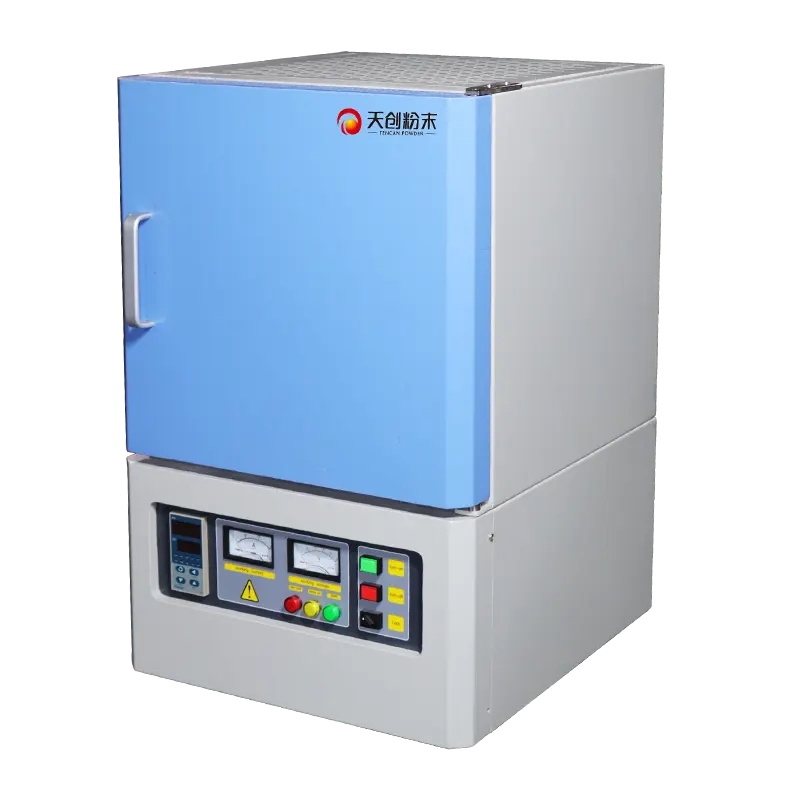
For a specific product example, the TENCAN laboratory muffle furnace can be reviewed against these criteria. The product page provides the current configuration and options, which should be compared with the process requirements rather than assumed to be suitable for every powder.
FAQ: Muffle Furnace Selection for Powder Labs
Can a muffle furnace be used for sintering metal powders?
It can be used for some metal powders, but oxidation is a major concern. Standard muffle furnaces operate in air, so they are generally better suited to oxide ceramics and materials that tolerate oxygen. If the metal powder requires a reducing or inert atmosphere, a controlled-atmosphere furnace or a tube furnace may be more appropriate. Some muffle furnaces can be purged with inert gas, but the achievable oxygen level depends on the design and should be confirmed with the manufacturer.
How do I choose between a muffle furnace and a tube furnace?
A muffle furnace offers a larger chamber and easier loading of crucibles and trays, which is useful for batch processing of powders. A tube furnace provides better atmosphere control and can achieve faster heating and cooling for small samples. If the process requires precise gas composition or high-purity inert atmosphere, a tube furnace is often preferred. If the process is in air and requires a larger working volume, a muffle furnace may be more practical.
What causes temperature differences inside a muffle furnace?
Temperature differences can result from heating element layout, insulation condition, door sealing, thermocouple placement, and loading pattern. Samples placed near the door or walls may experience lower temperatures. Using the central working zone, leaving space for heat circulation, and validating the chamber with a separate thermocouple can reduce variability.
How often should a muffle furnace be calibrated?
The calibration interval depends on the process requirements, the furnace usage, and the quality system. High-temperature processes, frequent cycling, and critical results may require more frequent checks. A common practice is to verify the control thermocouple periodically with an independent thermocouple and to replace it when drift exceeds the process tolerance. The manufacturer's recommendations should be followed.
Validating a Muffle Furnace for Your Powder Process
Once a muffle furnace is installed, validation should go beyond checking that it reaches the setpoint. A useful validation plan includes an empty-chamber temperature survey, a loaded test with a representative powder, and a repeatability check. The empty-chamber survey identifies the working zone and reveals cold spots near the door or corners. A separate calibrated thermocouple can be placed at several positions, and the furnace can be taken through a typical ramp-and-soak profile.
The loaded test is more relevant to the actual powder process. Use the same crucible, powder mass, and bed depth as the production or routine method. Place a thermocouple in a dummy sample or in a separate test crucible to measure the sample temperature. Compare the sample temperature with the controller reading. This step shows whether the controller setpoint represents the powder temperature or only the chamber air temperature. If the difference is significant, the process profile may need to be adjusted.
Repeatability should be checked by running the same cycle several times and analyzing the product. For a sintering process, measure density, phase composition, or particle size. For calcination, measure weight loss, crystallinity, or chemical composition. If the results vary beyond the acceptable range, investigate the furnace, the loading method, and the raw material. Small changes in powder bed depth, crucible position, or door closure can affect the outcome.
It is also wise to document the furnace settings, the load configuration, and the maintenance history. This record helps troubleshoot future problems and supports method transfer to other laboratories. If the process is scaled up or transferred to a different furnace, the validation should be repeated because chamber size, element type, and control behavior may differ.
In powder processing, the muffle furnace is a tool that connects the milled powder to the final material properties. Selecting it on the basis of temperature alone is rarely sufficient. The heating elements, insulation, atmosphere, control system, and loading method all contribute to the result. By defining the process requirements first and then evaluating the furnace against those requirements, laboratories can improve reproducibility, reduce contamination, and avoid the cost of failed batches. For more details on a specific laboratory model, the TENCAN muffle furnace for sintering page can be used as a starting point for comparison.