
Lab Disperser: A Practical Guide for Powder and Liquid Dispersion in the Laboratory
If you have ever tried to mix a fine powder into a liquid, you already know it is rarely straightforward. Particles tend to clump together, forming agglomerates that resist wetting. Powders with low bulk density float on the surface, while heavier particles settle to the bottom within seconds. Even after prolonged stirring with a simple paddle, the dispersion remains uneven, affecting the consistency of your final product. This is exactly where a lab disperser becomes an essential tool.
A lab disperser is designed to break down agglomerates, wet powders efficiently, and create stable suspensions or emulsions at the laboratory scale. Unlike conventional stirrers that rely on bulk rotation, a disperser generates high shear forces by rotating a specially shaped dispersing tool at high tip speeds. The result is rapid deagglomeration, uniform particle distribution, and significantly shorter processing times. In this article, we will walk through how a lab disperser works, which applications benefit most from it, and what factors you should consider when selecting one for your lab.
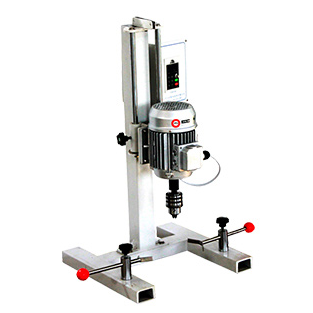
How a Lab Disperser Achieves Efficient Dispersion
At the heart of every lab disperser is a high-speed motor coupled with a dispersion shaft and tool. The tool, often a toothed or slotted rotor, rotates at speeds that produce a tip speed typically in the range of 10 to 40 meters per second. This high tangential velocity creates intense hydraulic shear in the narrow gap between the rotor and the stationary stator (if present) or directly within the liquid.
When the rotating tool passes through the mixture, it generates a strong suction that draws both liquid and powder into the working zone. The particles are subjected to three main forces:
- Impact: Particles collide with the tool and each other at high speed.
- Shear: The velocity gradient between the rotating tool and the surrounding liquid stretches and tears apart agglomerates.
- Cavitation: Rapid pressure changes cause micro-bubbles to form and collapse, further breaking down clusters.
This combination of forces can reduce agglomerates down to the micrometer or even submicrometer range in a short time, depending on the material and process conditions. The result is a homogenous dispersion with improved stability and reproducibility.
Common Applications of a Laboratory Disperser
Lab dispersers are widely used across multiple industries and research fields. Because the same basic principle applies to many types of materials, you will find them in laboratories working on:
Paints, Coatings, and Inks
Pigments and fillers need to be fully wetted and distributed to achieve consistent color, opacity, and gloss. A lab disperser quickly breaks down pigment agglomerates and reduces particle size to the target range, which is critical for both R&D formulation and quality control before scale-up.
Cosmetics and Personal Care
Creams, lotions, and sunscreens often require fine dispersion of active ingredients or solid particles. The high shear action of a disperser helps create stable emulsions and prevents separation, ensuring a smooth texture and uniform application.
Pharmaceuticals
In drug formulation, active pharmaceutical ingredients (APIs) and excipients must be dispersed uniformly. A lab disperser can handle small batches for pre-formulation studies, solubility enhancement, or nanoparticle suspension preparation.
Battery Materials and Electrode Slurries
Lithium-ion battery electrode slurries consist of active materials, conductive additives, and binders dispersed in a solvent. Achieving a homogeneous slurry is critical for coating quality and battery performance. A lab disperser provides the high shear needed to break up agglomerates of carbon black or active powder.
Food and Beverage
Reconstituting powders, creating stable suspensions, or preparing emulsions for flavor encapsulation are common tasks where a lab disperser offers precise control over the final particle size and texture.
Key Factors to Consider When Choosing a Lab Disperser
Selecting the right lab disperser depends on several practical aspects of your work. Below are the most important parameters to evaluate.
Batch Volume and Vessel Size
Lab dispersers are available for processing from as little as a few milliliters up to several liters. Common laboratory models can handle volumes between 100 mL and 5 L. The size of the dispersion tool and the length of the shaft must match the dimensions of your container. Too small a tool in a large vessel will not provide adequate circulation, while too large a tool may splash or cause vortex problems.
Speed Range and Control
Most lab dispersers offer variable speed control, typically from around 500 rpm to 10,000 rpm or higher. The required speed depends on the viscosity of the mixture and the difficulty of dispersion. A digital controller with feedback stabilization helps maintain consistent speed even as the load changes, which is important for reproducible results.
Dispersion Tool Design
Different dispersion tools are optimized for different tasks. Common designs include:
- Standard dispersion impeller (Cowles blade): A flat disc with teeth around the edge, suitable for general dispersion and powder wetting.
- Serrated or toothed rotor-stator generator: Provides higher shear and is used for emulsification and fine dispersion.
- High-shear rotor-stator with slotted stator: Offers intense shear for breaking down tough agglomerates and reducing droplet size.
Many lab dispersers allow quick change of tools, so you can adapt the same drive unit to different applications.
Lift and Stand Configuration
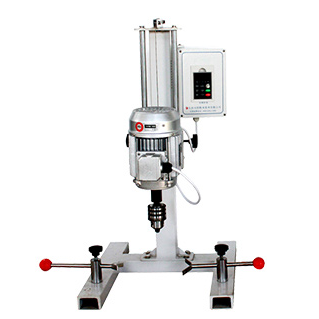
A laboratory disperser is typically mounted on a stand with a manual or pneumatic lift mechanism. This allows you to raise and lower the dispersion shaft into the container easily. A robust stand with a heavy base ensures stability during operation, especially at high speeds.
Material of Wetted Parts
The shaft and dispersion tool come into direct contact with your sample. For most applications, stainless steel (304 or 316L) is sufficient. However, if you work with corrosive chemicals, you may need tools made from Hastelloy, titanium, or coated with PTFE or other inert materials.
Practical Tips for Using a Lab Disperser
To get the best performance from your lab disperser, keep these points in mind:
- Optimize the order of addition: When dispersing powders into liquids, it is often better to gradually add the powder to the liquid while the disperser is running at a moderate speed, rather than adding all at once. This helps prevent clumping and reduces dust.
- Use appropriate vessel geometry: A cylindrical vessel with baffles or a dished bottom improves circulation and prevents dead zones.
- Control temperature: High shear generates heat. If your material is temperature-sensitive, use a cooling jacket, slow the speed, or operate in short intervals.
- Choose the right speed: Start at a lower speed to incorporate the powder, then increase to the desired dispersion speed. This minimizes splashing and reduces air entrapment.
- Run sufficient time: Dispersion time depends on the material properties and the target fineness. Typically, 5 to 20 minutes is enough for many laboratory tasks, but you should monitor the sample and run a particle size check when necessary.
Lab Disperser vs. Other Lab Mixing Equipment
It is helpful to understand how a lab disperser differs from other common laboratory mixing equipment. For simple blending of miscible liquids, a magnetic stirrer or overhead stirrer may suffice. When you need to incorporate powders into liquids and achieve fine dispersion, a lab disperser is more effective because of its high shear capability. For applications that require simultaneous grinding and dispersion (e.g., wet milling), a high speed dispersing homogenizer or a bead mill is often needed. For dry powder mixing, equipment like a V-type mixer is appropriate.
If your process involves both dispersion and deaeration, a vacuum disperser can remove air bubbles during the process. Some lab dispersers can be fitted with a vacuum lid for this purpose, which is common in battery slurry preparation.
Making the Right Choice for Your Lab
When you are ready to select a lab disperser, gathering a few details about your process will help narrow down the options:
- Type of powder and liquid (viscosity, density, chemical compatibility)
- Batch size (minimum and maximum volume)
- Target fineness (particle size or degree of dispersion)
- Whether you need vacuum or inert atmosphere capability
- Local voltage and frequency (e.g., 110V/60Hz or 220V/50Hz)
- Expected duty cycle and operating temperature
With this information, you can select a disperser drive unit, shaft length, and tool that match your typical tasks. Many suppliers offer complete lab disperser systems with stands, clamps, and a choice of dispersion tools.
The lab disperser from TENCAN is one example of a versatile laboratory disperser that supports interchangeable tools and adjustable speed, making it suitable for a wide range of research and small-scale production applications. Whether you are developing a new paint formula, preparing electrode slurries, or conducting formulation studies, a reliable lab disperser is a practical investment that directly impacts the quality and consistency of your results.