
What is a Stainless Steel Vacuum Glove Box? A High-Purity Inert Atmosphere Enclosure for Handling Air-Sensitive Materials
Introduction: What is a Stainless Steel Vacuum Glove Box?
At its core, a stainless steel vacuum glove box is a specialized sealed enclosure that provides an ultra-pure inert atmosphere (typically argon or nitrogen) with moisture and oxygen levels below 1 ppm. Researchers and manufacturers use it to safely handle, process, and store materials that are highly reactive with air or moisture—such as lithium battery components, organometallic compounds, and advanced electronic materials. The robust stainless steel construction ensures durability, vacuum integrity, and compatibility with rigorous laboratory and production environments.
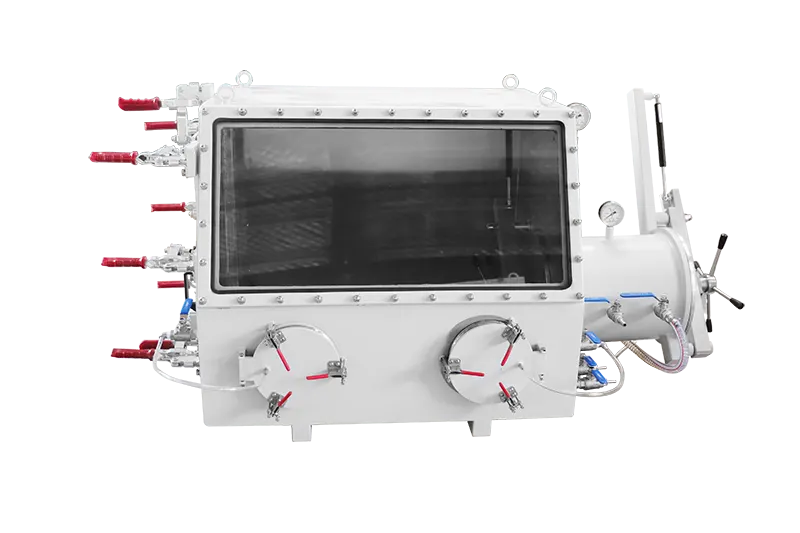
Core Function & Working Principle
The primary function of a stainless steel vacuum glove box is to transform a normal ambient atmosphere into a rigorously controlled inert environment. The system operates through a combination of vacuum evacuation and continuous gas purification. First, the main chamber and transfer chamber (antechamber) are evacuated using a vacuum pump to remove residual air. Then, high-purity inert gas (e.g., argon or nitrogen) is introduced to reach a slight positive pressure, typically 0–16 mbar adjustable. A PLC-controlled purification unit continuously circulates the internal gas through columns filled with molecular sieves and catalysts that chemically remove water vapor and oxygen. The result is a stable atmosphere with H2O <1 ppm and O2 <1 ppm, enabling users to perform operations such as weighing, mixing, assembling, or coating without compromising material integrity.
Key process parameters include regeneration frequency (typically once per year for the purifier), gas flow rate (around 70 m³/h at ΔP=60 mbar), and automatic pressure control. The system also features an automatic purge function to replace the internal atmosphere quickly when needed.
Key Components & Critical Technologies
A stainless steel vacuum glove box is more than just a box with gloves; it integrates several sophisticated subsystems:
- Main Chamber & Transfer Chamber: Made of 304 stainless steel with welded seams to achieve leak rates below 10⁻⁵ mbar·L/s. The antechamber allows sample introduction without disturbing the main atmosphere.
- Gas Purification System: Contains a recirculation blower, dual-column purifier (one active, one regenerating), and automatic regeneration control via a PLC touchscreen. Regeneration can be performed semi-automatically or manually using a H₂/N₂ or H₂/Ar gas mixture.
- Vacuum System: A two-stage rotary vane vacuum pump (e.g., 12 m³/h) with an oil mist filter and anti-backflow valve reaches ultimate pressure <1×10⁻³ mbar.
- Monitoring & Control: The touchscreen interface displays pressure, H₂O and O₂ concentrations (from analyzers), and provides automated pressure maintenance (0–16 mbar). Foot pedals allow hands‑free pressure adjustment.
- Accessories: Optional stereomicroscope ports, feedthroughs for electrical signals, and integrated glove ports with leak‑testable gloves.
Key Performance Indicators & Selection Tips
When selecting a stainless steel vacuum glove box, consider the following:
- Atmosphere Purity: Look for systems capable of achieving H₂O <1 ppm and O₂ <1 ppm. Higher‑end models can reach <0.1 ppm for critical applications like organic electronics or additive manufacturing of titanium alloys.
- Leak Rate: For long‑term stability, the overall system leak rate should be ≤10⁻⁵ mbar·L/s.
- Gas Purification Capacity: Evaluate the purifier’s regeneration cycle (typically once per year under normal use) and the gas flow rate (common values 70–120 m³/h).
- Automation & Ease of Use: A PLC with a color touchscreen, automatic purge and regeneration programs, and remote monitoring capability greatly simplify operation.
- Durability & Maintenance: Stainless steel chambers with rounded corners and epoxy‑coated exteriors resist corrosion. Easy‑access valves and modular design simplify filter replacement and pump oil changes.
For most battery research and organic synthesis labs, a standard stainless steel vacuum glove box with a purification system (as offered by TENCAN’s stainless steel vacuum glove box) is sufficient. For applications requiring extremely low oxygen (e.g., titanium additive manufacturing), consider a glove box with advanced purification system that can achieve PPB levels.
Application Fields & Selection Recommendations
Stainless steel vacuum glove boxes are widely used in:
- Lithium Battery Research & Production: Electrode material handling, electrolyte filling, cell assembly under dry atmosphere.
- Organic Electronics (OLED/PLED): Device encapsulation and material purification.
- Pharmaceuticals: Handling hygroscopic or oxygen‑sensitive active ingredients.
- Nuclear & Metallurgy: Processing reactive metals like alkali metals, uranium, or titanium alloys.
- Academic & Industrial R&D: Chemical synthesis, materials science, crystal growth.
For general laboratory use, a benchtop stainless steel vacuum glove box (e.g., acrylic glove box is a cost‑effective alternative, but stainless steel offers higher vacuum integrity and longer service life. If your process involves heavy contamination or frequent regeneration, choose a model with dual purification columns and automatic regeneration. For ultra‑high purity requirements, opt for a system with a dedicated purification system box that can scale gas flow and reduce downtime.