
¿Qué es una mezcladora de artesa? Un equipo de mezcla profesional para homogeneizar polvos y pastas en laboratorio y producción.
¿Qué es una mezcladora de artesa? Un equipo de mezcla profesional para homogeneizar polvos y pastas
En esencia, una mezcladora de artesa es un dispositivo de mezcla horizontal diseñado específicamente para la mezcla completa y uniforme de polvos secos, gránulos y materiales pastosos. Industrias como la farmacéutica, la química y la de procesamiento de alimentos dependen de él para combinar múltiples componentes en una mezcla homogénea, garantizando una calidad constante en los procesos posteriores. El equipo cuenta con una cubeta en forma de U que sostiene el material, mientras que un agitador montado internamente gira para lograr la mezcla mecánica.
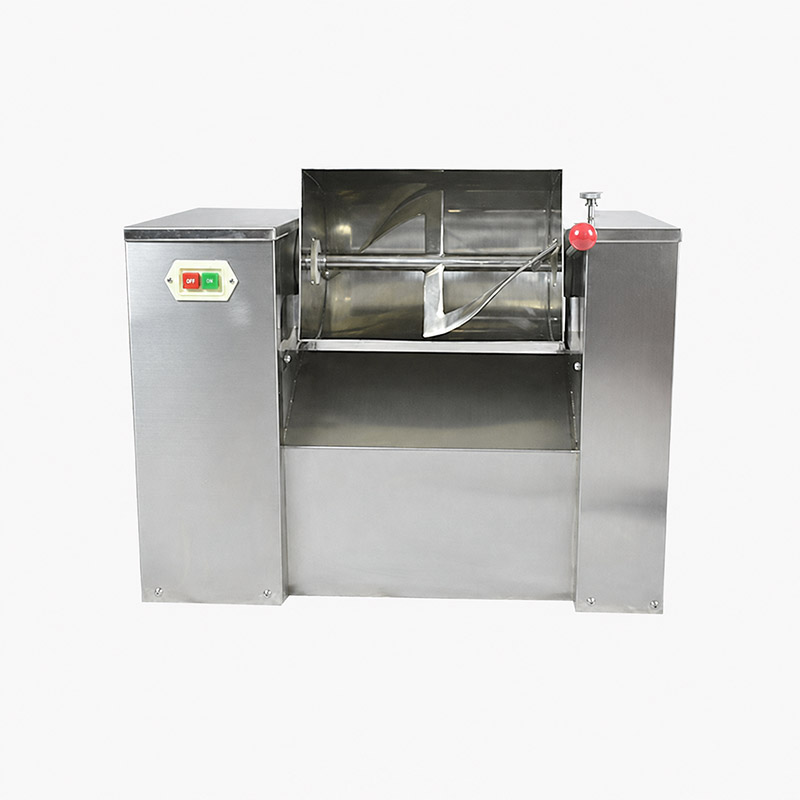
Función central y principio de funcionamiento
La función fundamental de una mezcladora de artesa es transformar ingredientes separados en polvo o pasta en una mezcla uniforme. La máquina funciona girando una paleta en forma de S (o de espiral simple) especialmente diseñada dentro del canal estacionario. Esta paleta gira a una velocidad controlada, normalmente alrededor de 24 rpm para los modelos estándar, y empuja el material con un movimiento de adelante hacia atrás. El levantamiento y plegado continuo del material garantiza que incluso las partículas más pequeñas se distribuyan uniformemente, evitando segregaciones o zonas muertas.
Los parámetros clave del proceso incluyen el tiempo de mezcla, que se puede preestablecer mediante un panel de control eléctrico, y la velocidad de rotación. Una vez completado el ciclo de mezclado, la máquina se detiene automáticamente y la cubeta se puede inclinar hidráulicamente (hasta 105°) para descargar el lote. Esta función de inclinación automática mejora enormemente la eficiencia, especialmente en entornos de producción donde se procesan varios lotes seguidos.
Componentes centrales y tecnologías clave
Si bien el mezclador de artesa es un solo tipo de equipo, se puede personalizar con diferentes capacidades y materiales. El modelo más común es la serie CH, que incluye variantes como CH-100, CH-200 y CH-400, donde el número indica el volumen de trabajo en litros. Todas las versiones comparten los siguientes componentes principales:
- Comedero de acero inoxidable : La cubeta en forma de U está hecha de acero inoxidable de alta calidad (a menudo de grado 304) para resistir la corrosión y cumplir con los estándares de higiene. La superficie interior está pulida para facilitar la limpieza y evitar la adherencia del material.
- Brazo agitador en forma de S : El agitador es una sola paleta en forma de S que se puede quitar fácilmente para limpiarlo. Su diseño crea un poderoso flujo convectivo, forzando el material desde el centro hacia los lados y hacia atrás, asegurando una mezcla completa incluso para polvos pegajosos o cohesivos.
- Sistema de transmisión y propulsión : Un motor (normalmente de 5,5 kW para el CH-400) impulsa la paleta a través de una caja de cambios y una cadena. La velocidad es fija o regulable según el modelo.
- Descarga inclinable automática : Un motor secundario (0,75 kW para CH-400) controla la inclinación del canal, lo que permite una descarga fácil y segura del lote mezclado.
- Panel de control eléctrico : Los operadores pueden configurar el tiempo de mezclado, monitorear la operación e iniciar ciclos automáticos de parada e inclinación.
Indicadores clave de desempeño y criterios de selección
Al seleccionar un mezclador de artesa, los usuarios deben evaluar los siguientes parámetros según sus necesidades específicas:
- Volumen de trabajo (capacidad) : Varía desde 100 L hasta 400 L y más. Una regla común es llenar el comedero hasta aproximadamente el 60-70% de su volumen total. Por ejemplo, una mezcladora CH-400 puede procesar hasta 400 litros de material por lote.
- Velocidad de mezcla : Los modelos estándar funcionan a 24 rpm, pero las versiones de servicio pesado pueden ofrecer velocidades más altas para una mezcla más rápida de polvos que fluyen libremente.
- Material de construcción : El acero inoxidable (304 o 316) es estándar para aplicaciones farmacéuticas y alimentarias. Todas las piezas de contacto deben ser de acero inoxidable y fáciles de limpiar.
- Potencia del motor : Para mezclar pastas viscosas o polvos densos se necesitan motores de mayor potencia (p. ej., 5,5 kW). Los sistemas eléctricos deben ser a prueba de explosiones cuando se manipulan materiales inflamables.
- Ángulo de descarga : Normalmente <105°, lo que garantiza un vaciado completo sin intervención manual.
- Automatización y Control : Se pueden agregar temporizadores digitales y controladores lógicos programables (PLC) para lograr una coherencia precisa entre lotes.
- Facilidad de mantenimiento : El brazo agitador extraíble y las paredes interiores lisas simplifican la limpieza y reducen el tiempo de inactividad.
Campos de aplicación y sugerencias de selección
Los mezcladores de artesa se utilizan ampliamente en la industria farmacéutica para mezclar ingredientes en polvo seco para tabletas y cápsulas, en el sector químico para mezclar pigmentos, catalizadores y aditivos, y en la industria alimentaria para combinar mezclas para hornear, condimentos y polvos instantáneos. También son adecuados para pastas como lodos para electrodos y pastas cerámicas.
Para trabajos de I+D a escala de laboratorio, un modelo pequeño CH-100 es ideal. Para lotes piloto o de producción, el CH-200 o el CH-400 ofrecen un equilibrio entre capacidad y control. Si el material es propenso a la estática o requiere una acción de mezclado suave, se recomienda un mezclador de artesa con una velocidad más lenta y una construcción totalmente de acero inoxidable. Para necesidades de mezcla más especializadas, como una mezcla suave de gránulos frágiles, se puede considerar un mezclador de doble cono o un mezclador tipo V, pero el mezclador de artesa sigue siendo la opción más versátil y robusta para la mayoría de las aplicaciones de polvo y pasta.