
What is a Trough Mixer? A Versatile Mixing Equipment for Powders and Pastes
Introduction
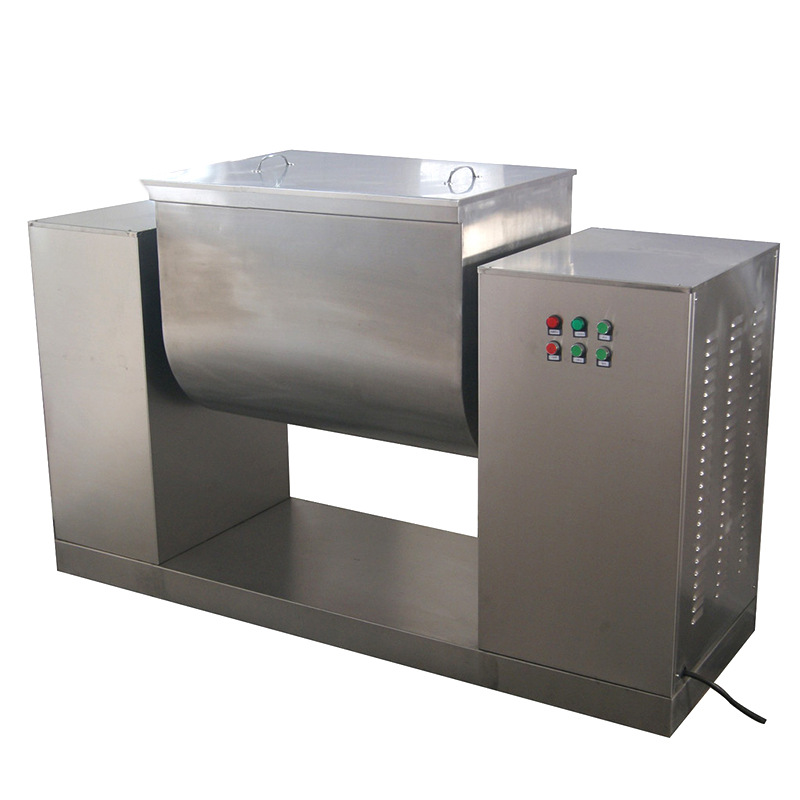
At its core, a trough mixer is a specialized horizontal mixing equipment used in pharmaceutical, chemical, and food industries to uniformly blend powder or paste materials. It utilizes a rotating S-shaped stirring arm inside a trough-shaped container to achieve homogeneous mixing through mechanical agitation. This robust design makes it ideal for applications requiring consistent product quality.
Core Function and Working Principle
The basic function of a trough mixer is to transform ingredients from a segregated state into a homogenous mixture. The key working component is a horizontal trough, typically made of stainless steel, containing an S-shaped or paddle-type stirring arm. When the motor drives the arm to rotate, the material is continuously lifted, pushed, and folded, promoting thorough mixing. The mixing action is gentle yet effective, suitable for fragile or cohesive powders without causing excessive heat generation or particle breakage.
Key process parameters include mixing time, rotation speed, and batch volume. The mixing time can be preset via an electrical control panel, and the machine automatically stops when the cycle ends. The electric tilting mechanism allows easy discharge of the final product. For models like the CH-400, the stirring arm rotates at 24 rpm, and the working volume is 400 liters, achieving a high degree of uniformity.
Core Components and Key Technologies
Since the trough mixer is a single-type design, we focus on its essential parts:
- Mixing Trough: A U-shaped or rectangular container often made of 304 stainless steel. It is corrosion-resistant and easy to clean. The trough can be tilted hydraulically or electrically for discharge.
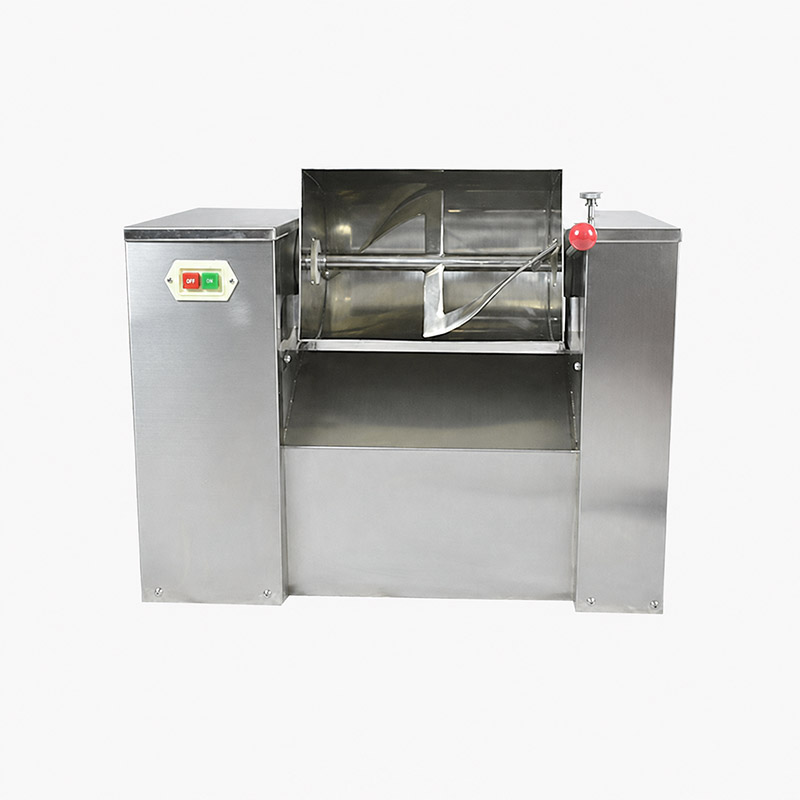
- Stirring Arm: The S-shaped single stirrer is the heart of the mixer. It is removable for cleaning and maintenance. The arm pushes material in a reciprocating motion, ensuring no dead zones.
- Drive System: Consists of a motor, reducer, and transmission. It provides consistent torque to handle viscous pastes or heavy powders.
- Control System: Electrical controls with timer, start/stop, and emergency stop. Some models allow adjustable mixing time and speed.
- Sealing System: Seals prevent dust leakage and contamination, especially important for pharmaceutical and food applications.
Key Performance Indicators and Selection Guide
When selecting a trough mixer, consider the following critical parameters:
- Working Volume: Typically ranges from 100 L to 1000 L. Choose a volume that matches your batch size. For example, the CH-400 has a 400 L capacity.
- Mixing Speed: Usually between 20-30 rpm. Higher speeds may cause heat buildup or material degradation.
- Material of Construction: Stainless steel (304 or 316) is standard for corrosion resistance and hygiene. Ensure all contact parts are food-grade or pharmaceutical-grade as required.
- Discharge System: Manual or electric tilting. Electric tilting (e.g., with a 0.75 kW motor) improves efficiency and safety.
- Power Consumption: Main motor power (e.g., 5.5 kW for 400 L model) and auxiliary motor for tilting. Choose based on energy efficiency and available power supply.
- Cleanability: Removable stirring arm and smooth internal surfaces facilitate cleaning between batches.
- Automation Level: Basic models have timers; advanced models may include programmable logic controllers (PLC) for recipe management.
Application Fields and Selection Recommendations
Trough mixers are widely used in:
- Pharmaceutical Industry: Blending active pharmaceutical ingredients (APIs) with excipients, wet granulation, and mixing ointments or creams.
- Chemical Industry: Mixing pigments, dyes, catalysts, and powder additives.
- Food Industry: Blending spices, seasonings, powdered milk, and dough-like pastes.
For small-scale R&D or pilot production, a compact model with a working volume of 50-200 L is recommended. For production batches, choose a model with automatic tilting and larger volume (400 L or more). If your material is sticky or requires vacuum mixing, consider a vacuum kneading machine instead. For dry powder blending, the V-type mixer or double cone mixer may be more suitable.