
Three Roll Mill Gap and Speed Settings
A three roll mill often reveals whether its settings are correct through the paste, not through the gap indicator. The material should transfer from the feed roll to the center roll and then to the apron roll in a stable film. If it stalls, channels, mists, or leaves streaks, tightening the gap may seem logical, but gap is only one part of the shear field. Roll speed, speed ratio, temperature, paste rheology, roll condition, and pass count all change the result.
The machine is a precision disperser rather than a fine crusher. Its rolls create high shear in narrow nips, split films, and repeatedly expose agglomerates to stress. That action can wet out powders, break soft clusters, and distribute a vehicle evenly, but it may not reduce the primary particle size of a hard solid. For a TENCAN three roll mill, the useful question is therefore not “What is the smallest gap?” but “Which gap, speed, temperature, and pass strategy give a stable dispersion without damaging the product?”
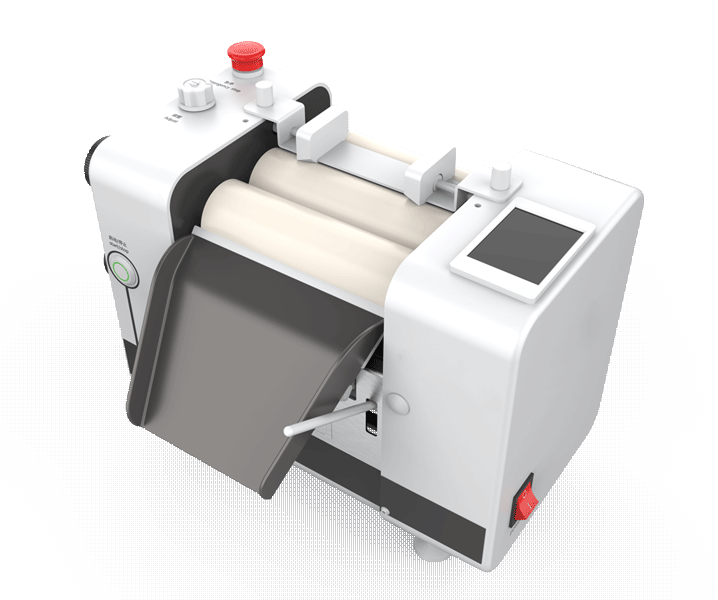
This distinction matters when a specification calls for a particle size distribution that dispersion alone cannot produce. A three roll mill can remove the coarse agglomerate tail while leaving primary crystals intact. If the target requires true comminution, another process may be needed. The mill should be selected for the job it can actually do.
What the Gap Actually Controls in a Three Roll Mill
Gap is a geometric constraint, not a particle size setting. It controls film thickness, pressure distribution, residence time, and shear rate in each nip. The feed gap and apron gap do different work, and treating them as one adjustment usually produces unstable results.
Feed gap versus apron gap
The feed gap between the feed roll and center roll governs how readily paste enters the first nip. Too wide, and a thick, poorly wetted bank may pass with too little work. Too tight, and the nip may starve, torque may rise, and the paste may climb or channel instead of transferring. The feed gap should establish a stable working bank.
The apron gap between the center and apron rolls controls the final film and the last high-shear exposure before the scraper removes the product. It often has a strong effect on the visible drawdown, but a tight apron gap cannot compensate for poor wetting or a starved center roll. Adjust the two gaps as a pair.
Why shear rate is only a starting point
A useful first approximation for shear rate is the surface speed difference between adjacent rolls divided by the gap. A smaller gap or a larger speed difference raises the calculated shear rate. That is why operators tighten the gap when dispersion is incomplete. The estimate is useful, but it does not describe the whole nip. The paste forms a rolling bank, slips at the surface, splits into films, and changes viscosity with temperature.
Some agglomerates may pass through without seeing the average stress. This is why a small gap change can produce a non-linear result. One setting may give a stable bank and a clean film; a slightly tighter setting may raise shear while reducing throughput and increasing heat. The sample must represent the whole batch, and the test must reflect the property that matters in service.
Gap, film thickness, and particle size
Measured film thickness is not equal to the gap. The film leaving the apron roll depends on speed, viscosity, and the amount of material in the nip. A gap reading is still valuable as a repeatable reference, but it should not be converted directly into a particle size. The dispersion target should be defined by agglomerate size or functional performance.
For a three roll mill, the relevant particle size is usually the size of dispersed clusters, not primary crystals. A laser result may show a smaller coarse tail without a large change in median size. That can mean the mill has done its job by eliminating agglomerates while leaving primary particles intact. If a smaller primary size is required, a media mill, jet mill, or other comminution step may be more appropriate, depending on the material and contamination limits.
The problem with “just tighten the gap”
A very tight gap raises mechanical load, heat, and roll wear. It can force the rolls apart if the frame is not rigid enough, changing the effective gap across the face. It also increases the risk of metal-to-metal contact when the zero reference is poor. The result may be contamination that is invisible in a drawdown but unacceptable in an electronic paste or pharmaceutical product.
A tight gap can also overwork the formulation. Flake-like materials may be crushed or oriented differently. Heat-sensitive resins may cure or degrade. Volatile solvents may be lost. Color concentrates may shift hue because the dispersion has moved past the intended point. The correct gap meets the dispersion target at an acceptable throughput and temperature, not the one that gives the finest-looking drawdown.
Verify the gap with the method specified for the machine, such as a feeler gauge or calibrated indicator, and confirm that the rolls are parallel and at the correct temperature. A cold reading may not represent the running condition once thermal expansion and roll deflection occur.
Roll Speed Ratio and Shear History
Three roll mills usually run the rolls at different speeds. The speed difference between adjacent rolls creates relative motion, shears the paste, transfers it from one roll to the next, and splits the film. The ratio between roll speeds is often more important than the absolute speed of any one roll, because it sets the relative shear and transfer behavior.
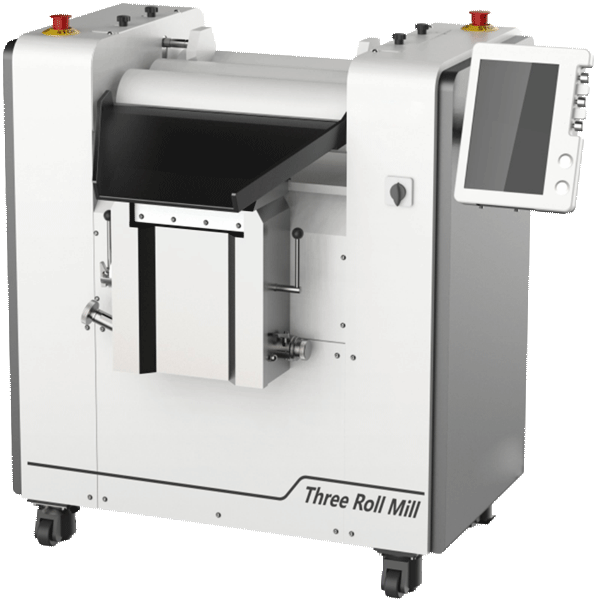
Ratio versus absolute speed
If the ratio is too low, the paste may not transfer cleanly and shear may be insufficient for difficult agglomerates. The bank can become unstable and the film uneven. If the ratio is too high, paste may be thrown from the rolls, mist, or heat rapidly. High speed can also increase air entrainment and dry the product at the edges. The appropriate ratio balances dispersion with handling.
Changing absolute speed while keeping the ratio constant changes throughput, residence time, and energy input rate. A higher speed can increase output, but it also reduces residence time in the nip and raises temperature. In some formulations, faster stress application improves dispersion. In others, the vehicle thins too much or solvent evaporates. The response is material-specific, so speed must be tested with the same paste and temperature as production.
Shear history and multiple passes
A three roll mill is often used as a multi-pass device. Paste is passed, collected, and passed again, sometimes with a change in gap or speed. The total shear history is the sum of all passes, not just the final setting. A product that looks well dispersed after three moderate passes may be damaged after five tight passes. A single aggressive pass may create heat and re-agglomerate the product, while several gentler passes produce a more uniform result.
Record the number of passes, gap at each pass, speed ratio, paste temperature, and rest time. If the paste cools or rests between passes, thixotropic recovery may change bank behavior. If it is passed continuously without cooling, temperature may rise and viscosity may fall. The same nominal settings can therefore produce different results.
Temperature effects
Heat is a process variable. The work of dispersion becomes heat, and paste temperature can rise quickly in a tight nip or at high speed. A warmer paste usually has lower viscosity, which can improve flow but reduce shear stress at a given speed. Heat can also accelerate reactions, drive off solvent, or change binder crystallization. For heat-sensitive products, the temperature limit may define the maximum speed and minimum gap more than the dispersion target does.
Set roll temperature control before the trial and allow it to stabilize. Measure paste temperature at the inlet and outlet, not only at the roll surface. A cold roll can chill the film and make the paste appear more viscous than it is in bulk. A hot roll can dry the edges and create a skin that behaves differently from the center.
Feed stability and the rolling bank
The mill performs best with steady feed and a bank that is neither starved nor flooded. A starved nip gives uneven shear and can let the rolls run dry in patches. A flooded nip may overload the motor, raise heat, and create a film that is too thick to transfer efficiently. Watch the bank, not only the gap indicator. Changes in bank height often reveal a rheology, feed-rate, or temperature change before the product shows a defect.
Keep the feed method consistent. Manual feeding can vary if rate and placement change. A controlled feed system may improve consistency, but it must match the paste's yield stress and adhesion. The target is a stable bank across the working width, with no dry edges and no localized flooding.
Reading Paste Rheology Before Changing Settings
Gap and speed only make sense in relation to the paste. A three roll mill does not handle every material in the same way, and a formulation that runs well on one machine may fail on another because its rheology is different. Before changing the gap, check whether the paste is suitable for the process.
Viscosity, yield stress, and adhesion
The mill needs a paste that adheres to the rolls and forms a stable bank. If viscosity is too low, material may run off, fail to form a film, or pass through with little shear. If viscosity is too high, the paste may not wet the rolls evenly, may overload the drive, or may not release from the scraper. Yield stress is equally important. A high-yield-stress paste may stand up instead of flowing into the nip, while a very low-yield-stress paste may not stay on the roll.
Adhesion links rheology to machine behavior. The paste must stick to the feed roll long enough to enter the nip, transfer to the center roll, and then transfer to the apron roll. If it releases too early, the bank becomes unstable. If it sticks too strongly, it may wrap a roll or resist the scraper. A flow curve, sag test, or simple spatula test can be more informative than a single viscosity number.
Thixotropy and time-dependent behavior
Many pastes are thixotropic: viscosity depends on how long they have been sheared and how long they have rested. A paste that is stiff in the container may flow after one pass and then stiffen before the next. This changes bank height and effective gap. If the process uses multiple passes, control the rest time. Otherwise, the operator may adjust the gap to compensate for a rheology change that is really a scheduling issue.
Thixotropy also affects start-up. A mill started with cold, rested paste may see higher torque than it does after several minutes of circulation. Allow the paste to reach steady state before setting the final gap. After a shutdown, the first material through the mill may behave differently from material produced after the rolls and paste reach thermal equilibrium.
Solids loading and wetting
Higher solids loading can increase the shear stress that reaches agglomerates, which may improve dispersion. It can also reduce wetting, raise viscosity, and make transfer difficult. If the solids are not wetted before milling, the roll mill may break large clusters but leave dry pockets inside them. Premixing or a wetting step can be more effective than a tighter gap.
The vehicle and dispersant system also matter. A dispersant can reduce attraction between particles, lower viscosity, and make the mill more effective. An incompatible vehicle can cause slip on the rolls or separation after milling. When dispersion is poor, first ask whether the formulation is wetting the powder properly. A gap change cannot fix a formulation that has not wetted the solid.
Recognizing an unsuitable paste
Some symptoms point to the paste rather than the machine. If paste repeatedly climbs the roll, forms a dry skin, or fails to transfer at any reasonable speed, the formulation may be outside the practical range for a three roll mill. If it contains large hard particles or abrasive filler, roll wear and contamination may be unacceptable. If it contains a fast-evaporating solvent, the open design may cause drying and exposure problems.
The right response may be to adjust solids content, change the vehicle, add a wetting agent, or select a different dispersion method. A three roll mill is flexible but not universal. A short bench trial can show whether the paste has the adhesion and coherence the process needs. That is usually faster than a series of machine adjustments made on an unsuitable formulation.
A Practical Gap and Speed Adjustment Sequence
A structured sequence reduces the chance of chasing several variables at once. Exact values differ by material and machine, but the logic is consistent: define the target, establish a baseline, change one variable, and verify with a test that reflects product function.
Step 1: Define the dispersion target
Write down what “good” means. It may be a fineness-of-grind reading, particle size distribution, color value, gloss level, conductivity target, or filtration result. The target should be measurable and related to performance. “Looks smooth” is not enough, because a drawdown can hide coarse agglomerates that appear later in a coating or printed layer. If a customer specification exists, use it. If not, establish a laboratory reference from a known acceptable batch.
Step 2: Establish a clean baseline
Clean the rolls, check the scraper, and confirm the zero reference according to the manufacturer's procedure. Verify parallelism and temperature. Record gap, speed, ratio, paste temperature, and pass count. A baseline is useful only if it is repeatable. Run a small quantity of the same paste and keep the sample for comparison. If the machine has cooling, confirm that it works before the trial, because temperature drift can invalidate a gap comparison.
Step 3: Set the feed gap, then the apron gap
Start with a feed gap that accepts the paste and forms a stable bank. If the bank is starved, open the feed gap slightly. If the nip floods or the motor loads heavily, close the feed gap in small increments or reduce the feed rate. Once the bank is stable, set the apron gap to control the final film. Make small changes and allow the mill to reach steady state before sampling. A sample taken immediately after a gap change may represent the transition, not the new setting.
Step 4: Adjust speed ratio with the gap stable
After the gaps are stable, change the speed ratio in small steps. Watch the bank, film, product temperature, and motor load. If the product mists, dries at the edges, or wraps the roll, the ratio or absolute speed may be too high. If the film does not transfer cleanly, the ratio may be too low. Keep absolute speed within a range that gives practical throughput and acceptable temperature rise. The goal is stable shear with controlled heat, not maximum speed.
Step 5: Control the pass strategy
Decide whether the product will run in one pass, multiple passes, or a recycle loop. Each option gives a different shear history. Multiple passes can improve dispersion but add heat and handling time. A recycle loop can be efficient but may expose the product to repeated shear and air. Record the number of passes and the time between them. For thixotropic products, keep rest time consistent. For heat-sensitive products, measure temperature after each pass and stop before the limit.
Step 6: Evaluate the whole batch
Take samples from the beginning, middle, and end of the run. Test the property that matters and compare with the baseline. A fineness-of-grind gauge is useful for coarse agglomerates, but it does not replace a particle size distribution or a performance test. If the beginning differs from the end, the process is not at steady state. The cause may be temperature drift, a changing bank, or inconsistent feed. Resolve that before changing the gap again.
Step 7: Document the process window
Record the final gap and speed plus the acceptable range. A window is more useful than a single point because raw materials, ambient conditions, and machine temperature vary. Include feed gap, apron gap, speed ratio, temperature limit, pass count, and acceptance test. Note the symptoms that require an operator to stop and investigate, such as misting, a dry edge, a sudden torque rise, or a change in film appearance.
When a Three Roll Mill Fits the Process
A three roll mill is often a good fit for high-viscosity pastes that must be deagglomerated and spread into a uniform film. It is less suitable for low-viscosity slurries that flow too readily to form a stable bank, or for hard particles that require true comminution. The decision should be based on rheology, dispersion target, batch size, cleaning needs, and exposure control.
Applications and process conditions
Common applications include pigment concentrates, printing inks, electronic pastes, cosmetic creams, pharmaceutical ointments, and other pastes where agglomerates must be broken down in a vehicle. In these products, the mill can improve color strength, smoothness, conductivity, or appearance by reducing the coarse agglomerate tail. The benefit depends on proper wetting, a stable bank, and controlled temperature.
The mill can also be useful when the formulation cannot tolerate grinding media. In a media mill, beads can break, wear, or leave contamination. A three roll mill avoids that contact, but it introduces its own contact with rolls and scraper. Material selection and maintenance still matter. The process is not contamination-free by default; it must be designed and monitored.
Limitations to recognize early
Throughput is usually lower than a continuous media mill, especially for low-viscosity products. The open design can expose operators to solvent vapor or dust, so ventilation and handling controls may be required. Cleaning between products can be significant if the paste is tacky or pigmented. Hard, abrasive particles can wear the rolls and create a maintenance cost that is unacceptable for the application.
Volatile solvents can evaporate at the edges, changing the formulation across the batch. Heat-sensitive products may need cooling or shorter runs. Products with very high yield stress may not form a stable bank. These are not reasons to reject the technology, but they are reasons to test the formulation on the actual machine before committing to a process.
Selection questions
Before choosing a three roll mill, define the paste rheology, target dispersion, required batch size, temperature limits, cleaning frequency, and material contact requirements. Ask whether the product needs deagglomeration or true particle size reduction. Ask whether the mill will run one pass or several, and whether the feed will be manual or controlled. These answers determine the roll configuration, control needs, and operating procedure far more than a generic capacity figure.
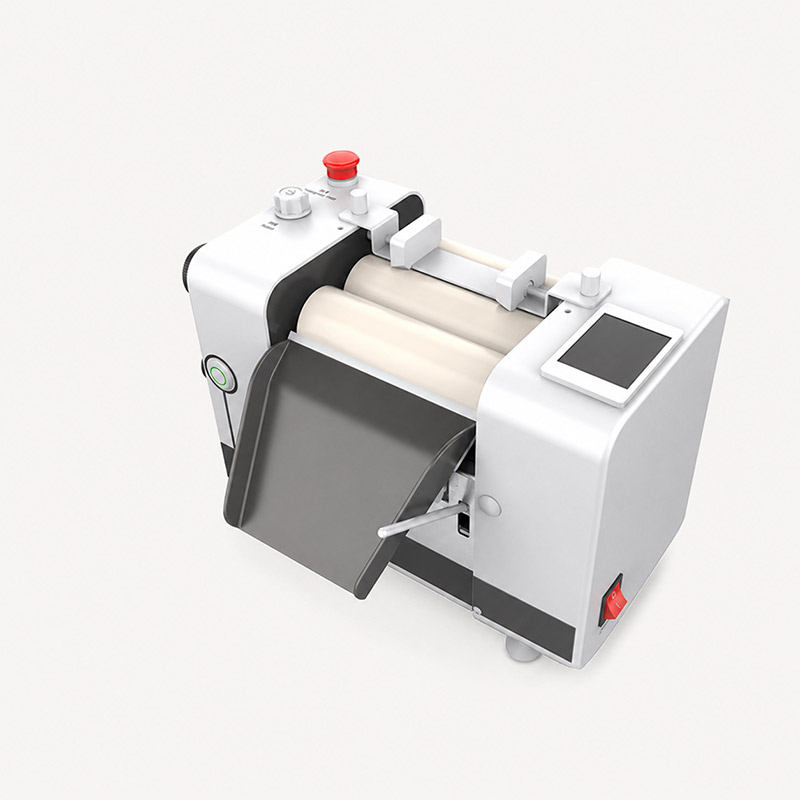
The TENCAN three roll mill should be evaluated against those questions, not against a list of features alone. A useful trial checks whether the paste forms a stable bank, whether the film transfers cleanly, and whether the dispersion target is reached within the temperature and time limits. If the trial requires settings outside a reasonable window, a different process may be the better choice.
Maintenance, Validation, and Scale-Up Checks
Gap and speed settings are only reliable when the machine is in condition to reproduce them. Roll wear, poor parallelism, a worn scraper, or a drifting temperature control can change the effective shear without changing the indicator. Maintenance should therefore be part of process control, not a separate activity.
Roll and scraper condition
Inspect roll surfaces for scoring, corrosion, and buildup. A damaged roll can leave a streak in the film and change the local gap. Check parallelism and the zero reference at the recommended interval. A worn scraper may leave product on the apron roll, reducing yield and causing rework. End seals and cooling connections should also be checked, because a small leak or blockage can change temperature and rheology.
Cleaning is part of maintenance. Dried paste on the rolls can create high spots, and aggressive cleaning can damage the surface finish. Use the cleaning method and materials specified for the machine. If the product changes frequently, validate that the cleaning procedure removes residue that could contaminate the next batch.
Validation records
Keep records of incoming material, gap, speed ratio, roll temperature, paste temperature, pass count, and test results. Validation should include the properties that matter in service, not only appearance. A product can look smooth and still fail in filtration, conductivity, adhesion, or stability. If a batch is outside the process window, investigate before adjusting the gap. The cause may be a raw material change or a machine condition issue.
A useful validation protocol tests the lower and upper ends of the process window, not just the center point. That shows how sensitive the product is to gap and speed. It also reveals which variable should be controlled most tightly. If a small temperature change shifts the result, temperature control may be more important than a finer gap.
Scale-up and technology transfer
Scale-up is not a simple multiplication of gap and speed. Roll diameter, speed ratio, cooling capacity, residence time, and feed method all change. A setting that works on a small mill may not transfer directly to a larger one. The safer approach is to maintain the relevant shear and thermal conditions, then confirm with a pilot run. Measure power, temperature, throughput, and dispersion at each scale.
Technology transfer should include a written procedure with a process window, acceptance tests, and troubleshooting guidance. Operators need to know what a stable bank looks like, how to check the gap, and when to stop. That knowledge is more valuable than a single recipe. It allows the process to remain stable when a raw material lot or ambient condition changes.
Final process check
Treat gap and speed as a coupled system. Set the feed gap for a stable bank, the apron gap for final film control, and the speed ratio for shear and transfer. Confirm the result with a test that reflects product performance. Keep temperature, pass count, and machine condition within the validated window. When the product changes, re-establish the window instead of assuming that the previous setting will work.
A three roll mill can deliver consistent dispersion when the process is built around the paste rather than a single gap number. The most useful improvements often come from better wetting, stable feeding, controlled temperature, and a clear acceptance test. Gap and speed then become adjustable tools instead of guesses.