
How to Choose a Dual Planetary Ball Mill: 5 Common Mistakes to Avoid
How to Choose a Dual Planetary Ball Mill: 5 Common Mistakes to Avoid
A Dual Planetary Ball Mill is designed for laboratories that require high-energy grinding, fine powder preparation, material mixing, mechanical activation, and small-batch research. Compared with an ordinary planetary ball mill, its more complex planetary movement can generate stronger impact, shear, and friction forces.
However, higher grinding energy does not automatically mean that the machine is suitable for every material. Selecting a model only according to appearance, maximum speed, jar volume, or price may result in excessive heat, unstable particle size, contamination, inefficient grinding, or unnecessary investment.
This guide explains how a dual planetary ball mill works, the most common mistakes buyers make, and the key information that should be confirmed before choosing an SXQM model.
What Is a Dual Planetary Ball Mill?
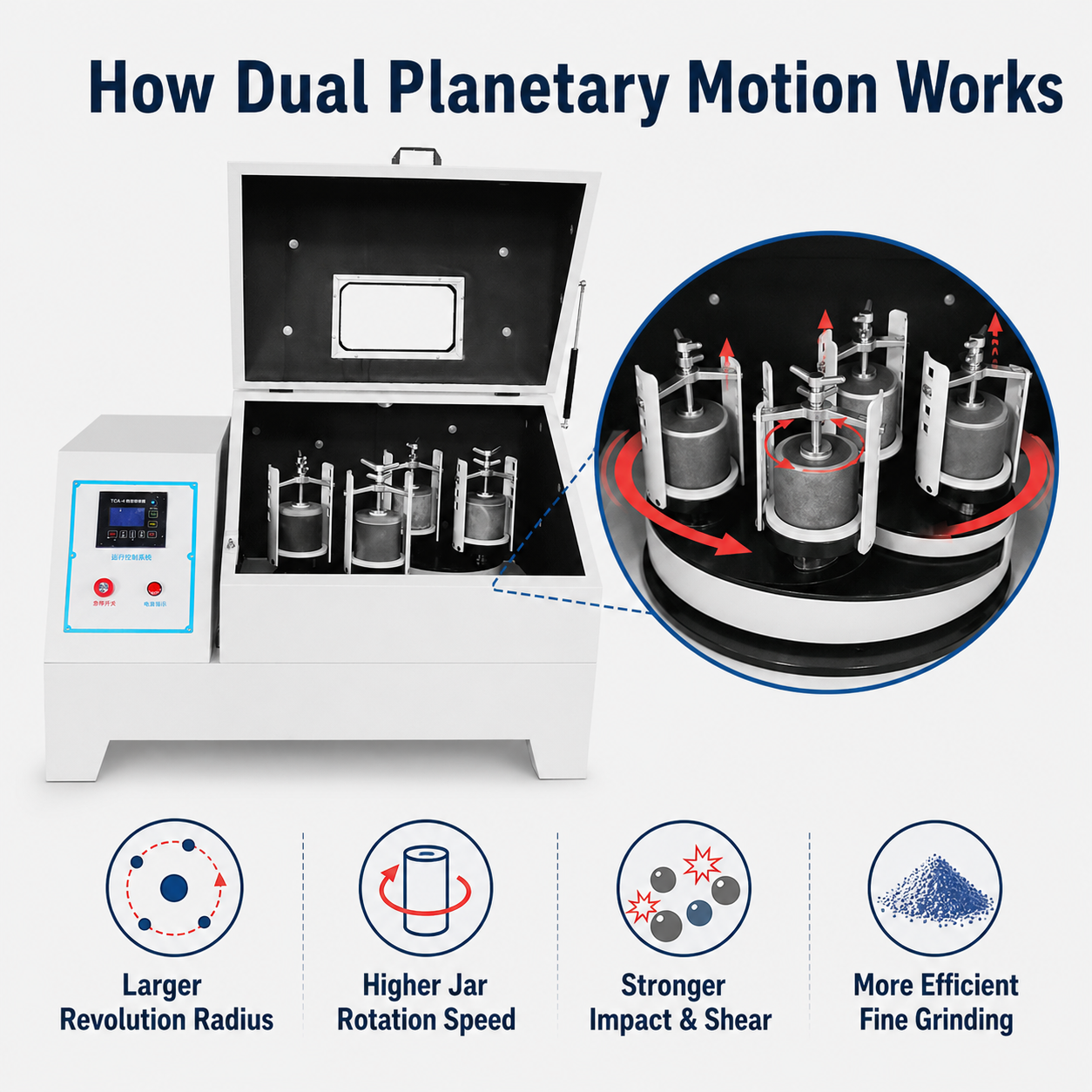
A conventional planetary ball mill normally uses a planetary disk to drive several grinding jars. Each jar rotates around its own axis while revolving around the central axis of the machine. This compound movement causes the grinding balls to collide with the powder and jar wall.
A dual planetary ball mill adds another level of planetary movement. In the SXQM structure, the large planetary disk drives a smaller planetary disk, while the grinding jars continue rotating within this system.
This design increases the movement radius and motion intensity of the grinding jars. The grinding balls therefore receive greater acceleration and produce stronger impact, friction, rolling, and shear forces.
The dual planetary structure can be useful for:
- Fine and ultrafine powder preparation
- Hard or brittle material grinding
- Mechanical activation
- Powder mixing and homogenization
- Battery and electronic material research
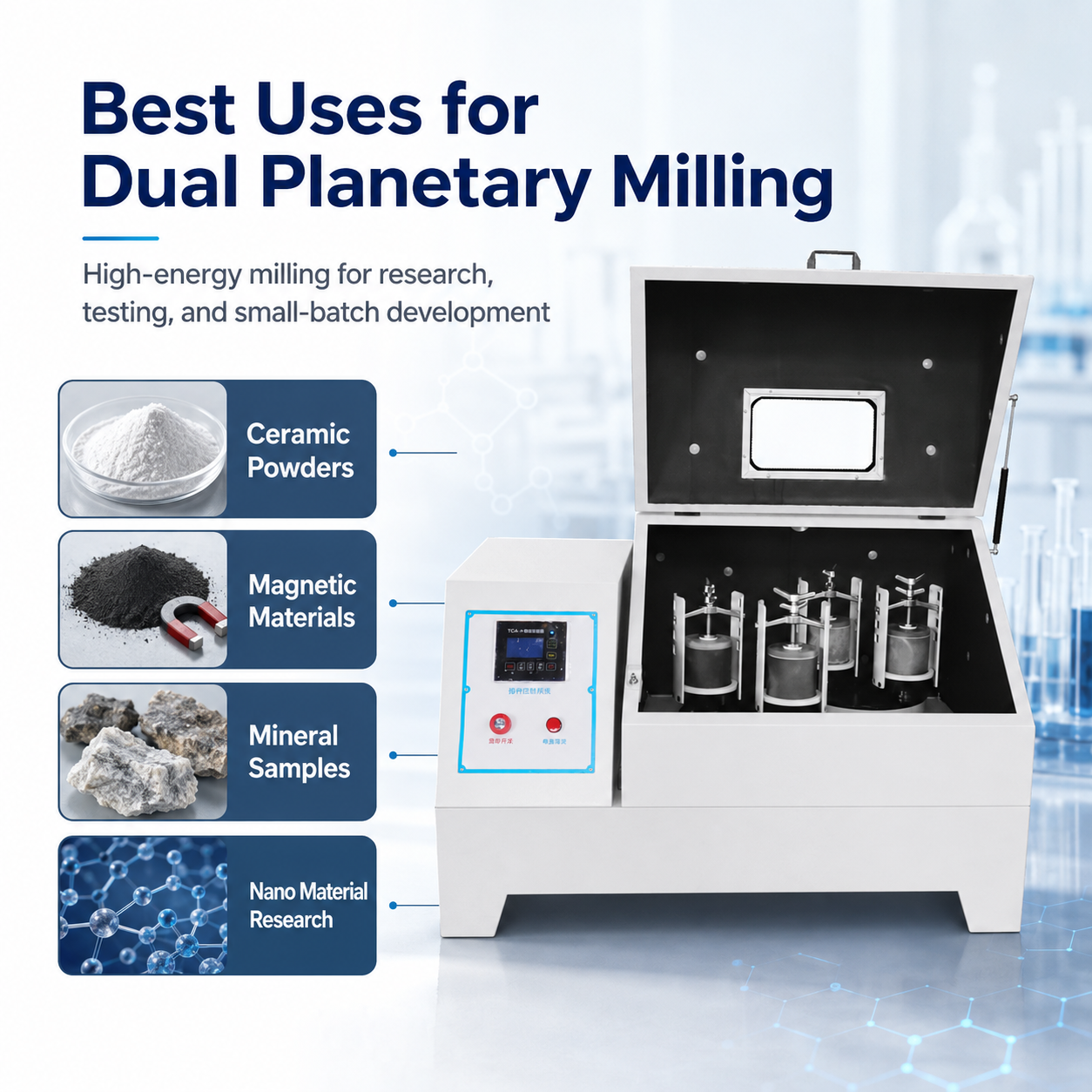
- Ceramic and magnetic material preparation
- Small-batch advanced material development
- Applications requiring relatively high grinding energy
Mistake 1: Assuming It Is the Same as an Ordinary Planetary Ball Mill
One of the most common mistakes is treating a dual planetary ball mill as simply another version of a standard planetary mill.
Although both machines use planetary movement, the grinding intensity is different. The dual planetary mechanism increases the movement complexity and centrifugal force applied to the grinding media. This can improve the processing efficiency of hard, brittle, or difficult-to-grind powders.
However, stronger grinding energy is not always necessary.
For routine powder mixing, simple homogenization, or materials that are already easy to break, a standard planetary ball mill may provide sufficient performance. Using excessive energy for these materials may increase operating cost without producing a meaningful improvement.
High-energy grinding may also create problems for soft, elastic, sticky, or heat-sensitive samples, including:
- Rapid temperature increase
- Powder agglomeration
- Material sticking to the jar wall
- Changes in particle morphology
- Accelerated wear of grinding jars and balls
- Unwanted physical or chemical changes
Before choosing a dual planetary model, first determine whether the sample truly requires higher impact and shear energy.
Mistake 2: Selecting the Machine Only by Grinding Jar Volume
Nominal grinding jar capacity is often misunderstood. A 1000 ml grinding jar cannot normally be filled with 1000 ml of powder because sufficient space must be reserved for grinding balls and material movement.
The effective working volume depends on:
- Grinding jar capacity
- Grinding ball quantity
- Ball diameter combination
- Powder density
- Dry or wet grinding method
- Required movement space
- Material flow characteristics
If the jar is overloaded, the grinding balls cannot move freely. Instead of producing effective impact and rolling action, the balls and powder may rotate together as one mass. This reduces grinding efficiency and may create an uneven final particle size.
Excessive loading can also increase motor load, jar pressure, seal wear, and the possibility of material leakage.
The SXQM series can be configured with grinding jars ranging from approximately 50 ml to 1500 ml, depending on the selected model and jar type. Smaller jars are suitable for formulation comparison, high-value samples, and early-stage research, while larger jars can process greater laboratory quantities.
A four-jar configuration can also be useful for comparative experiments because multiple samples may be processed under similar operating conditions.
Practical Jar Selection Reference
| Jar Size | Typical Use | Selection Consideration |
|---|---|---|
| 50–100 ml | Small samples and preliminary testing | Suitable for expensive materials and formulation screening |
| 250 ml | Routine laboratory grinding | Balances sample quantity and parameter flexibility |
| 500 ml | Medium laboratory batches | Requires careful machine and jar balancing |
| 1000–1500 ml | Larger research or small-batch preparation | Confirm total load, motor capacity, and effective working volume |
Mistake 3: Comparing Machines Only by Maximum Speed
Maximum rotational speed is an important parameter, but it does not independently determine the grinding result.
In a dual planetary ball mill, grinding energy is influenced by several factors working together:
- Planetary disk revolution speed
- Grinding jar self-rotation speed
- Revolution radius
- Grinding jar diameter
- Grinding ball material and density
- Grinding ball diameter
- Ball-to-powder ratio
- Sample hardness and feed size
- Grinding time
- Dry or wet operating conditions
The SXQM series provides variable-frequency speed control. Depending on the model, the listed revolution speed range is approximately 70–560 rpm, while the grinding jar self-rotation speed can reach approximately 140–1120 rpm.
Using the maximum speed immediately is not recommended for every sample. Higher speed can increase impact energy, but it can also increase:
- Powder temperature
- Jar and ball wear
- Contamination risk
- Motor and bearing load
- Material agglomeration
- Changes in sensitive sample properties
A better method is to carry out step-by-step process testing. For example, the same sample can be tested at different speeds or grinding times, such as 30 minutes, 60 minutes, and 120 minutes.
After each stage, check the particle size, powder temperature, agglomeration condition, jar wear, and material morphology. This allows the process to be optimized without exposing the sample or equipment to unnecessary stress.
Mistake 4: Ignoring Grinding Jar and Ball Materials
The machine provides motion and energy, but the grinding jar and balls directly contact the powder. Their materials therefore affect grinding efficiency, wear, chemical compatibility, and sample purity.
The hardest or most expensive grinding jar is not automatically the best choice. The correct material should match the sample and the acceptable contamination level.
| Jar Material | Main Characteristics | Typical Considerations |
|---|---|---|
| Stainless Steel | Strong, durable, and suitable for high-impact grinding | May introduce iron, chromium, or nickel contamination |
| Zirconia | High hardness, high density, and good wear resistance | Suitable for ceramics, battery materials, and high-purity powders |
| Agate | Good chemical stability and relatively low contamination | Commonly used for minerals and analytical sample preparation |
| Alumina or Corundum | Hard and wear-resistant | Suitable when alumina contamination is acceptable |
| Tungsten Carbide | Very high hardness and density | Suitable for hard and abrasive samples; contamination must be considered |
| Nylon, PTFE or Polyurethane | Reduced metal contact and good chemical resistance | Suitable for softer materials or contamination-sensitive applications |
Grinding balls should normally be compatible with the jar material. Using very hard balls in a softer jar can accelerate jar wear, while low-density balls may not provide enough impact energy for hard materials.
Large balls are usually more effective for initial crushing and larger feed particles. Small balls provide more contact points and are useful for fine grinding. A combination of different ball sizes can often improve the overall grinding process.
Mistake 5: Overlooking Temperature, Oxidation, and Atmosphere Requirements
High-energy grinding generates heat through repeated impact and friction. This is particularly important when processing battery materials, polymers, organic compounds, pharmaceutical ingredients, low-melting materials, or other heat-sensitive samples.
Excessive temperature may cause:
- Material softening or melting
- Powder agglomeration
- Oxidation
- Loss of volatile components
- Changes in crystal structure
- Decomposition of sensitive materials
Temperature can be managed by reducing speed, shortening each operating cycle, adding programmed pauses, using wet grinding, or selecting a cooling configuration when required.
Air-sensitive, moisture-sensitive, or oxidation-sensitive materials may require vacuum grinding jars or inert-gas protection. The SXQM series can be matched with vacuum jars in different capacity ranges, depending on the selected model.
Before selecting a vacuum jar, confirm:
- The required jar capacity
- The sealing method
- The jar material
- The target vacuum or protective atmosphere
- Whether gas filling is required
- Compatibility with the selected SXQM model
How to Select an SXQM Dual Planetary Ball Mill
A lower-risk selection process should begin with the material and grinding objective rather than the machine specifications.
Before requesting a quotation, define the following information:
| Selection Point | Information to Confirm |
|---|---|
| Grinding objective | Mixing, fine grinding, ultrafine grinding, mechanical activation, or nano powder preparation |
| Material characteristics | Hard, brittle, soft, fibrous, sticky, abrasive, reactive, or heat-sensitive |
| Initial feed size | Confirm whether preliminary crushing is required |
| Target particle size | Define the required micron or nano-scale range |
| Sample quantity | Select a suitable jar size between approximately 50 ml and 1500 ml |
| Grinding method | Dry grinding, wet grinding, vacuum grinding, or inert-atmosphere grinding |
| Contamination limit | Select compatible grinding jar and ball materials |
| Temperature sensitivity | Determine whether pause cycles or cooling are required |
| Process repeatability | Confirm speed control, timing, and forward-reverse programming |
| Daily workload | Confirm the number of batches and expected operating duration |
Available SXQM Models
The SXQM series includes several models for different laboratory capacities and research requirements:
- SXQM-0.4
- SXQM-1
- SXQM-2
- SXQM-4
- SXQM-6
Different models support different grinding jar and vacuum jar capacity ranges. The final model should be selected according to the actual sample quantity, jar material, total load, required grinding energy, and operating conditions.
Who Should Choose a Dual Planetary Ball Mill?
A dual planetary ball mill may be suitable when:
- The material is hard, brittle, or difficult to grind
- Higher grinding energy is required
- Fine or ultrafine powder preparation is the main objective
- Mechanical activation or alloying is required
- Multiple samples need to be processed under comparable conditions
- Vacuum or inert-atmosphere grinding may be required
- The laboratory needs programmable speed and timing control
- Small-batch advanced material development is being conducted
A conventional planetary, roll, stirred, or vibratory ball mill may be more suitable when the task involves only gentle mixing, low-energy processing, very soft materials, or highly heat-sensitive powders.
Important Operating Suggestions
- Install grinding jars symmetrically and keep opposite stations balanced.
- Confirm that all jar clamps are fully tightened before operation.
- Do not fill the grinding jar to its nominal capacity.
- Leave sufficient space for grinding balls and powder movement.
- Begin with moderate speed instead of immediately using the maximum setting.
- Use programmed pauses for heat-sensitive materials.
- Inspect the powder condition at different grinding stages.
- Stop the machine if abnormal noise or vibration occurs.
- Inspect jars, balls, sealing rings, and clamping components regularly.
- Use dedicated jars when cross-contamination must be strictly controlled.
Conclusion
A Dual Planetary Ball Mill provides stronger grinding energy than an ordinary planetary mill because of its more complex planetary motion. This makes it suitable for fine grinding, mechanical activation, nano powder research, and small-batch processing of advanced materials.
However, the best result does not come from simply selecting the highest speed, largest jar, or most powerful model. Successful grinding depends on matching the machine, jar material, grinding balls, sample quantity, speed, time, temperature, and atmosphere conditions.
By defining the material characteristics and grinding objective before purchasing, laboratories can reduce trial-and-error, control contamination, improve powder consistency, and select an SXQM configuration that provides reliable long-term performance.
FAQ
1. What is a Dual Planetary Ball Mill?
A dual planetary ball mill is a high-energy grinding machine that uses a large planetary disk and a smaller planetary mechanism to create more complex jar movement. This increases the impact, friction, and shear forces applied to the sample.
2. How is it different from a standard planetary ball mill?
A standard planetary ball mill uses the revolution of the main disk and the self-rotation of the grinding jars. A dual planetary mill adds another planetary movement, creating a larger movement radius and stronger grinding energy.
3. What grinding jar sizes are available?
Depending on the SXQM model and jar configuration, grinding jar specifications from approximately 50 ml to 1500 ml are available.
4. How many grinding jars can be installed?
The SXQM dual planetary ball mill uses a four-jar configuration, allowing several samples to be processed under similar operating conditions.
5. What SXQM models are available?
Available models include SXQM-0.4, SXQM-1, SXQM-2, SXQM-4, and SXQM-6.
6. What speed range does the SXQM series provide?
Depending on the model, the listed revolution speed range is approximately 70–560 rpm, while the grinding jar self-rotation speed can reach approximately 140–1120 rpm.
7. Can the machine use vacuum grinding jars?
Yes. Different SXQM models can be matched with vacuum grinding jars in different capacity ranges. The jar size and material should be confirmed according to the selected machine and sample requirements.
8. Can a dual planetary ball mill produce nano powder?
Its high-energy movement can help some materials reach very fine or nano-scale particle sizes. However, the actual result depends on material properties, feed size, jar and ball materials, speed, time, temperature, and wet or dry grinding conditions.
9. Is maximum speed always the best setting?
No. Maximum speed may increase grinding energy but can also increase heat, wear, contamination, and agglomeration. The operating parameters should be optimized through controlled testing.
10. What materials can be processed?
Typical applications include ceramics, electronic materials, battery materials, magnetic materials, minerals, metals, chemicals, catalysts, building materials, environmental samples, and other research powders.
Call to Action
Looking for a reliable Dual Planetary Ball Mill for high-energy powder grinding, nano powder preparation, or small-batch material research?
TENCAN provides SXQM dual planetary milling solutions with four-jar operation, variable-frequency speed control, vacuum jar compatibility, and multiple grinding jar and ball material options.
Contact us with your material name, feed size, target particle size, sample quantity, contamination requirements, and grinding method. Our technical team will help you select the appropriate model, grinding jar, grinding balls, and process configuration.