
What Is a Colloid Mill? Working Principle, Applications, and Selection Guide
When you need to process wet, viscous, or semi-liquid materials into a fine, stable dispersion or emulsion, traditional dry grinding equipment often falls short. Whether you are producing peanut butter, pharmaceutical ointments, chemical suspensions, or cosmetic creams, achieving a consistent particle size below a few tens of microns requires a machine that can combine high shear, impact, and cavitation. That is exactly where a colloid mill comes into play.
A colloid mill is a wet processing machine designed for ultrafine grinding, homogenizing, emulsifying, dispersing, and mixing of fluids, semi-fluids, and high-viscosity materials. Unlike ball mills or three roll mills that rely on compression and friction, a colloid mill uses a high-speed rotor and a stationary stator to create intense shear forces that break down particles and droplets. In this article, we will walk you through how a colloid mill works, what it is used for, and how to choose the right one for your application.
How Does a Colloid Mill Work?
At the heart of a colloid mill is a rotor-stator system. The rotor rotates at high speed inside a precisely machined stator, leaving a narrow, adjustable gap between them. The material enters the grinding chamber through a hopper or inlet pipe and is forced to pass through this gap under centrifugal and gravitational forces (often assisted by a feeding pump for viscous materials).
As the material travels through the gap, it experiences three main mechanical actions:
- Shear force: The velocity difference between the rotor and stator creates strong shear layers that tear particles or droplets apart.
- Impact: Particles hit the stator surface and each other at high speed, causing further size reduction.
- Cavitation and turbulence: The rapid motion generates local pressure changes and eddies that contribute to deagglomeration and dispersion.
Many colloid mills are designed with multiple grinding zones — typically a first stage for coarse grinding, a second stage for fine grinding, and a third stage for micro-fine grinding. This progressive reduction allows the machine to achieve final particle sizes in the range of approximately 2 to 50 microns, with homogeneity often exceeding 90% for many formulations.
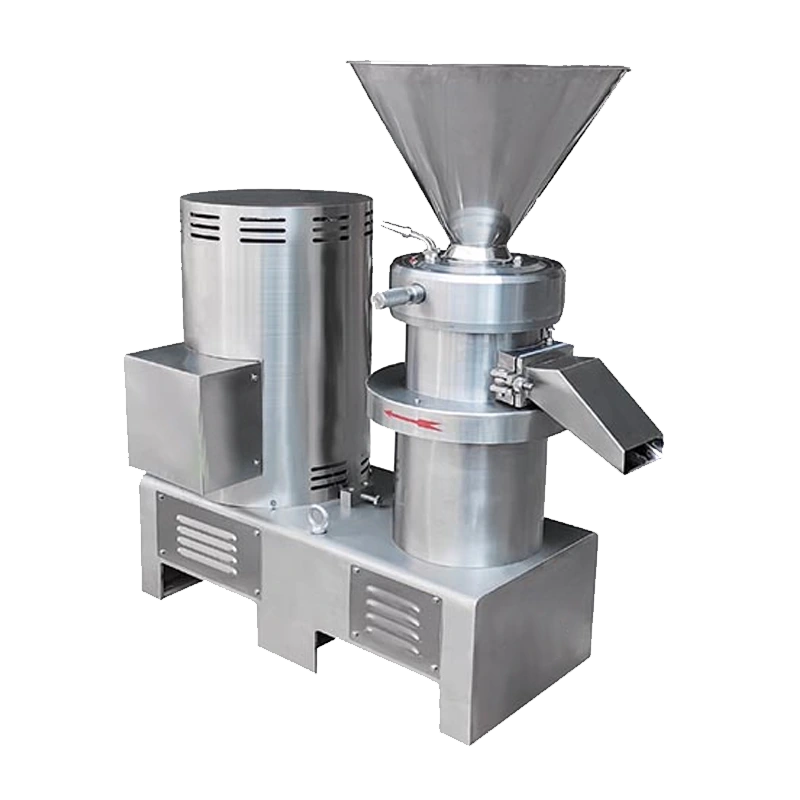
The gap between the rotor and stator can be adjusted manually or automatically while the machine is running or shut down. A typical adjustment range is from a few tens of microns up to several millimeters. This adjustability allows operators to control the fineness of the final product without changing the machine configuration.
Types of Colloid Mills
Although the basic working principle remains the same, colloid mills come in several configurations to suit different production scales and application needs.
Vertical Colloid Mill
In a vertical colloid mill, the rotor is mounted on a vertical shaft. The material enters from the top, passes through the grinding zone, and exits from the bottom. This design is compact, easy to clean, and suitable for small to medium production batches. It is widely used in laboratories and small-scale food or pharmaceutical processing.
Horizontal Colloid Mill
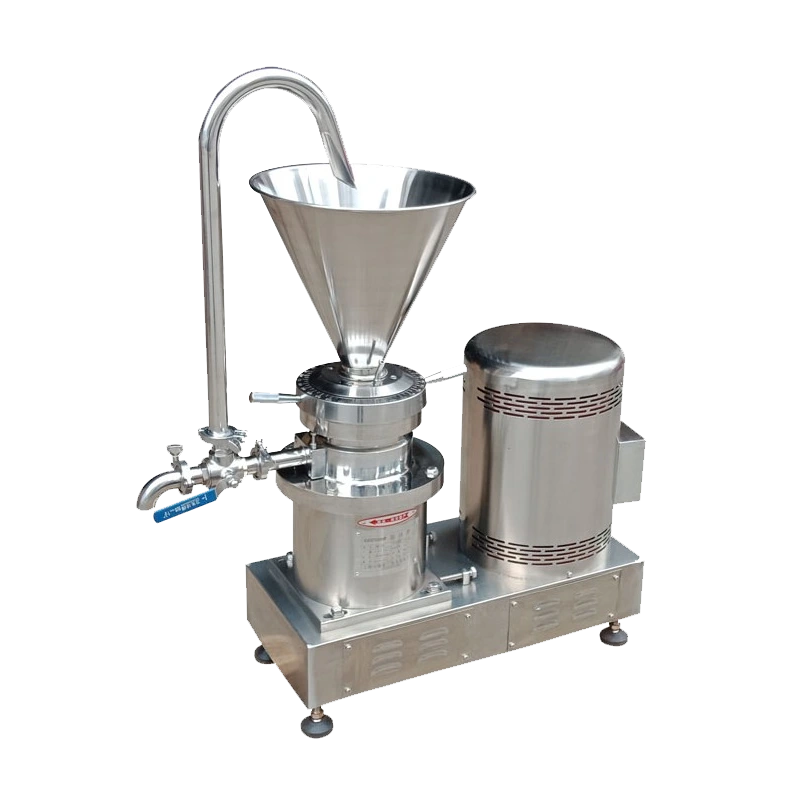
Horizontal colloid mills have the rotor shaft mounted horizontally. They are often used for continuous inline processing because the material flows directly through the mill, making them easier to integrate into a production line. Horizontal models can handle higher flow rates and are common in large-scale chemical and food manufacturing.
Pipeline (In-Line) Colloid Mill
Also called a pipeline or in-line colloid mill, this type is installed directly in a piping system. The material is pumped through the mill, and the grinding process occurs as it passes through the rotor-stator assembly. In-line mills provide continuous operation, high throughput, and minimal product hold-up. They are ideal for processes where the product must remain in a closed system, such as in sterile pharmaceutical production or handling volatile solvents.
Key Applications of Colloid Mills
Colloid mills are used across a wide range of industries because they can handle materials with viscosities from low to very high. Some of the most common applications include:
Food Industry
Peanut butter, almond butter, sesame tahini, fruit concentrates, sauces, salad dressings, and chocolate are frequently processed using colloid mills. The machine ensures smooth texture and stable emulsions without separating oil and solids.
Pharmaceutical and Cosmetic Industry
Ointments, creams, lotions, gels, and oral suspensions require a uniform particle size for proper skin feel, drug release, and stability. Colloid mills are often used in combination with other equipment to achieve the required fineness and homogeneity.
Chemical Industry
Paints, inks, pigments, adhesives, lubricants, and polymer dispersions benefit from the high shear action of colloid mills. The machine can break down agglomerates and produce stable dispersions with controlled particle size distribution.
Biotechnology and Fine Chemicals
Cell disruption, enzyme extraction, and nanoparticle production sometimes rely on colloid mills for preliminary size reduction before more intensive processes.
How to Select the Right Colloid Mill
Choosing a colloid mill is not simply a matter of picking a model from a catalog. Several factors should be considered to ensure the machine meets your production requirements and product quality goals.
Material Characteristics
The nature of your material — its viscosity, abrasiveness, corrosiveness, and heat sensitivity — directly affects the choice of materials of construction and the mill configuration. For example:
- Food products require stainless steel (typically 304 or 316L) with smooth surfaces and hygienic design.
- Abrasive materials (e.g., mineral slurries) may need hardened alloy steel or ceramic rotors/stators.
- Heat-sensitive materials may require a cooling jacket on the grinding chamber to prevent degradation.
Required Final Particle Size
While colloid mills typically achieve particles in the 2–50 micron range, the exact result depends on the material, rotor speed, gap setting, and number of passes. If your target is below 1 micron, you may need to combine a colloid mill with other equipment such as a bead mill or high-pressure homogenizer.
Batch vs. Continuous Processing
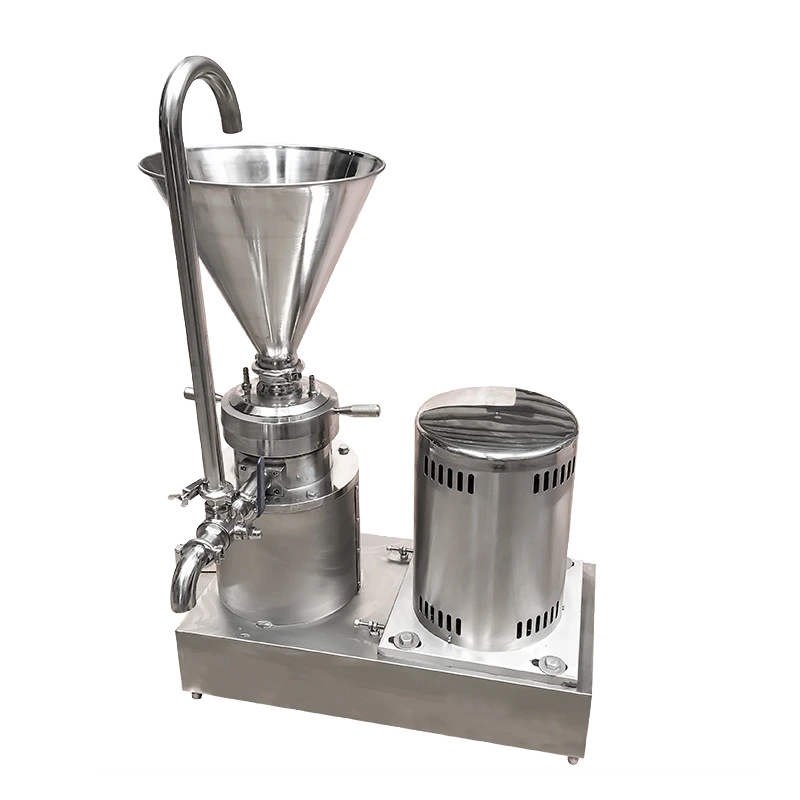
For small batches, a vertical or stand-alone colloid mill with a hopper is convenient. For continuous large-scale production, an in-line colloid mill that integrates with your existing piping system is more efficient.
Hygiene and Cleaning
Industries like food and pharmaceuticals require easy cleaning and sterilization. Look for colloid mills that can be disassembled without tools, have no dead corners, and support CIP (clean-in-place) or SIP (sterilize-in-place) procedures.
Additional Features
Moderns colloid mills may include variable speed drives, automatic gap adjustment, temperature monitoring, pressure gauges, and safety interlocks. These features improve process control and operator safety, especially when handling volatile or toxic substances.
Comparison with Other Wet Grinding Equipment
It is helpful to understand how a colloid mill compares with other common wet processing machines.
| Equipment | Mechanism | Typical Particle Size | Best For |
|---|---|---|---|
| Colloid Mill | High shear, rotor-stator | 2–50 µm | Emulsions, pastes, viscous products |
| Three Roll Mill | Shear between rollers | 1–20 µm | High-viscosity inks, pigments, cosmetics |
| Ball Mill (wet) | Impact and attrition | Down to 1 µm | Laboratory grinding, mineral slurries |
| High Pressure Homogenizer | Pressure-driven cavitation | 0.1–10 µm | Emulsions, liposomes, dairy products |
Each technology has its own strengths. A colloid mill is often the most economical solution when you need continuous, moderate fineness with simple operation and easy maintenance.
Common Operational Tips for Colloid Mills
To get the best performance from your colloid mill, keep the following in mind:
- Always run the mill with the gap fully open when starting to avoid overloading the motor.
- Gradually close the gap to the desired setting while monitoring the product outlet temperature and motor current.
- For materials that generate heat, use a cooling jacket and allow the mill to cool between passes.
- Regularly inspect and replace the rotor and stator if you notice a decline in grinding efficiency or an increase in particle size.
- Clean the mill immediately after use, especially when processing sticky or acidic materials, to prevent residue buildup and corrosion.
Safety Considerations
Because colloid mills run at high rotational speeds and handle potentially hazardous materials, safety should not be overlooked.
- Ensure the machine has a safety interlock that prevents opening the grinding chamber while the rotor is spinning.
- When processing flammable or volatile substances, use an enclosed model with explosion-proof motor and seals, and consider inert gas purging.
- Always wear appropriate personal protective equipment (gloves, glasses) when cleaning or adjusting the mill.
Selecting and operating a colloid mill is a practical skill that improves with experience. If you are new to the technology, start with a lab-scale unit to test your material under different gap settings and speeds before scaling up to production.
For high-quality colloid mills built with hygienic stainless steel, adjustable gap, and reliable motor drives, visit our colloid mill product page. We can help you choose the right model based on your material type, batch size, and fineness requirements.