
What is Micro Planetary Ball Mill? A Compact Ultrafine Grinding Device for Laboratory Research
What is Micro Planetary Ball Mill? A Compact Ultrafine Grinding Device for Laboratory Research
At its core, a Micro Planetary Ball Mill is a specialized laboratory grinding device that researchers and engineers use to reduce small quantities of solid materials from coarse particles into fine or ultrafine powders, often reaching sub-micron or nanometer sizes. Combining a compact footprint with powerful planetary motion, this instrument is essential for material science studies, nanotechnology development, and routine sample preparation in fields such as geology, metallurgy, chemistry, and pharmaceuticals.
Core Function and Working Principle
The primary function of the Micro Planetary Ball Mill is to transform bulk or granular feed materials (typically 0.5–3 mm) into finely ground powders (as fine as <0.1 µm) through high-energy ball milling. The core mechanism relies on the so-called “planetary” motion: the grinding jars are mounted on a rotating sun disk, and each jar simultaneously rotates around its own axis in the opposite or same direction. This dual rotation generates extremely high centrifugal forces, up to many times the acceleration of gravity.
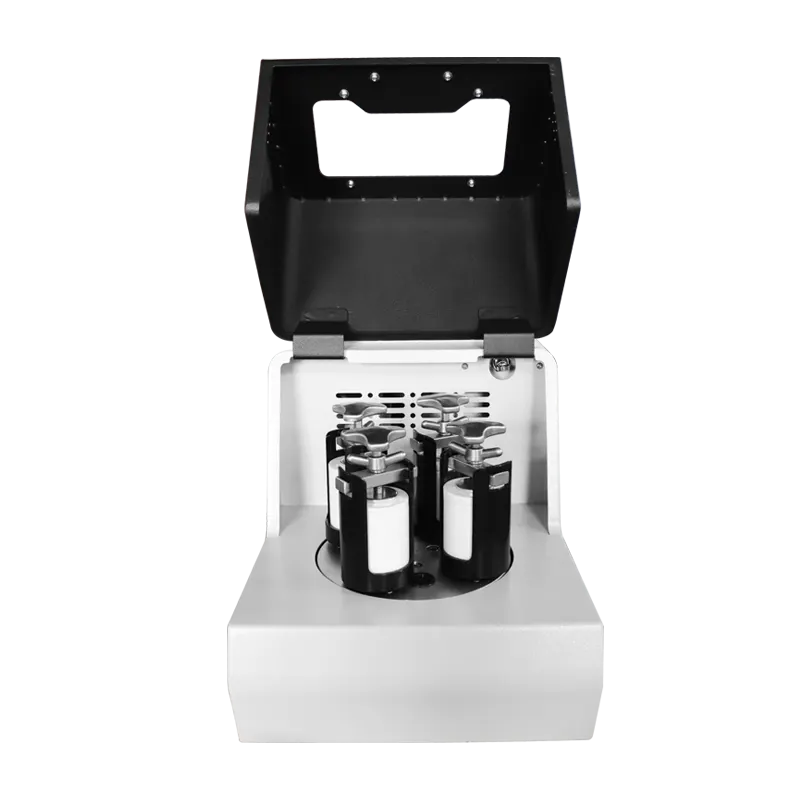
Inside the sealed jar, grinding balls (made of materials like agate, zirconia, stainless steel, or tungsten carbide) collide repeatedly with the powder particles, creating strong impact and friction. This results in rapid size reduction, mechanical alloying, or even mechanochemical reactions. Key process parameters include rotation speed (typically adjustable from 100 to 600 rpm), milling duration (from minutes to hours), direction reversal (to prevent agglomeration), and ball-to-powder weight ratio. By optimizing these variables, users can precisely control the final particle size distribution, morphology, and even induce phase transformations in the sample.
Core Components and Key Technologies
Although the Micro Planetary Ball Mill is a relatively small device, it incorporates several critical components that determine its performance and versatility:
- Grinding Jars and Balls: Available in a wide range of materials – agate, zirconia (ZrO₂), alumina (Al₂O₃), stainless steel, carbide tungsten (WC), nylon, PTFE, and more. The choice depends on the sample hardness, required purity, and contamination sensitivity.
- Drive and Control System: Microcomputer control allows programmable forward/reverse rotation, pause intervals, and total run time (e.g., 0–999 minutes). Some models feature a touchscreen interface for easy parameter setting and storage of up to 10 standard operating procedures (SOPs).
- Vacuum and Atmosphere Option: Special vacuum-rated jar lids enable grinding under inert gas (argon, nitrogen) or vacuum, preventing oxidation or chemical reactions for air-sensitive materials.
- Safety Features: Robust jar clamping mechanisms with safety locks ensure the jars are securely fastened before operation, protecting both the user and the instrument.
Key Performance Indicators and Selection Guide
When selecting a Micro Planetary Ball Mill for your laboratory, consider the following essential metrics:
Grinding Capacity and Throughput
Typical models process small sample volumes – from a few grams up to about 200 mL per batch. The most common configurations have 2 or 4 grinding stations, allowing simultaneous milling of multiple samples. For example, a model with 4 stations can handle up to 4 × 50 mL jars in one run.
Final Fineness and Particle Size Control
The hallmark of a planetary ball mill is its ability to reach sub-micron (<1 µm) and even nano (<100 nm) particle sizes. The achievable fineness depends on the material’s brittleness, milling time, and speed. The higher the rotational speed, the faster the grinding, but excessive speed may cause excessive heating or wear. Most units offer variable speed control from 100 to 600 rpm.
Energy Efficiency and Noise Level
Compact lab mills are designed for low energy consumption. Advanced designs incorporate FFCS (Friction-Free Control System) technology to ensure stability on the bench and reduce vibration noise. Typical noise levels range from 60 to 75 dB during operation.
Automation and Programmability
Modern micro planetary ball mills feature microcomputer control with memory for multiple protocols, interval operation (on/off cycles for cooling), and even RS-232 or USB interfaces for data logging and remote monitoring. Touchscreen models simplify parameter input and visualization.
Maintenance and Durability
Look for models with easily replaceable sealing gaskets, robust drive belts (or direct drive), and long-life bearings. The grinding jars and balls are consumables; choose high-quality materials to minimize contamination and extend service life.
Application Fields and Selection Recommendations
The Micro Planetary Ball Mill finds extensive use in:
- Materials Science & Nanotechnology: Synthesis of nanoparticles, nanocomposites, and mechanical alloying of advanced alloys.
- Geology & Mineralogy: Preparation of rock, ore, soil, and sediment samples for X-ray diffraction (XRD), XRF, or ICP analysis.
- Ceramics & Refractories: Fine grinding of alumina, zirconia, silicon carbide, and other hard ceramics for sintering studies.
- Chemistry & Pharmaceuticals: Homogenization of catalysts, pigments, polymers, and herbal medicines.
- Electronics & Battery Research: Milling electrode materials for lithium-ion batteries, solid electrolytes, and conductive pastes.
For successful selection, consider your typical sample volume and hardness: if you frequently mill very hard materials (e.g., tungsten carbide, silicon), choose jars and balls made of tungsten carbide or ZrO₂ to avoid contamination and achieve fast grinding. For soft or fibrous materials, a jar made of stainless steel or agate is often sufficient. Always verify the maximum feed size and the speed range to match your desired throughput and fineness.