
What is a Three Roll Mill? A Precision Grinding Machine for Dispersing High-Viscosity Materials
What is a Three Roll Mill?
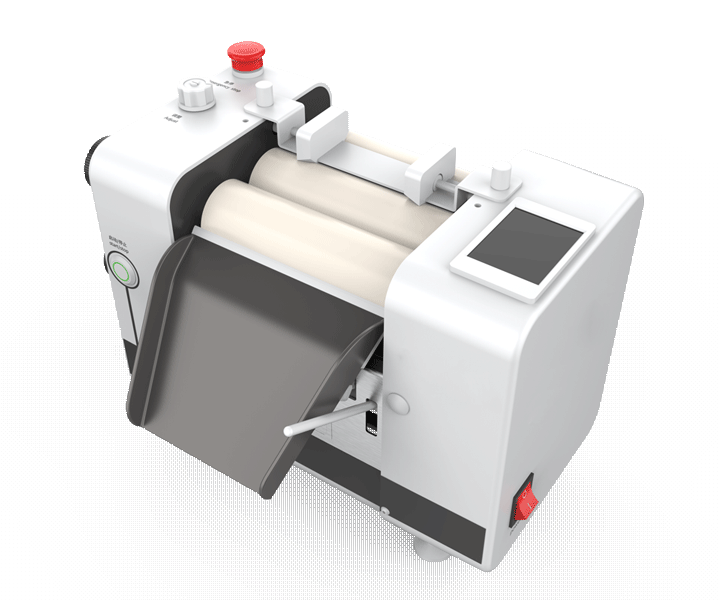
At its core, a three roll mill (also called a triple roll mill) is a specialized grinding and dispersing machine designed to process high-viscosity pastes and slurries. It uses intense shear forces generated by three horizontally positioned rollers that rotate in opposite directions at different speeds to break agglomerates, reduce particle size, and achieve homogeneous dispersion. Industries such as printing ink manufacturing, paint production, cosmetics, electronics, and pharmaceuticals rely on this equipment to transform coarse, lumpy materials into smooth, fine-textured, and stable products.
How Does a Three Roll Mill Work?
The working principle is elegantly simple yet highly effective. The machine consists of three parallel rollers mounted horizontally: the feed roller (slowest speed), the center roller (medium speed), and the apron roller (fastest speed). Material, typically in the form of a thick paste, is fed into the gap between the feed roller and the center roller. As the rollers rotate, the paste is drawn into the narrowing nip region where it experiences tremendous shear due to the differential speeds. The material that passes through the first nip adheres to the center roller and is carried into the second gap between the center roller and the apron roller, where an even higher shear force is applied (because the apron roller rotates faster and the gap is usually smaller). Finally, a knife blade scrapes the processed material off the apron roller, and the finished paste is collected. This process can be repeated multiple times to achieve the desired fineness.
The degree of dispersion is controlled by adjusting the gap between the rollers (typically set via a handwheel or hydraulic system) and the number of passes. The maximum achievable fineness can reach 1–3 microns (measured with a grindometer), depending on the material and machine settings. Cooling systems are often built in to dissipate heat generated by the intense shear, preventing temperature-sensitive materials from degrading.
Types and Configurations of Three Roll Mills
Three roll mills come in various sizes and roller materials to suit different applications and production scales:
Laboratory / Small Batch Models
Models like the SM65 (roller diameter 65 mm) are compact benchtop units designed for R&D labs, small batch production, or sample preparation. They typically feature manual gap adjustment and are ideal for testing formulations before scaling up.
Production / Heavy-Duty Models
Models such as the SM260 (roller diameter 260 mm) and SM315 (315 mm) are built for continuous industrial production. They often include features like hydraulic gap control, variable speed drives, automatic feeding systems, and robust cooling circuits to maintain consistent quality under high throughput.
Roller Material Options
Rollers can be made from chilled alloy cast iron (hardness up to HS70) for general use, ceramic (e.g., zirconia or alumina) for applications requiring contamination-free processing, or hard alloy steel for extremely abrasive materials. The choice depends on the product's chemical compatibility and abrasiveness.
Specialty Models
Some mills are equipped with heating rollers for processing thermoplastic materials or with explosion-proof motors for solvent-based formulations. Hydraulic and PLC-controlled models are also available for advanced automation.
Key Performance Indicators and Selection Criteria
When choosing a three roll mill, consider the following technical parameters:
- Roller Size & Surface Area: Determines throughput and cooling efficiency. Larger diameters (e.g., 260 mm vs. 150 mm) allow higher production rates.
- Speed Ratio: Typical ratios between feed/center/apron rollers range from 1:2:4 to 1:3:9. Higher ratios generate more shear but also more heat.
- Motor Power: From 0.75 kW for lab models up to 15 kW or more for production units. Sufficient power ensures stable operation under load.
- Fineness Capability: Most three roll mills can achieve 3–18 μm in normal operation, and with multiple passes, down to 1 μm.
- Cooling System: Internal water or oil cooling is essential for heat-sensitive materials (e.g., cosmetics, electronics pastes).
- Automation: Manual gap setting is cost-effective for small batches; hydraulic or servo-controlled systems provide reproducible results for mass production.
- Material of Construction: Chilled iron rollers offer good wear resistance and economy; ceramic rollers prevent metal contamination; hard alloy rollers handle abrasive fillers.
Applications and Selection Advice
Three roll mills are indispensable in industries where uniform dispersion and particle size reduction are critical:
- Printing Inks & Pigments: For producing high-gloss offset inks, screen inks, and pigment pastes with consistent color strength.
- Paints & Coatings: To deagglomerate titanium dioxide, carbon black, and other fillers in high-viscosity formulations.
- Cosmetics & Personal Care: For lipsticks, mascara, foundations, and creams requiring a smooth, creamy texture.
- Electronics: For conductive pastes, solder pastes, and dielectric materials used in PCB and semiconductor manufacturing.
- Pharmaceuticals & Food: For ointments, pastes, and confectionery fillings where particle size affects bioavailability or mouthfeel.
For laboratory development, a small model like the SM65 is recommended. For small-scale production, the SM150 (150 mm diameter) offers a balance of capacity and cost. For continuous high-output manufacturing, the SM260 or SM315 with automation features is the best choice. Always confirm the roller material compatibility with your specific product to avoid contamination or excessive wear.
References
Product page: Three Roll Mill – labballmill.com