
Stainless Steel Roll Mill Jar: Selection Tips
A stainless steel roll mill jar is often selected when a laboratory needs a durable grinding chamber for a roller ball mill, but the material choice is only one part of the decision. The jar determines how the sample and grinding media move, how easily the mill can be sealed, how much material is lost during recovery, and how much contamination risk the process carries. Two jars with the same nominal volume can produce different particle size distributions if their internal geometry, wall thickness, lid design, or surface condition differ.
For that reason, jar selection should begin with the sample and the target result, not with a catalog page. A jar that works well for a dry, brittle mineral may be a poor choice for an acidic slurry or a trace-metal-sensitive powder. Stainless steel offers useful mechanical and handling advantages, but it is not automatically inert. Understanding where those advantages matter, and where they do not, is the practical basis for choosing a stainless steel roll mill jar.
What a Roll Mill Jar Does in Laboratory Milling
A roller ball mill rotates a closed jar on powered rollers. As the jar turns, the grinding media rises along the inner wall, then falls or rolls back into the sample bed. The resulting combination of impact, attrition, and shear reduces particle size and blends the charge. The jar is therefore not a passive container. Its diameter, internal shape, wall thickness, and surface finish influence media motion, energy transfer, sample hold-up, and the time needed to reach a target grind.
In dry milling, the powder must be able to move around the media rather than pack into a dense cake. In wet milling, the liquid carries the solids, changes the viscosity of the charge, and can leak through a lid that is not properly seated. Both modes place demands on the jar body and closure. A stainless steel jar is opaque, so the operator cannot watch the media bed through the wall. Process control must come from validated run parameters, sample checks, and careful attention to sound, motor load, and temperature where the mill provides that information.
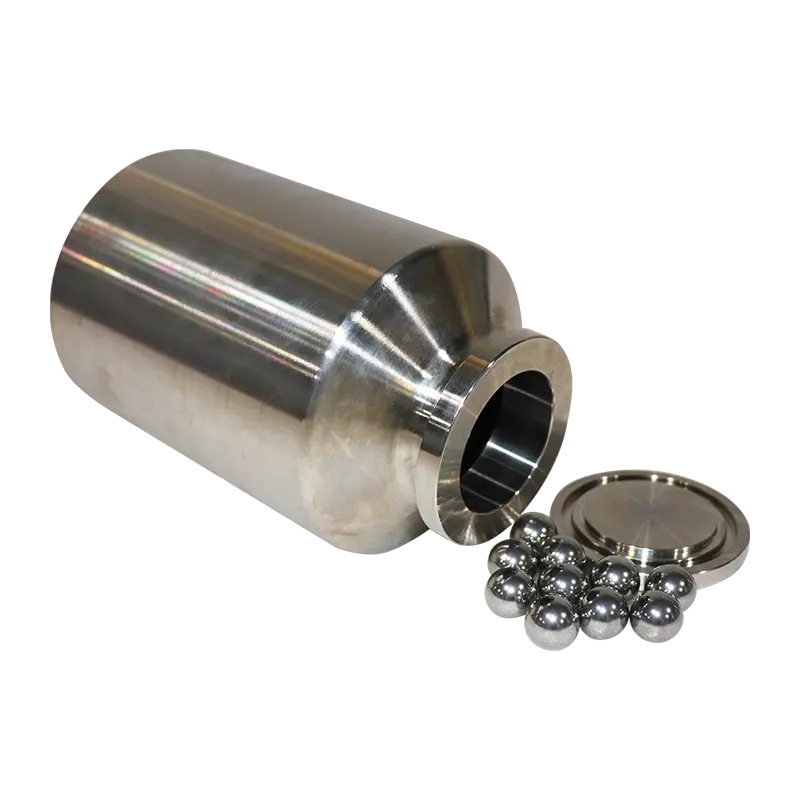
The geometry of the jar has a direct effect on how the media charge behaves. A narrow, tall jar and a wide, shallow jar can hold similar volumes but distribute energy differently. Internal corners, the fit of the lid, and any internal lifting features can change the tumbling pattern. The jar's actual dimensions and features should be confirmed from the product data rather than assumed from a photo. When a process is transferred from one jar to another, the media size and rotation speed may need to be adjusted to reproduce the same energy profile.
Media motion is also affected by the amount of free space in the jar. If the jar is filled too close to the lid, the media cannot rise and cascade effectively. If the sample load is too small, much of the media may contact other media instead of the powder. A practical laboratory trial should record the jar volume, media mass, sample mass, and liquid mass so that the working charge can be repeated. This record is more useful than a verbal description such as a half-full jar, because bulk density and media size change the meaning of that description.
Sample recovery matters as much as grinding. Fine powder can cling to the lid, collect behind the gasket, or remain between media particles. A jar with a simple, accessible interior is easier to empty and clean. Stainless steel can be wiped and rinsed, but the lid and closure still need attention. The time spent on recovery and cleaning should be included when comparing jar options, especially in laboratories that run many small batches.
Why a Stainless Steel Roll Mill Jar Is Chosen
Stainless steel is attractive in a laboratory because it combines mechanical toughness with a surface that can be wiped, rinsed, and inspected. Unlike a ceramic jar, it does not chip in the same way when a heavy media charge is unloaded or when the jar is handled roughly. Its thermal conductivity can also help move heat away from the sample during extended milling, although the mill, media, and ambient conditions still determine the actual temperature rise. TENCAN's stainless steel roll mill jar is listed for roller ball mill use, and the same practical questions apply to any jar of this type: what the sample needs, what the closure must contain, and how the jar will be cleaned between runs.
Practical advantages in the laboratory
A stainless steel jar can be a sensible starting point for dry, brittle samples that are not highly sensitive to iron or alloying elements. It can handle repeated loading and unloading, and its interior can be examined under good light for scratches, pitting, or retained powder. When the sample is abrasive, however, the same toughness does not eliminate wear. The jar, lid, and media will all wear to some degree, and the wear products have to be considered in the analytical result.
Cleaning is another reason laboratories choose stainless steel. A smooth metal surface is easier to brush and rinse than a porous ceramic or a scratched plastic surface, provided the jar is fully disassembled and the lid, threads, and gasket area are cleaned as well. Dried slurry can hide in corners, so the cleaning procedure should be written for the jar and not left to a quick rinse at the sink.
Where the material has limits
Stainless steel is a family of alloys, not a single universal material. Corrosion resistance depends on the alloy, the sample chemistry, the liquid phase, temperature, and cleaning agents. Acidic slurries, high-chloride solutions, some salts, and prolonged wet contact can be more aggressive than a simple water-based slurry. If the process involves a corrosive liquid or a trace-metal-sensitive product, ask the jar supplier for material compatibility information and consider a ceramic, agate, zirconia, or polymer jar when the risks justify it.
Opacity is a practical limitation as well. A stainless steel jar does not allow visual confirmation of media movement or slurry mixing. Operators should use documented run settings and check the product after milling rather than adjusting the process by eye.
| Jar material | Potential advantages | Points to verify |
|---|---|---|
| Stainless steel | Tough body, thermal conduction, easy wipe-down, suitable for many dry brittle samples | Alloy corrosion, metallic wear, gasket compatibility, opaque wall |
| Agate | Low metallic contamination, good for many soft to medium-hard samples | Brittleness, impact limits, cleaning of porous areas |
| Zirconia | High density and wear resistance, useful where ceramic contamination is acceptable | Cost, jar weight, media matching, lid wear |
| Alumina ceramic | Wear resistance and low metallic contamination | Chipping risk, thermal shock, seal fit |
| Plastic or PTFE | Chemical resistance and visual inspection in some designs | Low wear resistance, temperature limits, solvent swelling |
Construction details to confirm
Before a jar is placed in service, confirm the details that affect safe operation and repeatability. The lid should seat without forcing, the gasket should fit its groove, and the closure should remain secure when the jar rotates. Wall thickness and jar mass matter because they influence heat transfer and the load on the mill rollers. A very heavy jar may require a mill with suitable roller spacing and drive capacity. The supplier's operating limits should take priority over general workshop assumptions.
The interior finish should be smooth enough to clean but not polished to a mirror surface that hides fine scratches under normal light. Check the thread or clamp area for burrs and the lid for flatness. If the jar has a pouring lip or other feature, confirm that it does not create a crevice where powder can collect. These details are not cosmetic; they determine whether the jar can be used for sensitive samples and whether cleaning can be verified.
Contamination and Corrosion Risks to Evaluate
Contamination in a roll mill jar can come from several places at once. The jar wall and lid can wear, the gasket can release material or retain old sample, the grinding media can wear, and powder can remain in threads or under the lid. A visually clean jar is not proof of a clean blank. For trace analysis, the only useful evidence is a controlled blank run with the same jar, media, liquid, and cleaning procedure used for the sample.
With a stainless steel jar, the main technical concern is metallic wear or corrosion rather than simple abrasion of a ceramic surface. Abrasive powders can slowly remove material from the jar and media, and aggressive liquids can change the surface condition. The significance depends on the sample and the analytical method. A major component in a construction material may tolerate small iron additions, while a trace-element study or a battery material may not. The correct question is not whether stainless steel is clean in general, but whether the expected wear is acceptable for this sample and this measurement.
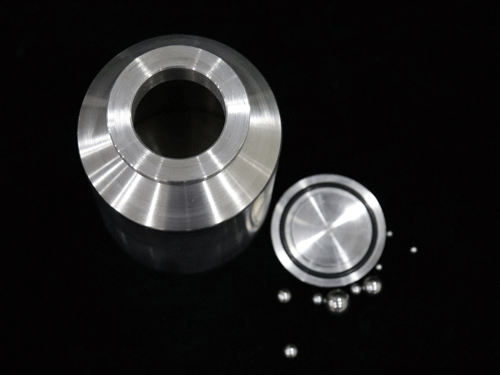
Corrosion risk deserves separate attention. A stainless steel surface may perform well in one aqueous system and poorly in another. Chloride content, pH, temperature, dissolved oxygen, cleaning chemicals, and the length of wet contact all matter. Do not assume that a jar used successfully for a neutral mineral slurry will be suitable for an acidic or high-salt process. When the chemistry is outside ordinary laboratory experience, request compatibility guidance or run a small preliminary exposure test with the actual liquid before committing a batch.
Media wear can be larger than jar wear. A dense media in a small jar has many contact points, and the total wear area can be substantial. If the jar is stainless steel but the media is zirconia or agate, the contamination profile changes. If both jar and media are stainless steel, the metallic contribution may be higher in an abrasive duty. Select media for density and contamination first, then confirm that the jar can accept the media size, mass, and impact load.
Surface condition also affects cleaning and contamination. Scratches, pits, and rough weld areas can hold fine powder. A jar that has been cleaned with an abrasive pad may look bright but be harder to clean because the surface is now scratched. Use cleaning methods that preserve the finish, and inspect the interior with a light at an angle. If pitting or deep scratches appear, retire the jar from sensitive work or use it only for less demanding samples.
A blank run should match the intended process as closely as possible. Use the same jar, media type and mass, liquid, and cleaning sequence, but omit the sample or use a representative inert material if the analytical method requires it. Analyze the blank for the elements or phases that matter to the project. If the blank is acceptable, run a small sample and repeat the blank after cleaning to confirm that carryover is under control. This two-step check separates wear from insufficient cleaning, which is often the more likely source of unexpected contamination.
Wear and corrosion should not be treated as the same problem. Wear is a physical loss of material from jar, lid, or media; corrosion is a chemical change that may loosen surface material or create pits. A jar can show little visible wear but still release material after contact with an aggressive liquid. Conversely, a jar may show polishing from an abrasive powder without a significant change in the blank. The analytical result, not appearance alone, should determine whether the jar remains suitable.
Media, Fill, and Speed: Setting the Milling Window
Jar selection cannot be separated from media selection and operating conditions. The same stainless steel jar can produce a coarse mix at low energy or a fine grind at higher energy, but it can also generate heat, create excessive wear, or stall the media bed if the charge is poorly chosen. The useful approach is to define a milling window and then test within it, rather than changing every variable at once.
Grinding media choice
Media density, diameter, shape, and material determine the energy available at each contact and the contamination risk. Larger or denser media provide more impact energy, which can help break coarse or hard particles, but they also create more wear and may not produce a narrow fine grind. Smaller media provide more contact points and can be effective for fine milling, provided the feed particles are already small enough to be caught between them. The media must also be compatible with the jar and the sample. Stainless steel, zirconia, alumina, agate, and tungsten carbide media are used in laboratory milling for different reasons; the final choice should be based on contamination limits, required energy, and the supplier's guidance for the jar and mill.
Fill ratio and sample load
Media fill and sample load control how freely the charge moves. If the jar is packed with media and powder, there is little space for the media to cascade; if the sample load is too low, the media may do little useful work and recovery may be difficult. A common laboratory starting point is to fill part of the jar volume with media and add enough sample to occupy the spaces between media without drowning the charge in liquid or packing it into a solid mass. The exact proportions should be established by trial because bulk density, particle shape, and slurry viscosity vary widely. Record the media mass, sample mass, and liquid mass for every run so that a successful result can be repeated.
Rotation speed, time, and temperature
Roller mills normally operate below the speed at which the media would centrifuge against the jar wall. Within that range, increasing speed raises the frequency and energy of contacts, but it also raises heat input and wear. Long runs at high speed can warm the jar, change slurry viscosity, and increase pressure inside a sealed jar. A stainless steel jar can conduct heat, but it cannot remove heat faster than the mill and surroundings allow. If the sample is heat-sensitive, use shorter runs, lower speed, a cooler environment, or a different jar and mill configuration after checking with the equipment supplier.
Wet milling adds its own constraints. The liquid must be compatible with the jar, lid, and gasket, and the slurry must remain fluid enough to move. A slurry that is too thick can trap media or create a paste that does not grind evenly. A slurry that is too thin can allow coarse particles to settle and may increase leakage risk. Dry milling avoids liquid compatibility issues but can create dust, caking, and higher sample loss. In both cases, the jar closure and the recovery method are part of the process, not an afterthought.
Scale-up and repeatability
A result obtained in a small stainless steel jar is a starting point, not a direct prediction of a larger run. When jar diameter increases, the media path length and the number of contact events change. A larger jar may need a different media size, a different fill fraction, or a different run time to achieve the same particle size distribution. The mill's roller speed and the jar's mass also affect how the charge behaves. Scale-up should be done in stages, with particle size and contamination checked at each stage.
Repeatability depends on recording the variables that are easy to overlook: jar identity, media lot, sample moisture, liquid mass, cleaning method, and ambient temperature. If a run cannot be repeated with the same jar and media, the cause may be a worn gasket, a change in media size distribution, or inconsistent sample loading. A short trial matrix is usually more informative than a single long run, because it shows how the process responds to changes in energy and fill.
Sealing, Cleaning, and Maintenance Practices
The lid and seal are critical on a roll mill jar because the jar is moving. A loose lid can allow powder to escape, a worn gasket can leak slurry, and a thread contaminated with dried sample can prevent the lid from seating correctly. Before each run, inspect the lid, gasket, and mating surfaces. Confirm that the gasket is the correct one for the jar and the liquid, and that it is not swollen, hardened, or cut. Tighten the closure as recommended by the supplier; excessive force can distort a gasket or damage a thread as easily as insufficient force can cause a leak.
Cleaning procedure
A practical cleaning sequence is to empty the jar, remove the media, brush out loose powder, wash with a suitable detergent or solvent, rinse, and dry completely. The exact liquids depend on the sample and the jar materials. Avoid abrasive pads and strong chloride-containing cleaners on stainless steel unless the supplier confirms they are acceptable. Pay attention to the lid threads, the underside of the lid, the gasket groove, and the inside corners. If the same jar is used for different materials, a solvent rinse followed by a blank run may be needed to check for carryover.
Inspection and replacement
Inspect the jar interior for pitting, deep scratches, discoloration that does not clean away, and impact marks. Check the lid for deformation and the gasket for cracks or compression set. A jar that has developed a rough surface is harder to clean and may shed more material. Keep a simple log of jar use, cleaning, and inspection so that a change in performance can be traced to a specific jar or gasket. A damaged jar should not be returned to sensitive work simply because it still holds media.
Where practical, dedicate jars to sample families or contamination levels. A jar used for a major component in a formulation may be acceptable for a less sensitive mix, but it should not move into trace analysis without a full cleaning validation. Store clean jars with the lid off or loosely fitted so that residual solvent can escape and the gasket is not compressed for long periods. Label the jar and lid as a matched set if the closure has been fitted or adjusted.
Selection and Validation Checklist
A stainless steel roll mill jar is most likely to succeed when it is selected against a clear sample specification and then validated with a small, recorded trial. The checklist below is deliberately practical. It applies to TENCAN's stainless steel jar and to any comparable roller ball mill jar under evaluation.
- Sample chemistry: acidity, chloride, salt content, moisture, and sensitivity to iron or alloying elements.
- Target particle size and acceptable particle size distribution, not just a single average value.
- Feed size and hardness; confirm that the media can break the feed.
- Required batch mass and jar working volume, with enough free space for media motion.
- Media material, density, diameter, and fill; check compatibility with the jar.
- Dry or wet mode, liquid compatibility, slurry viscosity, and leakage risk.
- Temperature limits for the sample, gasket, and liquid.
- Cleaning method and acceptable turnaround time between samples.
- Contamination limit and the analytical method used to verify it.
- Scale-up plan, including whether small-jar results will be repeated in a larger jar.
A validation trial should be run with the actual sample, not a substitute that merely looks similar. Start with a conservative media charge and speed, then adjust one variable at a time. Record the jar, media mass, sample mass, liquid mass, speed, time, temperature, and recovery. After milling, check the particle size distribution, not only the median size. A process that produces a good median but a wide distribution with coarse tail may need a different media size, a longer run, or a two-stage approach.
For contamination-sensitive work, run a blank with the jar, media, and liquid under the same conditions. If the analytical result is close to the detection limit, the process may be acceptable; if not, change the jar material, media, or cleaning procedure. This step is more informative than a visual inspection because it measures what the sample actually sees. It is also a useful way to detect a worn gasket or a poorly cleaned lid.
Documentation is part of validation. A short batch record should identify the jar, lid, gasket, media, sample, and cleaning step. If the same jar is used repeatedly, note the number of runs and any change in appearance. When a result shifts, the record can show whether the cause was a new media lot, a changed cleaning solvent, or a jar that has reached the end of its useful life. This level of control is especially important when the mill is used for multiple projects in the same laboratory.
Finally, consider the practical life of the jar. A stainless steel jar can serve many campaigns when it is matched to suitable samples and maintained carefully, but it is not the right answer for every chemistry or every contamination limit. The most reliable selection is the one that connects the jar to the sample, the media, the mill, and the analytical target. When those elements are documented, the jar becomes a controlled part of the process rather than an accessory chosen at the last minute.