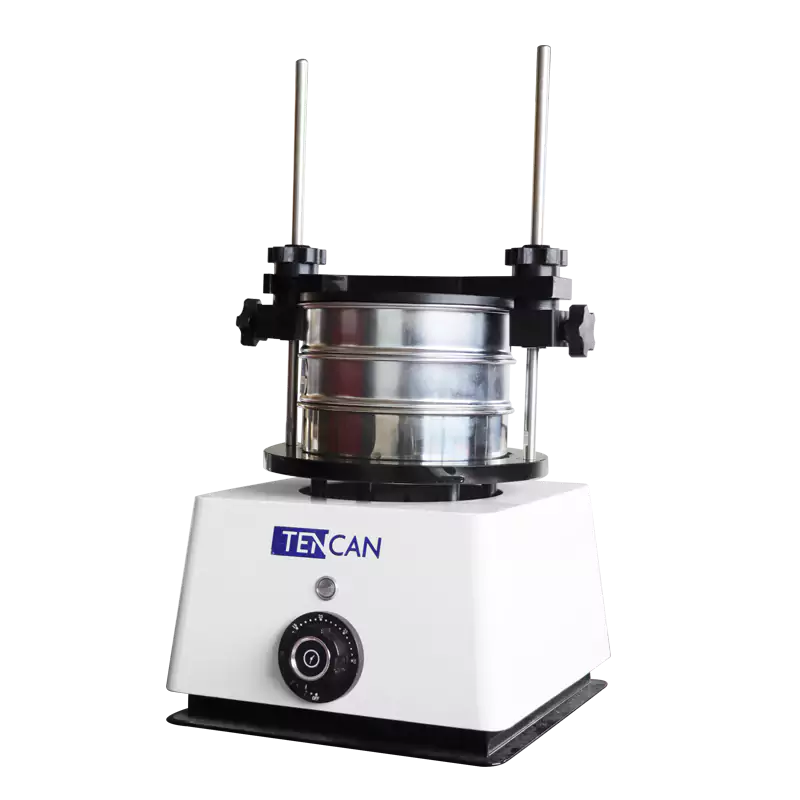
What is a Small Laboratory Screening Machine? A Compact Sieving Device for Particle Size Analysis and Sample Preparation
What is a Small Laboratory Screening Machine?
At its core, a small laboratory screening machine is a compact sieving device designed for precise particle size classification and sample preparation in research, quality control, and small-scale production environments. Laboratories and industries use it to separate bulk materials into different particle size fractions quickly and reliably. Unlike large industrial sieves, this benchtop machine offers high accuracy with minimal sample loss, making it indispensable for material analysis, powder technology, and formulation development.
Core Function and Working Principle
The primary function of a small laboratory screening machine is to transform a heterogeneous powder or granular mixture into distinct size fractions by passing the material through one or more mesh screens. The working principle is based on mechanical vibration: the machine generates controlled oscillations that cause the particles to move across the screen surface. Particles smaller than the mesh openings pass through to the next layer or collection tray, while larger particles remain on top. This process ensures a clean separation according to the specified particle size.
Key operational parameters include vibration amplitude, frequency, and screening time. Adjusting these parameters allows the user to optimize separation efficiency for different materials—whether it is a fragile powder, abrasive ceramic, or sticky chemical. The compact design of a small laboratory screening machine typically features a single or multiple sieve decks, an adjustable vibrator motor, and a clamp system to secure the sieves. The machine can handle sample sizes from a few grams to several kilograms, depending on the model.
Key Components and Technology
Although the product category is relatively straightforward, understanding its core components helps users appreciate its performance:
- Vibration Mechanism: Most small laboratory screening machines use an electromagnetic or eccentric motor to generate three-dimensional vibration. This motion ensures even particle distribution and high throughput.
- Sieve Mesh: Interchangeable test sieves made of stainless steel or brass with various mesh sizes (from coarse to micron-level) allow flexible particle classification.
- Clamping System: Quick-release clamps or pneumatic jigs hold the sieves firmly in place, preventing leaks and ensuring consistent results.
- Control Panel: Digital timers and amplitude controllers enable reproducible screening protocols—critical for comparative analysis.
Some advanced models incorporate ultrasonic deblinding technology to prevent mesh clogging and improve fine powder screening efficiency.
Key Performance Indicators and Selection Criteria
When selecting a small laboratory screening machine, consider these essential performance indicators:
- Screening Capacity and Sample Size: Models are available with working diameters from 75 mm (3 inches) to 200 mm (8 inches) or even larger. Choose a size that matches your typical sample volume—overloading reduces accuracy.
- Particle Size Range: Ensure the machine can accommodate the mesh sizes you need (e.g., 20 µm to several millimeters). The vibration intensity should be adjustable to handle fine or fragile particles without damage.
- Accuracy and Repeatability: Look for units with stepless amplitude control and digital timing to achieve consistent results across multiple tests.
- Noise and Vibration Isolation: Low-noise operation is important for laboratory environments. Many machines feature vibration-damping feet and sound enclosures.
- Ease of Cleaning and Maintenance: Quick-release sieve frames, smooth surfaces, and simple disassembly facilitate between-sample cleaning to avoid cross-contamination.
- Automation and Data Output: Some models offer interfaces for balance integration or data logging, which is beneficial for quality control documentation.
Application Fields and Selection Advice
Small laboratory screening machines are widely used in:
- Material Research & Quality Control: Analyzing particle size distribution of powders, granules, or aggregates in cement, pharmaceuticals, food, plastics, and cosmetics.
- Mining & Metallurgy: Sieving ores, minerals, and metal powders for grade control and process optimization.
- Chemical & Ceramic Industries: Classifying catalysts, ceramic powders, abrasives, and pigments.
- Education & Academic Labs: Teaching particle technology and performing R&D experiments.
For labs that require only occasional screening of small samples, a basic model with manual amplitude adjustment is cost-effective. If you need high throughput or handle sticky/hygroscopic materials, consider a model with ultrasonic deblinding and programmable cycles. For comprehensive particle size analysis, pairing the screening machine with a dedicated 3D rotary vibrating screen or a stainless steel vibrating screen machine may provide additional capabilities for larger volumes or continuous operation.