
What is a Microwave Vacuum Drying Oven? A High-Efficiency Low-Temperature Drying Equipment for Heat-Sensitive Materials
What is a Microwave Vacuum Drying Oven?
At its core, a microwave vacuum drying oven is a specialized drying system that integrates microwave energy with vacuum environment to remove moisture from heat-sensitive materials rapidly and uniformly. It is widely used in industries such as battery material manufacturing, pharmaceuticals, food processing, and chemical engineering to dry powders, granules, blocks, and pastes while preserving their color, aroma, active ingredients, and physical structure.
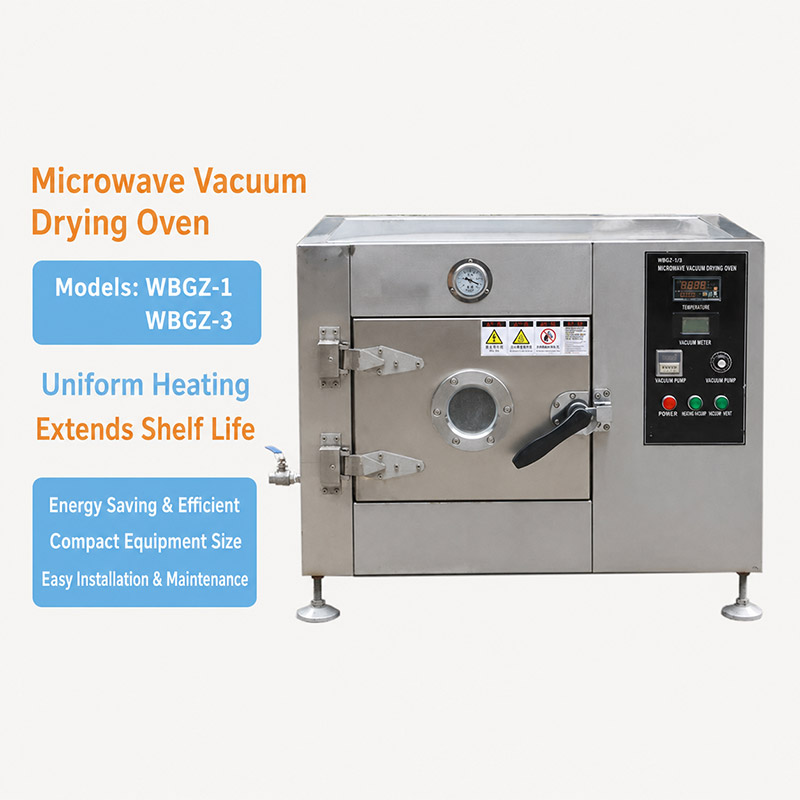
How It Works: The Synergy of Microwave and Vacuum
The core working principle combines two complementary technologies: microwave volumetric heating and vacuum-assisted low-temperature evaporation. Microwave energy (typically at 2450 MHz) penetrates the material and causes polar molecules – especially water – to oscillate at billions of times per second. This molecular friction generates heat directly inside the material, not from an external surface. As a result, heating is extremely fast and uniform, eliminating the temperature gradients common in conventional ovens.
At the same time, the vacuum chamber reduces the atmospheric pressure. Under a vacuum of < -0.08 MPa, the boiling point of water drops to between 30 °C and 40 °C. This means moisture can evaporate at significantly lower temperatures, preventing thermal degradation of sensitive compounds. The combination creates a unique internal-to-external moisture migration path: the interior is warmer than the surface, so water vapor moves outward quickly, accelerating drying without overheating the exterior.
Key Types and Configurations
Laboratory-Scale Microwave Vacuum Drying Ovens
These compact units are designed for R&D labs and small batch processing. For example, a typical lab model offers adjustable microwave power from 0 to 800 W, a vacuum pump capable of reaching -0.095 MPa, temperature control from 40 °C to 150 ℃, and a processing capacity of around 0.8 kg/h. They are ideal for process development, material screening, and small-scale sample preparation.
Industrial-Scale Microwave Vacuum Dryers
For production needs, larger systems integrate a high-power microwave generator (e.g., 30 kW adjustable) within a stainless steel vacuum chamber. They can handle hundreds of kilograms per batch, with drying temperatures adjustable between 30 °C and 70 °C. These units often feature PLC control, touch-screen interfaces, and multi-point temperature monitoring to ensure repeatability and compliance with GMP or similar standards.
Core Components and Key Technologies
Regardless of scale, a microwave vacuum drying oven comprises several critical subsystems:
- Microwave generation and distribution: Magnetrons generate the microwave energy, while a wave-guide or stirrer distributes it uniformly to avoid hot or cold spots.
- Vacuum system: A vacuum pump (often rotary vane or dry screw) maintains the desired low pressure, usually monitored by a vacuum gauge.
- Heating chamber: Typically made of 304 stainless steel to resist corrosion and comply with food/pharma hygiene requirements.
- Temperature and pressure control: Advanced models use IR temperature sensors and PID controllers to regulate drying parameters precisely.
- Safety features: Microwave leakage detection (typically < 5 mW/cm²), over-temperature protection, and interlock switches ensure operator safety.
Performance Indicators and Selection Guide
Key Performance Metrics
- Drying rate and efficiency: Microwave vacuum drying can be 4–10 times faster than conventional vacuum drying, often reducing cycle time from hours to tens of minutes.
- Temperature uniformity: Due to volumetric heating, temperature variation across the material is minimal, which is critical for consistent product quality.
- Energy consumption: Because microwave energy directly heats the moisture, overall energy efficiency is 30–50% higher than hot-air or steam-based systems.
- Control flexibility: Power, temperature, and vacuum level can be adjusted in real time, allowing precise drying profiles for different materials.
- Maintenance: Look for easy-to-clean chambers, accessible filters, and robust magnetron and vacuum pump designs.
Selection Considerations
- Material characteristics: Determine the initial moisture content, thermal sensitivity, and physical form (powder, granule, block, paste). For fine powders prone to dust explosions, an inert gas purge may be needed.
- Batch size or throughput: Lab units work for a few hundred grams; industrial units can process tens of kilograms per cycle.
- Solvent handling: If the material contains organic solvents, the vacuum system must be explosion-proof and solvent-resistant.
- Compliance requirements: For pharmaceutical or food use, the oven must meet GMP, FDA, or other regulatory standards.
Typical Applications
Battery materials: Drying lithium cobalt oxide, lithium hydroxide, ternary cathode precursors, and anode materials without causing oxidation or structural changes.
Pharmaceuticals: Low-temperature drying of heat-sensitive APIs, traditional Chinese medicine extracts, granules, and lyophilization pre-treatment.
Food processing: Dehydrating fruits, vegetables, meat products, and spices while retaining color, flavor, and nutrients.
Chemicals: Drying rare-earth compounds, catalysts, ceramic powders, and nano-materials that are sensitive to high temperature or oxygen.
By integrating microwave and vacuum technologies, the microwave vacuum drying oven offers a powerful solution for drying tasks that demand both speed and quality preservation. Whether you are developing a new formulation or scaling up production, understanding these fundamental principles will help you choose the right equipment and optimize your drying process.