
What is a Lab Roll Ball Mill? A Roller-Driven Grinding Machine for Laboratory Powder Processing
What is a Lab Roll Ball Mill? A Gentle yet Powerful Grinding Tool for R&D
At its core, a lab roll ball mill is a specialized roller-driven grinding machine designed for laboratories and small-scale production. It is used to mill, mix, blend, and homogenize powders, suspensions, and slurries in a controlled, gentle manner. Unlike high-energy planetary mills, the lab roll ball mill relies on the slow tumbling action of a rotating jar, making it ideal for heat-sensitive materials or when preserving the crystalline structure of the sample is critical. The lab roll ball mill is a staple in materials science, geology, chemistry, and pharmaceutical research for processing small batches of powders to submicron fineness.
Core Function & Working Principle
The fundamental function of a lab roll ball mill is to transform coarse particles into fine powders through a combination of impact and attrition. The device consists of a cylindrical jar (made of materials like stainless steel, ceramic, agate, or polyurethane) that is placed on two parallel rotating rollers. As the rollers rotate, friction between the jar and the rollers causes the jar to spin, lifting the grinding media (balls) and the material inside. The media cascade down, crushing and shearing the particles, resulting in uniform size reduction.
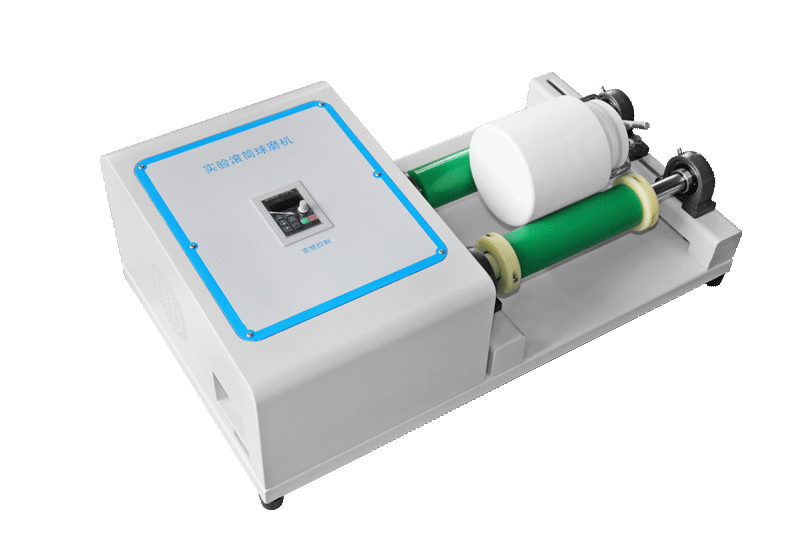
Key parameters that influence the grinding outcome include roller speed (typically 50–300 rpm), jar size, ball-to-powder ratio, and grinding time. The gentle rolling motion ensures low heat generation, minimizing sample degradation. This makes the lab roll ball mill particularly suitable for dry grinding of brittle materials, wet grinding of suspensions, and even mechanical alloying at low energy inputs.
Main Types of Lab Roll Ball Mills
Lab roll ball mills are available in several configurations to meet different throughput and processing needs:
Light-Duty Roll Ball Mill
The light-duty roll ball mill is designed for small batch sizes (typically up to 5–10 L per jar). It is compact, lightweight, and ideal for benchtop use. It is commonly used for grinding small quantities of precious materials, catalysts, or pharmaceutical samples.
Large Roll Ball Mill
For larger laboratory or pilot-scale production, the large roll ball mill offers higher capacity (up to 100 L per jar) and robust construction. It can handle continuous operation and is suitable for milling bulk ceramic powders, minerals, or battery materials.
Inner Lined Roll Ball Mill
The inner lined roll ball mill features a rubber or polyurethane lining inside the jar to reduce contamination and noise. It is preferred for abrasive materials or when metal contamination must be avoided.
Multi-Station Jar Mills
To increase throughput and enable parallel processing, multi-station models are available. The two working station jar mill, four station jar mill, and jar mill with 8 working station allow simultaneous grinding of multiple samples, saving time and ensuring consistency.
Key Performance Indicators & Selection Guide
When choosing a lab roll ball mill, consider the following parameters:
- Processing Capacity: Jar volumes range from 0.5 L to 100 L. Select based on your typical batch size.
- Grinding Fineness: Most models can achieve particle sizes down to 1–10 microns, depending on material and grinding time.
- Speed Control: Variable speed control (e.g., 50–300 rpm) allows optimization for different materials.
- Jar Material: Options include stainless steel, ceramic (alumina, zirconia), agate, polyurethane, and PTFE. Choose based on contamination sensitivity and abrasion resistance.
- Automation & Safety: Look for models with digital timers, speed displays, and safety interlocks that prevent operation when the door is open.
- Maintenance: Roller bearings should be easily accessible for lubrication; jars should be simple to clean and replace.
Applications & Selection Advice
Lab roll ball mills are widely used in:
- Materials Research: Grinding and mixing of ceramics, composites, and metal powders.
- Geology & Mining: Sample preparation for XRF, XRD, and other analytical techniques.
- Chemical & Pharmaceutical: Fine grinding of catalysts, pigments, and active pharmaceutical ingredients.
- Battery Materials: Mixing of electrode powders and slurries for lithium-ion batteries.
- Food & Agriculture: Grinding of grains, spices, and soil samples.
For routine R&D with small batches, a light-duty roll ball mill with a ceramic jar is sufficient. For larger pilot projects or continuous operation, consider a large roll ball mill or a multi-station model. If contamination is a concern, opt for inner lined mills or jars made of agate or zirconia.