
What is a 3D Rotary Vibrating Screen? A High-Efficiency Screening Equipment for Fine Particle Classification
What is a 3D Rotary Vibrating Screen? A High-Efficiency Screening Equipment for Fine Particle Classification
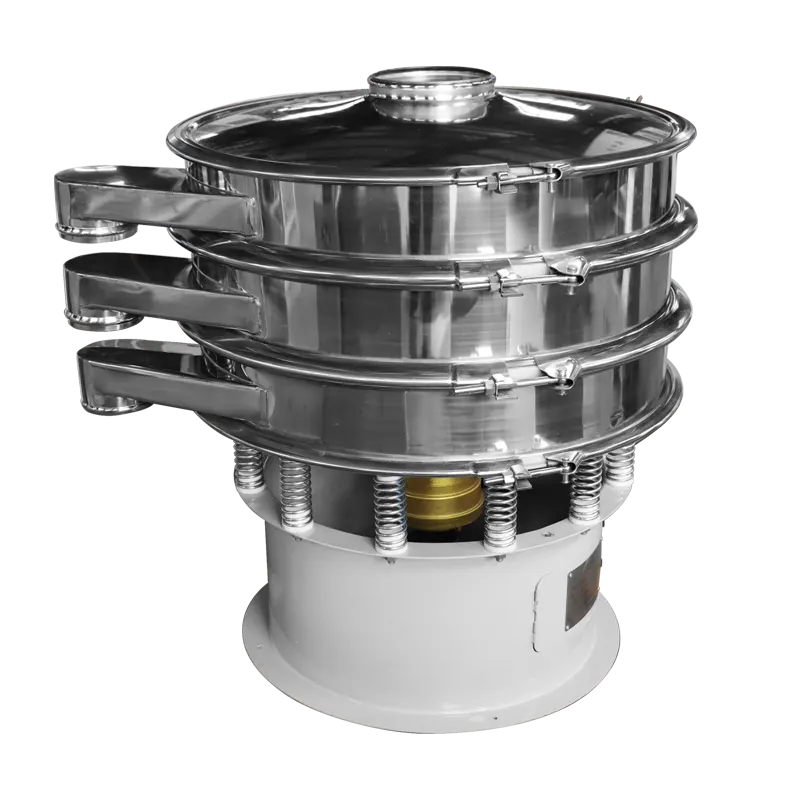
At its core, a 3D rotary vibrating screen is a specialized sieving machine that uses a unique three-dimensional vibration motion to efficiently separate, classify, and filter dry powders, granules, and liquid slurries. Industries such as chemical processing, ceramics, pharmaceuticals, food, and mining use it to achieve precise particle size separation from coarse impurities down to fine powder fractions. Unlike traditional flat screen shakers, the 3D rotary vibrating screen generates a simultaneous rotational and vertical vibration, allowing particles to move in a spiral path across the screen surface for maximum throughput and accuracy.
Core Function and Working Principle
The primary function of the 3D rotary vibrating screen is to transform a mixed particle feed into multiple fractions of defined size ranges. The equipment consists of a cylindrical screen frame, one or more mesh layers, a vibrating motor, and a spring base. The vibrating motor, mounted at the center or bottom, generates both horizontal and vertical oscillations. This combined motion forces the material to move in a three-dimensional spiral from the center of the screen to the periphery.
As the material travels, particles smaller than the mesh openings pass through each screen layer (undersize), while larger particles continue to the discharge outlet (oversize). The three-dimensional motion ensures that particles have multiple opportunities to contact the screen openings, reducing blinding and increasing separation efficiency. Key operating parameters include vibration amplitude (typically 2-5 mm), frequency (usually 1440-3000 rpm), and screen mesh size (from 2 mm down to 400 mesh or finer). Adjusting these parameters allows the user to optimize throughput and accuracy for different materials.
Key Components and Technical Features
The 3D rotary vibrating screen is typically composed of the following critical parts:
- Screen Mesh Layers: From 1 to 5 layers can be stacked to achieve up to 6 particle size fractions simultaneously. Mesh materials include stainless steel, nylon, or polyester depending on the material's abrasiveness and chemical compatibility.
- Vibration Motor: A high-frequency, adjustable-weight motor that generates the three-dimensional vibration. The motor's eccentric blocks can be adjusted to change the amplitude and vibration pattern.
- Spring Support System: Multiple coil or rubber springs isolate the vibration from the base and allow the screen deck to oscillate freely.
- Sealing and Dust Cover: Optional transparent or stainless steel covers prevent dust leakage and allow visual inspection during operation.
Compared to other screening equipment like linear vibrating screens or gyratory sifters, the 3D rotary vibrating screen excels in handling materials with high fines content, low bulk density, or tendency to agglomerate. Its compact design also makes it ideal for laboratory and small-scale production use.
Key Performance Indicators and Selection Guide
When choosing a 3D rotary vibrating screen, focus on these critical parameters:
- Processing Capacity: Typically ranging from 50 kg/h to 2000 kg/h for lab units, depending on screen area and mesh size. Higher capacity requires larger screen diameter (e.g., 400 mm, 600 mm, or 800 mm).
- Separation Accuracy: Expressed as screening efficiency (percentage of undersize passed) and oversize contamination. Good units achieve >95% efficiency for most powders.
- Mesh Size Range: Ensure the machine can accommodate the finest mesh you need. Some models support up to 500 mesh (25 µm) with appropriate tensioning.
- Material of Construction: Stainless steel 304/316 is standard for food, pharmaceutical, and corrosive materials. Carbon steel is suitable for dry minerals.
- Ease of Cleaning: Quick-release clamps and tool-free mesh change reduce downtime. Sanitary designs with no dead corners are preferred for food/Pharma.
- Automation: Options like continuous feed, discharge chutes, and programmable vibration patterns improve repeatability in R&D labs.
For laboratory use, a small tabletop model (e.g., 300 mm diameter) with adjustable amplitude and frequency is often sufficient. For pilot or production scale, a larger unit with multiple layers and automatic discharge is recommended.
Application Areas and Selection Recommendations
The 3D rotary vibrating screen finds wide application in:
- Chemical and Ceramic Industries: For sieving pigments, catalysts, ceramic powders, and abrasives.
- Food and Pharmaceutical: For classifying flour, sugar, spices, milk powder, and tablet granules.
- Metallurgy and Mining: For fine screening of metal powders, ores, and recycled materials.
- Environmental and Agriculture: For soil sample preparation, compost screening, and fertilizer classification.
When selecting a model, consider your material's moisture content, particle shape, and potential for electrostatic charging. For materials that tend to clog, a bouncing ball tray or ultrasonic deblinding system can be added. Always request a sample test with your material to verify performance before purchase.