
Qu'est-ce qu'une boîte à gants en acrylique ? Une enceinte à atmosphère inerte pour le traitement des matériaux sensibles à l'humidité et à l'oxygène
Qu'est-ce qu'une boîte à gants en acrylique ?
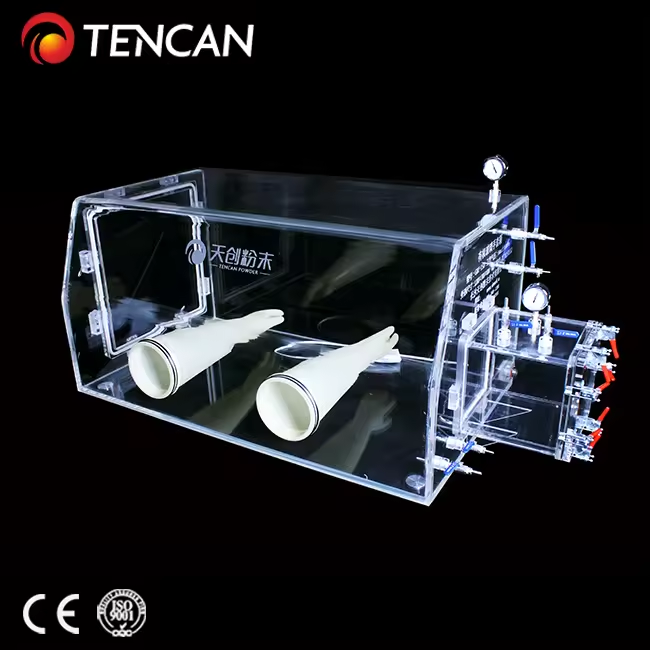
À la base, une boîte à gants en acrylique est une enceinte professionnelle à atmosphère inerte utilisée par les laboratoires et les industries pour manipuler des matériaux sensibles à l'humidité, à l'oxygène ou toxiques dans un environnement contrôlé. Construite en acrylique haute transparence (PMMA), la boîte permet aux opérateurs de travailler à l'intérieur d'une chambre scellée avec des gants intégrés tout en maintenant des niveaux ultra faibles de vapeur d'eau et d'oxygène. Elle est également connue sous le nom de boîte à gants sous vide, boîte à gants à gaz inerte ou boîte sèche, et est largement adoptée dans la recherche sur les batteries lithium-ion, la synthèse organique, le développement pharmaceutique et le traitement des semi-conducteurs.
Fonction principale et principe de fonctionnement
Une boîte à gants en acrylique crée un environnement scellé rempli de gaz inerte de haute pureté (généralement de l'argon ou de l'azote). L'opérateur accède à l'intérieur via des ports pour gants, ce qui permet une manipulation pratique sans perturber l'atmosphère. Le système fait circuler le gaz en continu à travers une unité de purification qui élimine l'humidité et l'oxygène, atteignant un niveau de pureté O₂ < 0,1 ppm et H₂O < 0,1 ppm (équivalent point de rosée).
Les composants clés comprennent:
- Chambre principale – en acrylique transparent pour une excellente visibilité et transmission de la lumière UV.
- Antichambre (chambre de transfert) – permet aux matériaux d'entrer et de sortir sans contaminer l'atmosphère principale.
- Unité de contrôle – doté d'un écran tactile couleur et d'un contrôleur PLC pour la purge, la régénération et la surveillance automatiques.
- Unité d'épuration – régénère automatiquement l'adsorbeur H₂O/O₂, réduisant ainsi la maintenance à une fois par an ou moins.
- Pompe à vide – évacue l'antichambre avant d'introduire du gaz inerte.
- Analyseur d'oxygène / humidimètre – fournit des lectures en temps réel de la pureté du gaz.
La séquence de travail est simple : l'opérateur place les matériaux dans l'antichambre, l'évacue et la remplit de gaz inerte, puis les transfère dans la chambre principale. À l’intérieur, toutes les opérations sont effectuées sous un flux continu de gaz inerte purifié, maintenant l’environnement requis à faible teneur en oxygène et à faible humidité.
Principaux types de boîtes à gants en acrylique
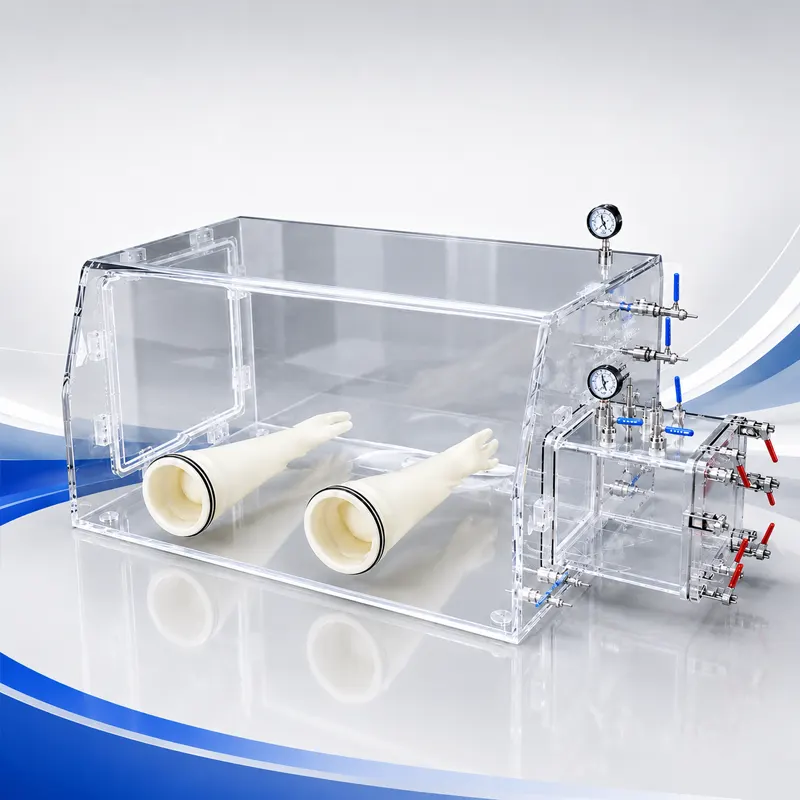
Bien que la conception de base soit similaire, les boîtes à gants en acrylique sont disponibles en plusieurs configurations pour répondre aux différents besoins du laboratoire.:
Boîte à gants en acrylique standard
Disponible dans des tailles courantes comme 650 mm (poste de travail simple) et 1 500 mm (poste de travail double). Ces modèles comprennent un ensemble complet d'accessoires : tuyauterie en acier inoxydable, contrôle automatique de l'antichambre, pompe à vide et analyseurs d'oxygène/humidité. Ils sont idéaux pour les expériences générales en atmosphère inerte.
Mini boîte à gants
Également appelée boîte à gants compacte, la version mini est une solution économique et peu encombrante. Il atteint toujours H₂O et O₂ ≤ 0,1 ppm, ce qui le rend adapté aux synthèses à petite échelle, à la préparation d'échantillons et aux laboratoires pédagogiques. La mini boîte à gants est entièrement en acier inoxydable à l’intérieur et peut être placée sur une paillasse.
Boîte à gants sous vide
Certaines boîtes à gants en acrylique sont conçues pour être évacuées directement (vide jusqu'à ≤ -1 bar). Cela permet une élimination rapide de l'atmosphère initiale de l'air, ce qui permet d'économiser du temps et de la consommation de gaz. Ils sont souvent utilisés pour des processus nécessitant à la fois des environnements sous vide et sous gaz inerte.
Indicateurs clés de performance et critères de sélection
Lors du choix d'une boîte à gants en acrylique, tenez compte des paramètres techniques suivants:
- Niveau de pureté – Recherchez O₂ < 0,1 ppm et H₂O < 0,1 ppm (ou lecture du point de rosée). Une pureté plus élevée est essentielle pour les matériaux extrêmement sensibles.
- Taux de fuite – Les conceptions de qualité industrielle atteignent un taux de fuite < 0,01 % vol/h, garantissant une stabilité à long terme.
- Régénération purificatrice – La régénération automatique permet de gagner du temps ; la durée de vie typique de l'adsorbeur est d'un an avant qu'un remplacement ne soit nécessaire.
- Système de contrôle – Un écran tactile couleur avec PLC offre une utilisation facile, un enregistrement des données et un mode d'économie d'énergie (réduit la consommation d'énergie jusqu'à 90 % en cas d'inactivité).
- Taille de l'antichambre – Des antichambres plus grandes (par exemple Ø380 mm × 600 mm) permettent un transfert plus rapide des objets volumineux.
- Ports pour gants – Poste de travail simple ou double ; certains modèles peuvent être reliés entre eux pour des configurations multi-opérateurs.
- Attestation – Les certifications CE, ISO et BV garantissent sécurité et fiabilité.
Domaines d'application et conseils de sélection
Les boîtes à gants en acrylique sont indispensables dans les domaines suivants:
- Recherche sur les batteries lithium-ion – pour assembler et tester des cellules dans un environnement sec et sans oxygène.
- Chimie organique et synthèse organométallique – manipulation de catalyseurs et de réactifs sensibles à l’air et à l’humidité.
- Médicaments – préparer des composés hydrophiles ou des principes pharmaceutiques actifs sous gaz inerte.
- Semi-conducteur et électronique – stockage et traitement de plaquettes et de composants sensibles à l'oxygène.
- Fabrication de cellules solaires – fabrication de pérovskite et de cellules solaires organiques.
- Dispositifs médicaux et biomatériaux – manipulation de l'hémoglobine, études métaboliques et culture anaérobie.
- Industrie nucléaire – travailler avec des matières radioactives ou toxiques en isolement.
Pour la plupart des laboratoires de routine, une boîte à gants en acrylique standard (par exemple 1 500 mm) avec purification automatique constitue un choix équilibré. Si l'espace est limité, une mini boîte à gants offre toutes les fonctionnalités dans un encombrement réduit. Pour les processus nécessitant des cycles de vide fréquents, envisagez un modèle résistant au vide.
Pour plus de détails, visitez la page officielle du produit: Boîte à gants en acrylique .