
Pourquoi votre laboratoire a besoin d'une étuve de lyophilisation sous vide : principes, applications et guide de sélection
Le défi du séchage des matériaux sensibles à la chaleur
Le séchage est une étape fondamentale dans de nombreux processus de laboratoire et industriels. Mais lorsque votre échantillon contient des composés sensibles à la chaleur, tels que des protéines, des enzymes, des vaccins ou des extraits biologiques, les méthodes de séchage conventionnelles comme les fours à air chaud ou l'évaporation rotative provoquent souvent une dégradation, une perte d'activité ou des dommages structurels. Comment éliminer l’eau tout en gardant le matériau intact ? C'est là qu'un étuve de lyophilisation sous vide , également connu sous le nom de lyophilisateur ou lyophilisateur de laboratoire, devient un outil essentiel.
La lyophilisation fonctionne en congelant d'abord le matériau, puis en réduisant la pression environnante pour permettre à l'eau gelée de se sublimer directement du solide au gaz, en contournant la phase liquide. L’ensemble du processus se déroulant à basse température, la stabilité biologique et chimique de l’échantillon est préservée. Dans cet article, nous passerons en revue le principe de fonctionnement, les applications clés et les facteurs importants à prendre en compte lors de la sélection d'un étuve de lyophilisation sous vide pour votre laboratoire.
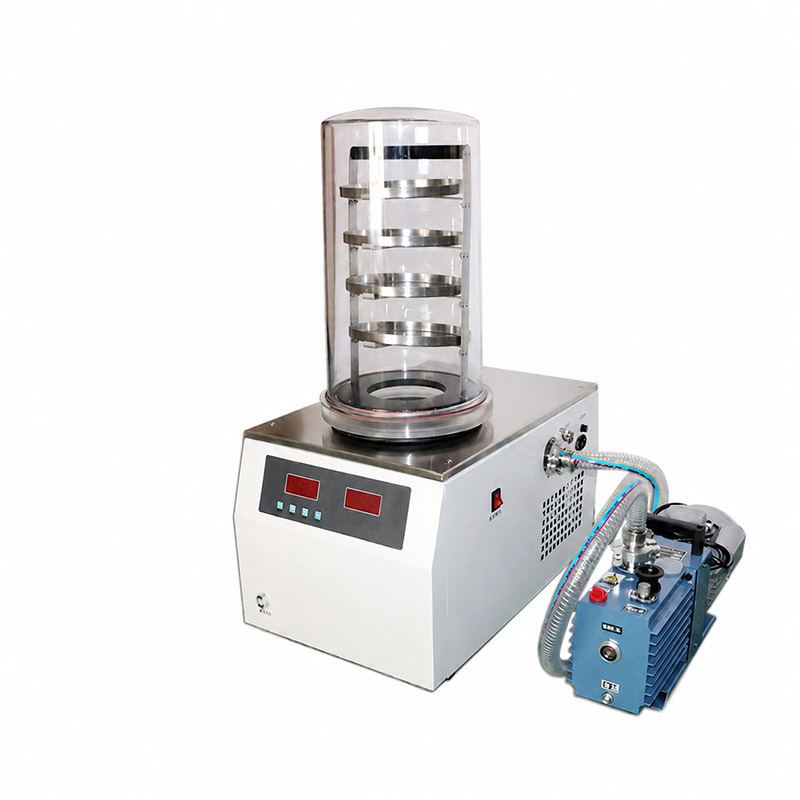
Comment fonctionne un four de lyophilisation sous vide
Les trois étapes de la lyophilisation
Un cycle de lyophilisation typique comprend trois phases : la congélation, le séchage primaire (sublimation) et le séchage secondaire (désorption).
1. Congélation: L'échantillon est refroidi en dessous de son point eutectique ou température de transition vitreuse. L'eau forme des cristaux de glace. Le taux de congélation affecte la taille des cristaux de glace et donc l'efficacité du séchage et la qualité du produit final.
2. Séchage primaire: La pression à l'intérieur de la chambre est réduite à un vide (généralement inférieur à 100 Pa) et les étagères sont légèrement chauffées. La glace se sublime et la vapeur d'eau est capturée dans un piège froid (condenseur) qui est généralement maintenu entre -50°C et -80°C. C'est la phase la plus longue.
3. Séchage secondaire: Une fois la glace retirée, l’eau liée restante est désorbée en augmentant la température sous vide. La teneur en humidité finale peut être réduite à 1 à 3 % ou moins, selon le produit.
Le principal avantage de l'utilisation d'un étuve de lyophilisation sous vide au-dessus d'une norme étuve de séchage sous vide est que le matériau ne subit jamais de températures élevées, ce qui le rend idéal pour les substances thermolabiles. Même si une étuve de séchage sous vide peut également fonctionner à basse température, elle repose sur l’évaporation (liquide en vapeur), qui nécessite néanmoins un certain apport de chaleur et peut provoquer une dégradation.
Applications clés d'un lyophilisateur de laboratoire
La lyophilisation est largement utilisée dans de nombreux domaines. Voici quelques-unes des applications les plus courantes où un lyophilisateur de laboratoire s'avère inestimable:
- Pharmaceutique et biotechnologique: Conservation des vaccins, des anticorps, du plasma sanguin et des enzymes. La lyophilisation permet un stockage à long terme à température ambiante, réduisant ainsi la logistique de la chaîne du froid.
- Aliments et nutraceutiques: Les fruits lyophilisés, le café, les probiotiques et les extraits de plantes conservent leur saveur, leur couleur et leur valeur nutritionnelle d'origine.
- Science des matériaux: Séchage d'aérogels, de nanomatériaux et de composites polymères dont la structure doit être préservée sans effondrement.
- Échantillons environnementaux et géologiques: Sols, sédiments et tissus végétaux pour une analyse précise des composés volatils ou des oligo-éléments.
- Cosmétiques et soins personnels: Sérums, masques et ingrédients actifs lyophilisés pour une durée de conservation prolongée et une stabilité améliorée.
Si votre travail implique l'un de ces matériaux, un étuve de lyophilisation sous vide devrait être un équipement essentiel dans votre laboratoire. Pour des tâches de séchage plus générales qui ne nécessitent pas de basse température, vous pouvez également envisager un four à circulation ou un séchoir à air de bureau .
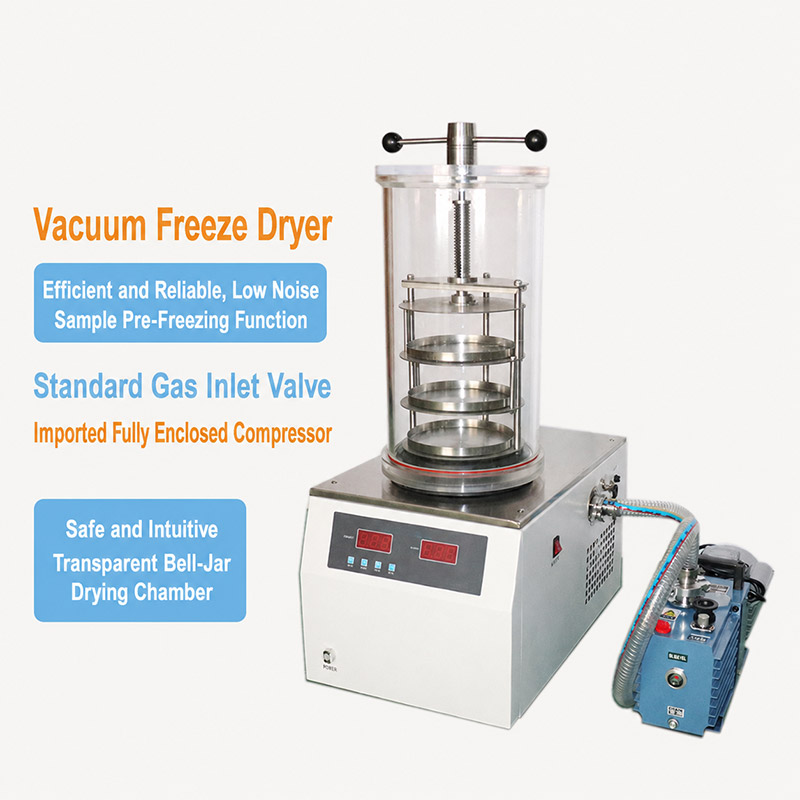
Comment sélectionner le bon four de lyophilisation sous vide
Choisir un lyophilisateur peut s’avérer difficile compte tenu du grand nombre de modèles et de spécifications. Vous trouverez ci-dessous les facteurs clés que vous devez évaluer en fonction de vos besoins spécifiques.
1. Température du piège froid
La température du piège froid (condenseur) détermine le niveau de vide maximum et l'efficacité du séchage. Les températures courantes du condenseur sont de -50°C, -60°C et -80°C. Une température plus basse fournit une plus grande force motrice pour la sublimation et un séchage plus rapide, mais augmente également le coût de l'équipement. Pour la plupart des échantillons biologiques, -50°C suffit. Pour les échantillons avec des points eutectiques faibles ou une teneur élevée en solvant, -80°C est recommandé.
2. Niveau de vide et pompe
Une pompe à vide fiable est essentielle. Le système doit atteindre un vide inférieur à 20 Pa (0,15 Torr) pour une lyophilisation efficace. Certains modèles avancés incluent une vanne de régulation du vide pour réguler la pression. Assurez-vous que la pompe est dimensionnée de manière appropriée pour le volume de la chambre et qu'elle dispose d'un bon filtre à brouillard d'huile ou qu'elle peut être utilisée avec une purge de gaz inerte.
3. Zone et capacité de lyophilisation
Tenez compte du volume d’échantillons que vous devez traiter par lot. Les lyophilisateurs à l'échelle du laboratoire offrent généralement une zone de lyophilisation de 0,1 m² à 0,5 m², avec des diamètres de plateaux d'échantillons de 200 mm à 350 mm. Le nombre d'étagères (3 à 6) détermine la capacité du lot. Si vous traitez plusieurs petits échantillons, recherchez un lyophilisateur de type collecteur permettant de fixer des flacons.
4. Système de contrôle et programmabilité
Les lyophilisateurs modernes offrent des contrôleurs programmables qui vous permettent de définir des rampes de température, des temps de maintien et des niveaux de vide. Ceci est crucial pour développer un cycle de lyophilisation reproductible pour différents produits. Les interfaces à écran tactile avec enregistrement des données facilitent la surveillance et l'optimisation du processus.
5. Matériau et construction
La chambre de séchage doit être en acrylique transparent ou en acier inoxydable avec un couvercle transparent pour plus de visibilité. Le piège à froid doit être en acier inoxydable pour résister à la corrosion. Vérifiez également si les étagères sont régulées en température (généralement via un fluide calorigène) et si le système comprend une fonction de précongélation.
6. Fonctionnalités supplémentaires
Certaines fonctionnalités peuvent améliorer considérablement la commodité et la sécurité:
- Remblai de gaz inerte: Permet de briser le vide avec de l'azote sec ou de l'argon pour protéger les échantillons hygroscopiques.
- Système de dégivrage: Le dégivrage chauffé accélère le nettoyage du piège froid entre les cycles.
- Verrouillages de sécurité: Empêchez le démarrage du système si le vide n'est pas suffisant ou si la porte est ouverte.
Avant de faire un achat, il est toujours sage de discuter de vos échantillons spécifiques avec le fabricant. Par exemple, à TENCAN, notre équipe technique peut vous aider à trouver le bon étuve de lyophilisation sous vide à votre application, en tenant compte de facteurs tels que la sensibilité thermique du matériau, l'humidité résiduelle souhaitée et la taille du lot.
Questions courantes sur les fours de lyophilisation sous vide
Puis-je utiliser une étuve de séchage sous vide ordinaire pour la lyophilisation ?
Pas exactement. UN étuve de séchage sous vide peut fonctionner sous vide et à basse température, mais il repose principalement sur l’évaporation (liquide en vapeur), et non sur la sublimation. Pour obtenir une véritable lyophilisation, vous avez besoin d’un condenseur (piège froid) pour capturer la vapeur d’eau et maintenir une faible pression partielle. La combinaison d'une étuve à vide avec un piège froid séparé est possible mais pas aussi efficace qu'un lyophilisateur dédié.
Quel est le temps de séchage typique ?
Le temps de séchage varie considérablement en fonction de l'épaisseur de l'échantillon, de la teneur en eau, du taux de congélation et des performances du lyophilisateur. Pour un échantillon typique de 1 cm d’épaisseur, le séchage primaire peut prendre de 12 à 48 heures. Le séchage secondaire ajoute 2 à 6 heures supplémentaires. De nombreux lyophilisateurs modernes vous permettent de programmer des cycles automatisés qui fonctionnent pendant la nuit.
Comment puis-je empêcher l’effondrement ou la fusion des échantillons ?
L'effondrement se produit lorsque la température pendant le séchage primaire s'élève au-dessus de la température de transition vitreuse (Tg') de la matrice congelée. Pour éviter cela, vous devez connaître la Tg' de votre formulation et maintenir la température de conservation en dessous pendant le séchage primaire. L’utilisation d’une température de piège froid plus basse et d’un niveau de vide suffisant contribue également à maintenir la structure gelée.
Conclusion
Choisir le bon étuve de lyophilisation sous vide est une décision cruciale pour tout laboratoire traitant de matériaux sensibles à la chaleur. Comprendre les principes de la lyophilisation, évaluer vos besoins en matière d'échantillons et comparer les spécifications clés vous aidera à sélectionner un système qui fournit des résultats fiables et de haute qualité. Que vous préserviez un nouveau vaccin, développiez un produit alimentaire lyophilisé ou prépariez des matériaux avancés, un lyophilisateur de laboratoire bien choisi deviendra la pierre angulaire de vos opérations de séchage.
Si vous avez des questions spécifiques sur votre application ou avez besoin d'aide pour la configuration, n'hésitez pas à consulter l'équipe technique au TENCAN. Ils peuvent vous guider tout au long du processus de sélection et vous aider à trouver celui qui vous convient le mieux. étuve de lyophilisation sous vide pour votre laboratoire.